
Berlinale: It is in the final moments of Jeremy Comte’s first feature that he renders the moments giving the film its title, in lyrical realism.
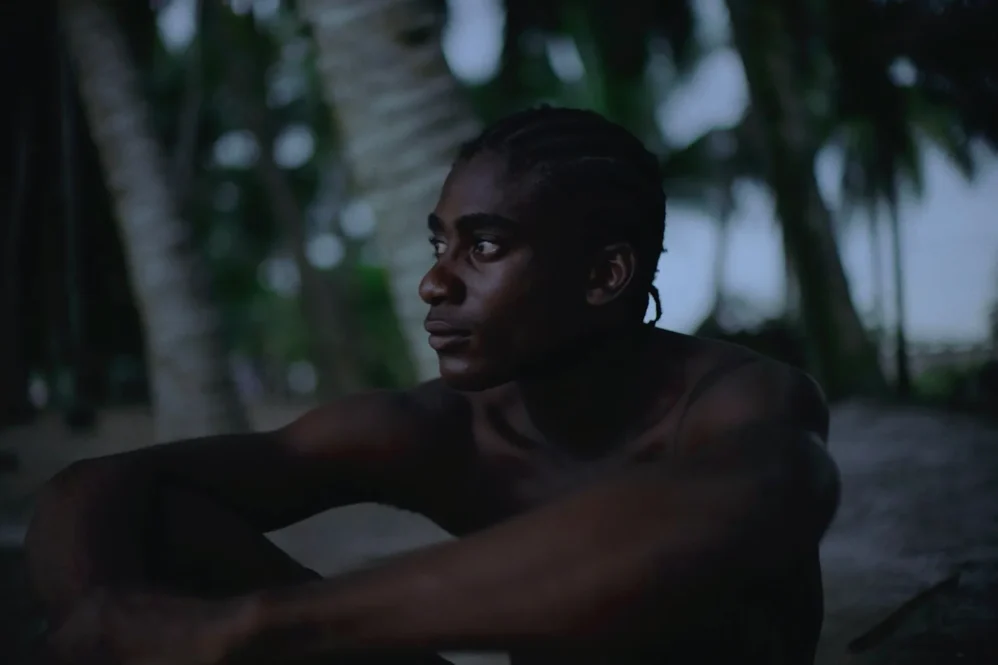
“…it burns,” our one-hand protagonist — far from his Quebec home — tells his mother from a hospital in Accra. His counterpart, the other-hand protagonist, holds his hands and says a short prayer. The Québécois boy sinks into his bed, into a dark void, shrouded in fire. He transfigures into the brightest star with fiery glow among a field of stars. Eventually, the image fades into a baby version of him, yearning and reaching. His mother walks in and picks him up, wrapping her arms around him, while her words continue over the sequence “…I’m here.” This is juxtaposed with a scene where our other-hand protagonist sits under the palms, by a large water body. He recalls the voice of his father, telling the final part of an experience, “…I told him to close his eyes and imagine. A place that brings him peace. Paradise.” These moments seem to be the thesis of Paradise, with everything else building up to that point being Comte dreaming up a social world to accommodate his spiritual imagination.
(Click to Follow the What Kept Me Up channel on WhatsApp)
In a small Ghanaian community, young Kojo is full of life and vibrant. He hawks fish in traffic, partakes in a money rain activity (rich people throwing money in public, while the poor scramble for it). He returns home to his father, a fisherman. Years pass in three cuts: Kojo as a boy sitting with others before a television; Eternal Sunshine of The Spotless Mind playing on screen; Kojo (Daniel Atsu Hukporti) as a young adult uttering the film’s words in unison, with an American accent. Television enters his life early. On a fishing outing with his father on a boat, he reads — literature appearing in the least convenient place. Both TV and literature appear in his life in striking ways. In one scene, Kojo’s father advises him against certain boys — Kojo is smart, they are a waste of time. Kojo ignores his father’s advice; he is seen smoking with a friend, his first act of “time-wasting.”
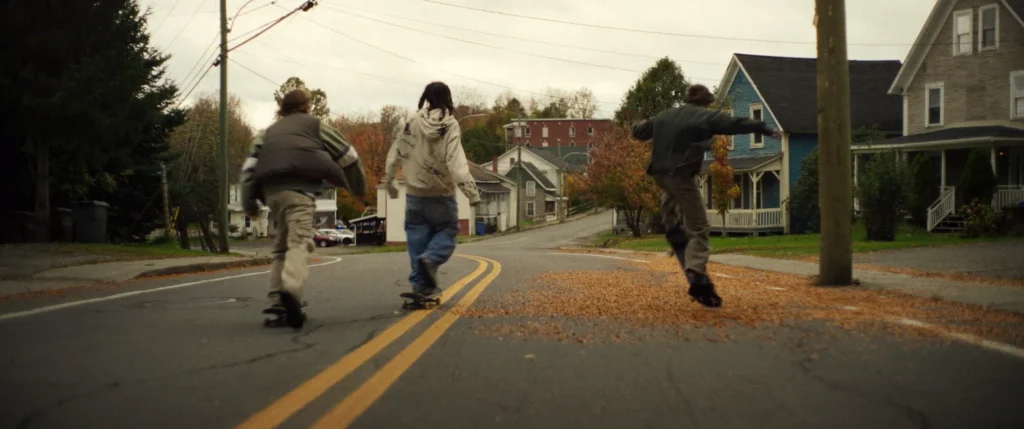
In Quebec, Antoine (Joey Boivin Desmeules) and his friends skateboard in a restricted area, while an authority figure struggles to have them leave. At home, Antoine smokes alone in his room. The parallels begin to surface. Kojo’s father goes missing, losing him further to street life. Antoine, by contrast, never knew his father, but he longs to. As in his 2018 critically lauded short film, Fauve, Comte once again tells the story of two boys on the brink of submersion. This time, they drown in paternal absence. Kojo and Antoine eventually cross paths under unlikely circumstances. What unfolds is an uneven, cross-continental, parallel narrative that converges. The focus on Kojo is more central, and we get to see Ghana more than Quebec.
Paradise, a co-production between Canada, France and Ghana, explores the issue of cyber fraud, which also becomes the medium that intersects the lives of our protagonists. The depiction carries the accuracy that could be derived mostly through lived experience, and social proximity to this practice — evident in the screenplay co-written by Ivorian-Ghanian filmmaker Will Niava. In Ghana, those engaged in the type of cyber fraud depicted in Paradise are called Sakawa Boys, which is an equivalent to the yahoo plus scam culture in Nigeria. The practice usually involves the use of juju, scam formats, voice manipulators and deepfake technology to perform scams. All of these are on display in Comte’s film. Kojo and his friend visit a “black magician,” requesting high paying clients. Also, Kojo lectures younger novices practically, showing them deep-fake software and voice manipulators; dropping insights from his own experience, “with women you have to play the long game.” His own first big scam was a result of playing the long game for six months with Antoine’s mother, Chantal (Evelyne de la Chenelière).
Paradise renders Sakawa with moral and social complexity. The practice is not framed as something existing in parallel to the primary vocation of fishing and everyday living that structures the town’s identity. Kojo and his friends justify their actions as repayment for colonial exploitation — a way of reclaiming Africa’s stolen dignity, and the film neither endorses nor dismisses this reasoning outright. It refuses the moral sensationalism that often accompanies similar depictions. The moral tension is internal: Kojo’s father warns him that the boys he keeps company with are no good — the community is not complicit. By spending more time with Kojo and tracing the gradual processes that lead him into cyber fraud, Comte resists the single story. West Africans are not cyber criminals; cyber criminals exist in West Africa, as in other parts of the world.
Paradise also examines longing, and its tendency to manifest in missteps that lay bare that which is absent. The absence centred here is paternal absence. After his father goes missing, Kojo drifts more into street life. He becomes a full-time street boy and internet scammer, squanders his big scam payout on clubbing and recreating the money rain activity he participated in as a kid. This time he is “the rich.” Antoine’s longing for his father makes him dig into his mother’s long distance relationship, suspecting that this man might be his father, and making decisions that lead him to a near death experience.
Ultimately, our protagonists learn, not explicitly, that paradise lies in the familiar, rather than the unknown. For Kojo, Paradise is a foreign continent of material abundance, which he accesses through scams. It becomes the memory of his father, whom he had left to chase his conception of paradise. For Antoine, paradise is his father, whom he has never known. It becomes the voice of his mother saying, “I’m here,” the memories of her wrapping her arms around him, comforting him.
For most of its runtime — before our protagonists’ paths cross — Paradise feels like two separate films, unfolding in different worlds. Comte, who headlined the editing, intelligently utilizes several elements to connect both worlds; he doesn’t just cut. In a scene, Kojo’s friend takes him to meet a gang of fraudsters after Kojo asks where he gets his marijuana from. We cut to a bird’s-eye view shot of a water body — or perhaps a painterly impression — filling the frame, and fading into a blue wall which Antoine paints white over. We are taken from Ghana to Quebec through vocation. This also foreshadows how Antoine and Kojo’s life’s would intertwine later in the film. At a different time we go from Ghana to Quebec again with Kojo and Chantal in a similar laying posture.
Comte has crafted a cross-continental film that is singular in identity. The gritty-realist performances that defined Fauve are realized on a larger scale across multiple characters in Paradise. Olivier Gossot’s austere, naturalist cinematography from Fauve opens outward in Paradise, utilizing colour and compositional scale, to articulate emotional states more fully. Of indelible impression is Valentin Hadjadj’s score, whose religiously evocative harmonies unfold like a passage to paradise. Paradise restores confidence in a cinema that treats the medium as an art form rather than a delivery system for answers. It resists safe narrative conventions or commercial formal grammar, withholding exposition and allowing ambiguity to structure the viewing experience.
Produced by Entract Studios (Canada), Ema Films (Canada), Constellation Productions (France), and I60 Productions (Ghana), Paradise had its world premiere at Berlinale 2026 in the Panorama section. Global Constellation (Germany) is handling world sales.
Side Musings
- I have put Jeremy Comte on a special auteur watch. If his next film is a cross-planet story about two thirty-something men, I’ll officially certify him an ‘auteur.’
- Swap Twi with any Nigerian language, change the accent, leave everything else as is, and we’ll have a film set in a Nigerian community and Quebec. Money rain? Leave it. Black magician? Keep him. Still passes as a Nigerian story.