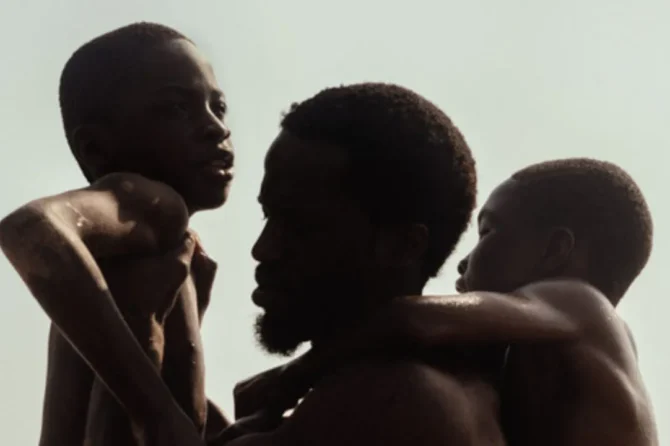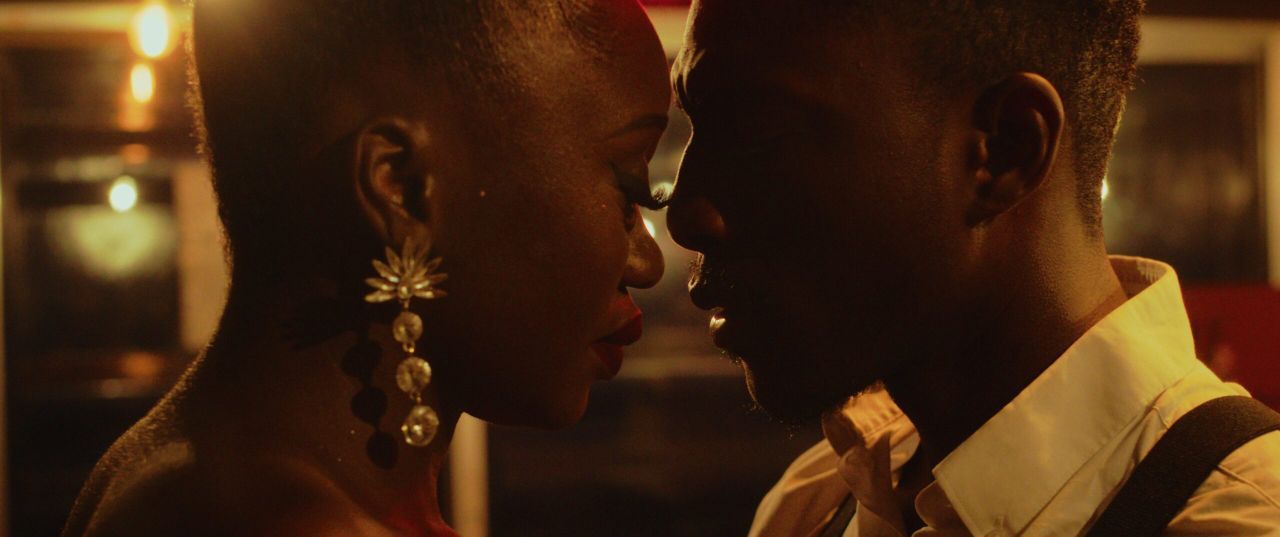
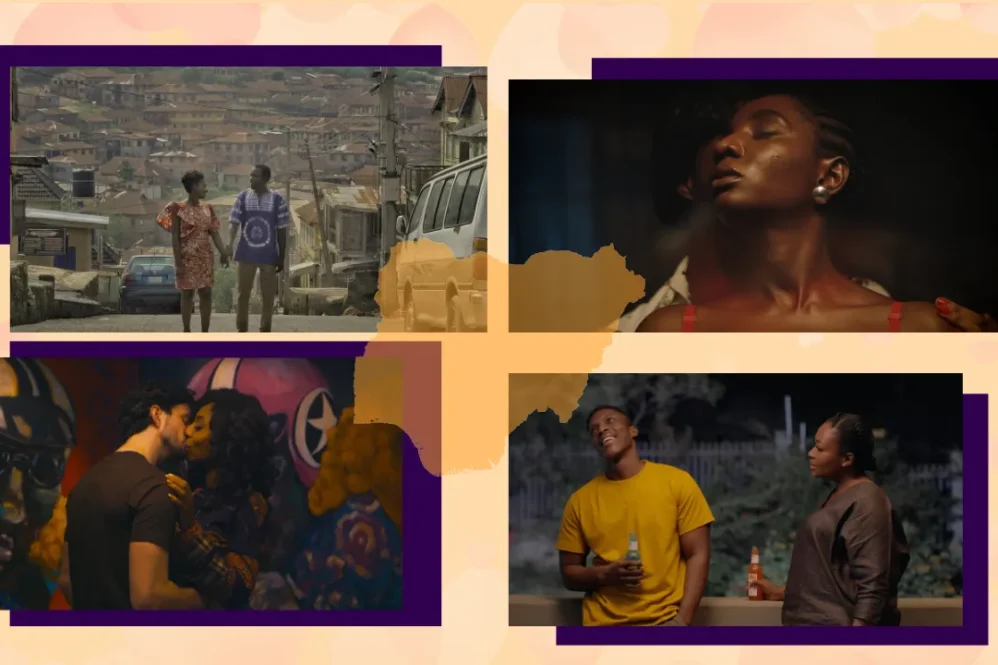
We might be quick to settle that romance is universal, but in the details, it is not. Naz Onuzo’s A Lagos Love Story is a love story shaped by its titular city. The familiar plot—man meets woman, obstacles arise, love survives—may look the same everywhere, but its pace, urgency, and emotional texture change with place. The rush towards marriage in Kathryn Fasegha’s 2 Weeks in Lagos occupies a different emotional world from the slow, poetic courting in Fred Amata’s Letters to A Stranger. Love moves differently across Nigerian cities: fast and ambitious in Lagos; more deliberate and heavy with history in quieter places like Ibadan. These films show that place shapes pace, class, ambition, and emotional expression, and that setting often determines the rhythm of romance.
These are not just tonal differences. In Nollywood romance, location operates structurally, determining which conflicts are even possible. A Lagos film can build an entire plot around a couple sneaking away from work events because the city’s idea of work is expansive, spanning corporate jobs, media, creative industries, entrepreneurship, and constant networking. The same premise collapses in smaller cities like Uyo, where work is more narrowly defined, often centered on civil service, and does not dominate social life in the same way. Public displays of affection also carry different meanings across geography. Lagos lovers can kiss in traffic or hold hands at beach bars without scandal, their anonymity protected by urban density. In towns where everyone knows everyone, the same gesture becomes a scandal that must be explained or defended.
Even wealth registers differently. In Lagos, designer bags and luxury cars announce class loudly, creating visible romantic obstacles. Elsewhere, class is signaled more quietly, through family name, lineage, or the scale of a family compound, shaping which love stories can be told. Nollywood may have inherited this geographic sensitivity from its regional origins. Yoruba theatrical traditions, Igbo entrepreneurial narratives, and Northern conventions of restraint never fully merge, yet they continue to inform how different places construct romance. What follows is an examination of how specific locations produce specific kinds of love stories.
(Click to Follow the What Kept Me Up channel on WhatsApp)
Lagos romances move at the speed of the city itself. Time is scarce, attention is short, and love is something you either seize or lose. Intimacy in Lagos films is shaped by this urgency: relationships are compressed by work or travel schedules, social competition, and the constant pressure to be elsewhere. 2 Weeks in Lagos makes this logic explicit. Love there is rarely gradual or exploratory, it is transactional, strategic, and keenly aware of its own precarity. A marriage proposal after just two weeks is not strange; it is a rational response to a city where delay feels like failure and opportunity expires quickly.
This pressure extends across public life. Characters fall in love at weddings, concerts, corporate events, and December parties, with the city itself acting as spectacle. In Jade Osiberu’s Christmas in Lagos, romance moves between Detty December itineraries, lavish ceremonies, and carefully staged moments, leaving little room for quiet interiority. Kemi Adetiba’s The Wedding Party amplifies this chaos, staging love within very public displays of wealth, family rivalry, and social expectation. Even when Lagos films hint at emotional depth, ambition remains central. Osiberu’s Isoken frames romance through success and social proof, while A Lagos Love Story entwines intimacy with celebrity, access, and proximity to fame. Romance then, is never separate from the city’s rhythm, stakes, or spectacle. It is fast, aspirational, and may be fleeting, not because it is shallow, but because the city never slows enough for tenderness to settle.
Unlike Lagos, Ibadan moves differently. Filmmakers who choose the city often seek something more lyrical, more serious. The air is not celebratory; it feels like an afternoon breeze, slow and reflective. In Nollywood, Ibadan becomes a place that turns inward and takes itself seriously, a tone that often reflects the director’s careful treatment of the city. Taiwo Egunjobi’s Crushed Roses (adapted from Ibiere Addey’s book) leans fully into this, letting lovers speak in poetry, desire stretched across long, patient shots. Another film of his, In Ibadan, works similarly: when Ewa returns from Lagos after five years, the city becomes an emotional archive, holding memories, regret, and unfinished conversations with Obafemi. Tunde Kelani’s Oleku, set around the University of Ibadan, frames romance as responsibility as much as desire; Ajani’s overlapping relationships feel less reckless than burdened, shaped by a place where choice carries weight. Even Owen Olowu’s Songs of Ubong, sparse and black-and-white, captures a kind of poetic madness—longing that is quiet, private, and carefully measured, yet charged with an intensity that borders on delirium. The title itself nods to Songs of Solomon, linking the film to a tradition of poetic declarations of love. Perhaps it is no coincidence that this style flourishes in Ibadan, a city with a reflective rhythm and a rich theatrical and literary heritage. Romance here accumulates slowly. The brown roofs, the unhurried afternoons, and the conversations that stretch yet refuse closure suggest a city and its directors so contemplative they sometimes hold themselves back.
Where Lagos announces itself through spectacle and Ibadan with its easy air, romance in Abuja and the North operates on a quieter register. Abuja carries a calmer confidence. Affection is restrained; emotion is implied rather than declared. In Nadine Ibrahim’s series Beyond the Veil, love unfolds within cultural and religious boundaries. Desire shows up in glances, pauses, and careful conversation instead of open display. Romance moves slowly, with tradition, family, and social expectation always present in the background. Mildred Okwo’s The Meeting, like Amata’s Letters to a Stranger, follows a similar rhythm. Makinde Esho (Femi Jacobs) meets Ejura (Linda Ejiofor) on a business trip to Abuja and is forced by bureaucratic delays to interestingly ‘slow down’ from the fast-paced Lagos, to talk, to pay attention and even fall in love. The city and circumstance make space for conversation, and conversation becomes intimacy. In Letters to a Stranger, late-night phone calls stretch over time, allowing two strangers to fall in love gradually. Jemima (Genevieve Nnaji), briefly in Abuja from her Lagos job, falls for Sadiq (Yemi Blaq), who shows up on her birthday with a compilation of her unpublished work, while her busy Lagos boyfriend forgets entirely.
These films also feel different in performance. Acting in Abuja-set stories is more inward, less theatrical. Silence, body language, and emotional control do much of the work. Even wealth is expressed differently. In Tope Oshin’s Up North (with romantic subplot), status is communicated through composure and dignity rather than extravagance. Korede Azeez’s With Difficulty Comes Ease (its romantic subplot likewise) carries the same restraint, following a widow (Uzoamaka Power) through grief with minimal dialogue and allowing stillness to carry the emotion. A suitor (Caleb Richards) courts her for most of the film, but the glimpse into the possibility of a romantic future is revealed at the end. The idea seems to be that in Abuja, expressions of love are rarely loud. It is slow, deliberate, and shaped by a cultural preference for composure.
Where Lagos competes and Abuja restrains, the East, like Owerri in Kunle Afolayan’s Phone Swap, performs and carries a different energy with romance. Love here is rarely private. It unfolds before family, shaped by community, with an audience always present. In Phone Swap, this contrast is clear when Mary (Nse Ikpe-Etim), a Lagos fashion designer, enters Owerri. It is hard to imagine Akin (Wale Ojo) falling for her if their connection had stayed in Lagos. Away from pressure and posturing, the slower rhythm of Owerri and the openness of the family compound make space for intimacy. Romance becomes warmer and more participatory, surrounded by relatives, obligations, and shared presence. Courtship shifts from a private negotiation to a social process.
This emphasis on family runs through Tchidi Chikere’s World Apart, which frames love through class and tradition, where personal desire bends to lineage and approval. The village is not a backdrop but an active force, shaping what love is allowed to become. Even in Dika Ofoma’s A Japa Tale, shot in Enugu, migration anxiety is rooted in place. The conflict is not only about leaving for better opportunities, but about what is lost when home and community are abandoned. Romance in the East also allows for emotional openness. Feelings are spoken, argued, and defended. In Wapah Ezeigwe’s Shall We Meet Tonight, set in Enugu, queer love exists quietly between two women, yet remains under constant pressure from social expectation and compulsory heterosexuality. Here, intimacy must negotiate visibility and consequence.
What ultimately links all these romances is pace. How fast or slow a story moves determines how love is felt and whether it has room to grow. These rhythms are not just stylistic choices; they shape the kind of intimacy each place allows. Fast pacing produces decisive, sometimes fragile love. Slower pacing allows uncertainty and depth. Controlled pacing contains emotion. Intimate pacing brings warmth but demands negotiation. Taken together, the conclusion is simple: in Nollywood, where a love story is set determines how it moves, how it sounds, and what it can become. The problem is that only a narrow set of places (as film setting or production location) are allowed to do this work.
Search any list of essential Nollywood romantic films, and Lagos will dominate, with occasional appearances from Abuja and Ibadan. Entire regions, however, remain romantically invisible. Where are the love stories set in Uyo, Calabar, Warri, Kaduna, or Jos? These cities exist, people fall in love there, yet Nollywood has barely touched their narrative possibilities. This underrepresentation is not unique to romance. Nigerian cinema generally struggles to capture life beyond its major production hubs, a problem rooted partly in economics. Filming where the infrastructure, stars, and audiences already are makes financial sense, but it creates a feedback loop: only certain cities feel cinematically legible, only certain romantic rhythms feel worth telling. The cost is enormous. Port Harcourt’s riverine geography, Jos’s cold, Maiduguri’s decades of insecurity, all offer emotional and visual textures unavailable in the usual locations. Nollywood romance will remain geographically narrow until it actively seeks out and amplifies filmmakers working in these underrepresented regions. This is not about fairness or regional balance, but more about accessing the full range of how Nigerians love, about showing audiences how life is lived in places the industry has historically ignored. Because the stories are there.
Become a patron: To support our in-depth and critical coverage—become a Patron today!
Join the conversation: Share your thoughts in the comments section or on our social media accounts.