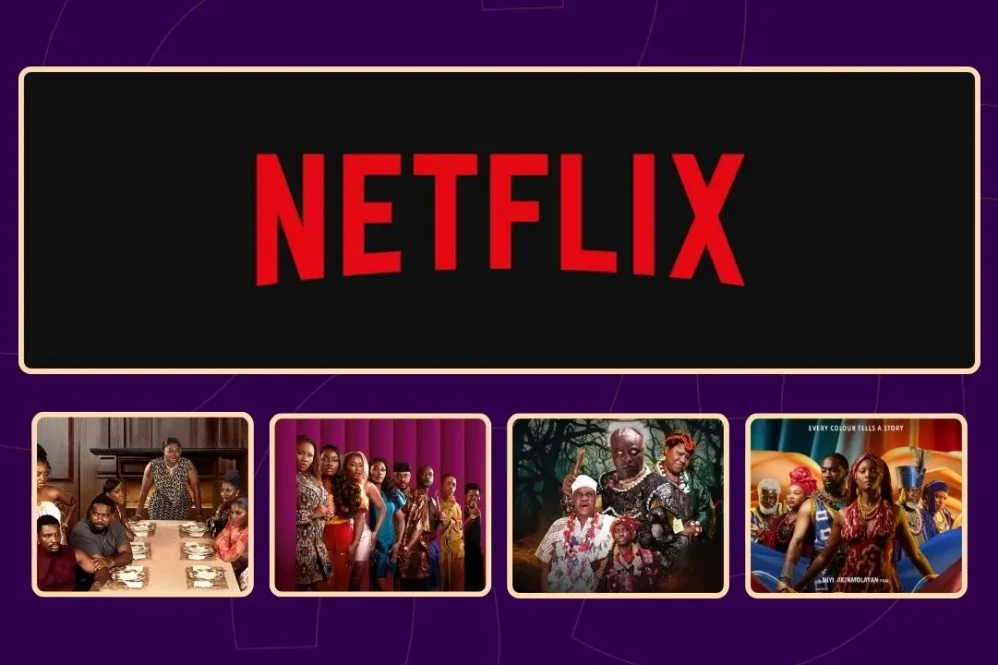
Netflix may have slowed down in Nigeria, but it has not disappeared as many still believe due to the late 2024 widespread rumours.
Much has already been said about the streamer’s reduced activity in the country by us, alongside broader cutbacks in content spending across several international markets. In Nigeria, one visible consequence has been the comparatively limited marketing support for both licensed and original titles.
Its activity in 2026, however, suggests that the streamer’s decisions increasingly appear cautious, calculated and built around established filmmakers, recognisable stars and projects whose commercial potential has already been tested. After years of operating in Nigeria and gathering audience insights from commissioning, licensing recent theatrical films and acquiring older catalogue titles, Netflix now seems more focused on reducing risk.
Post-theatrical licensing is becoming more consistent
The clearest development this year has been the return of more regular licensing activity around Nigerian films that have already established some form of commercial track record.
According to WKMUp’s tracking, the number of Nigerian films added to Netflix after their initial release windows in the first eight months of 2026 has already matched the total recorded across 2025.
That comparison does not mean 2025 was entirely inactive. After the early-year licensing of Ada Omo Daddy, Netflix had a concentrated four-film licensing run between September and November, although the titles were released within only three months. The distinction in 2026 is that since March, at least one licensed Nigerian film has arrived on the platform almost every month.
The titles have included Son of The Soil, Behind the Scenes, Gingerrr, King of Thieves (older catalogue licensing), King of Thieves 2 and, in August, Colours of Fire.
After the post pandemic glut of 2021-2022, the last longer stretch of consecutive monthly post-theatrical licensing came in 2023. From March through August of that year, Netflix added at least one Nigerian film every month, including a particularly packed June in which three titles arrived on the platform. While the current 2026 run has not reached that volume, it is the steadiest monthly pattern since then.
The individual titles so far in 2026 also offer some insight into the kinds of films the streamer currently considers attractive.
Son of the Soil is the first title in the 2026 run. The globally positioned action thriller is directed by British-Chinese filmmaker Chee Keong Cheung, known for action films including Redcon-1, and brings together Nigerian and international production interests. After opening the 2025 Africa International Film Festival, it went on to a theatrical run in Nigeria and the UK before landing on Netflix (and a US theatrical release earlier this year). Its path to the platform fits the broader pattern of titles arriving with an already established profile.
Behind the Scenes, now the Nigerian film industry’s highest-grossing title, arrived on Netflix after three consecutive Funke Akindele releases went to Prime Video following their theatrical runs. Its Netflix release marked Akindele’s return to the platform after Omo Ghetto: The Saga.
Gingerrr followed in May. The film grossed approximately 500 million naira and was one of the most commercially successful Nigerian releases and major collaborative productions of 2025. It arrived on Netflix shortly before the Africa Magic Viewers’ Choice Awards, where it entered the ceremony with nine nominations but went home with zilch.
The arrival of King of Thieves requires a slightly different context. The Femi Adebayo-led film was originally released in cinemas in 2022, grossing about 320 million naira through FilmOne’s distribution, before moving to Prime Video for its post-theatrical run that same year.
Its addition to Netflix in 2026 was therefore not a conventional direct post-theatrical deal. It appears instead to have been timed ahead of King of Thieves 2, which arrived on the platform one month later. Co-produced by Euphoria360, Hawk Studios, and Circuits, King of Thieves 2 also followed an unconventional release path. It bypassed the usual nationwide theatrical run and was released through community cinemas in December 2025. Femi Adebayo later reported earnings of approximately 400 million naira.
Niyi Akinmolayan’s Colours of Fire, produced by Anthill Studios, FilmOne Studios and Imuetinyan Productions, joined the party on Netflix in August. The film premiered in cinemas on Christmas Eve 2025 and attracted attention for its distinct visual approach, eventually grossing approximately 140 million naira.
These five films share recognizable commercial signals: established stars with strong social following, prominent production companies, strong audience awareness, notable box-office performances or an existing franchise.
They appear to indicate that Netflix is now prioritising titles whose market potential has already been demonstrated. There is also a visible similarity that they are often built around ensemble casts. All of these point to a preference for recognisable packages with existing audience appeal rather than riskier or less immediately marketable films.
The emerging consistency could signal the gradual return of a more dependable licensing pipeline, albeit for fewer filmmakers, even as the streamer limits the territories in which these licensed Nigerian titles are available, largely to African markets, while platforms such as Kava and Circuits have handled availability outside the continent.
Industry sources have also suggested that Netflix now prefers Nigerian films to complete a cinema or other commercial release before considering a licensing deal. Although the company has not publicly confirmed this as a formal policy, the approach would allow it to assess box-office earnings, audience response and wider market awareness before making any kind of offer.
In effect, the initial release window in cinemas now appears to be a crucial testing ground for the strongest (or those left with no choice, really). So, is the cinema route now a game of what’s the worst that could happen?
Two returning originals, but narrower distribution
Netflix has also released two Nigerian original continuations in 2026: the second seasons of Kunle Afolayan’s Aníkúlápó series and EbonyLife’s Blood Sisters. Their release means Netflix has delivered one major Nigerian original in each of the year’s first two quarters. But both also reiterate how the streamer’s strategy for Nigerian productions has changed.
The new season of Aníkúlápó was limited largely to Africa. Blood Sisters, meanwhile, received a broader but still restricted release concentrated in mostly English-speaking markets. Its availability excluded much of continental Western Europe, almost all of Latin America and major East Asian territories like Japan and South Korea.
Limiting the territories where Nigerian titles stream may reduce marketing and localisation costs, but it also restricts the international discovery that filmmakers and producers previously expected from working with the global streaming platform.
Still, when originals, direct-to-Netflix acquisitions, catalogue additions and post-theatrical licences are examined together, Netflix’s Nigerian output has remained steady than the post-2024 exit narrative suggests. Since the beginning of 2025, the platform has averaged roughly one new Nigerian title a month across the different library categories, even if the releases have not always arrived at perfectly even intervals.
That does not amount to a return to Netflix’s earlier period of expansion in Nigeria. It does, however, show that the company has maintained a continuing flow of Nigerian content while changing the kinds of projects it acquires, how widely it distributes them and how visibly it supports their releases.
South Africa remains Netflix’s priority market in Africa
The difference becomes clearer when Nigeria is compared with South Africa, which continues to enjoy the strongest and most visible relationship with Netflix on the continent.
South Africa has already delivered at least four globally released Netflix originals in 2026. They include the film 180, which recorded 37 million views during the first half of 2026. The Polygamist, meanwhile, reached 24 million views within its first five weeks, according to Netflix co-CEO Ted Sarandos, after recording 17 million views within Netflix’s January-to-June reporting period. Netflix itself highlighted both productions as global South African successes.
Released in June, The Polygamist became one of the year’s most prominent African streaming successes. The 22-episode telenovela was produced by South Africa’s Stained Glass Productions and adapted from Sue Nyathi’s novel by showrunner Akin Omotoso.
Netflix has also added the ongoing television telenovela The Four of Us after its weekday broadcast run, although its streaming availability is limited to Africa. Another South African original, the crime series Umthetho, is scheduled for a global release in August.
Beyond commissioning and licensing, Netflix continues to invest in South Africa’s production ecosystem. In June, it announced the first cohort of ScreenCraft Pathways, a year-long training programme placing 14 emerging creatives within South African production and post-production companies.
The activity reinforces South Africa’s position as Netflix’s principal production base and priority market in sub-Saharan Africa.
A smaller but more predictable Nigerian strategy
Netflix’s Nigerian activity in 2026 is therefore best understood not as a full recovery, but as the emergence of a smaller and more predictable strategy.
The company is clearly still licensing Nigerian cinema releases. But it appears to be doing so with tighter territorial controls, reduced marketing, a preference for proven talent and greater reliance on theatrical performance as an indication of demand.
For producers, this creates a different kind of opportunity. A strong cinema run may now increase the chances of a later Netflix deal. At the same time, that model could favour already prominent producers, star-led projects and films with the resources to secure meaningful theatrical distribution.
But it may also make the platform less accessible to smaller productions that lack major stars, established distributors or the resources required to generate visible theatrical performance. Netflix may therefore remain an important buyer without functioning as the development (African Folktales Reimagined, for example) and discovery engine it briefly appeared to be during its earlier exploratory phase in Nigeria which means a halt on acquired Netflix originals like Shanty Town and The Black Book and no direct to Netflix licensing like Shina, One Too Many, and Becoming Abi.
The question for the rest of 2026 is whether the monthly licensing pattern continues after August. Should Netflix maintain the current frequency, it would suggest that post-theatrical licensing are once again becoming a stable part of the Nigerian film economy, even without a return to the scale, spending or global reach associated with the streamer’s earlier years in the country.
For now, Netflix remains active in Nigeria, but on narrower, safer and increasingly measurable terms.
Become a patron: To support our in-depth and critical coverage—become a Patron today!
Track Upcoming Films: Keep track of upcoming films and TV shows on your Google calendar.
Editor’s Notes (August 14, 2026): Update includes the March Netflix release of Son of the Soil.