
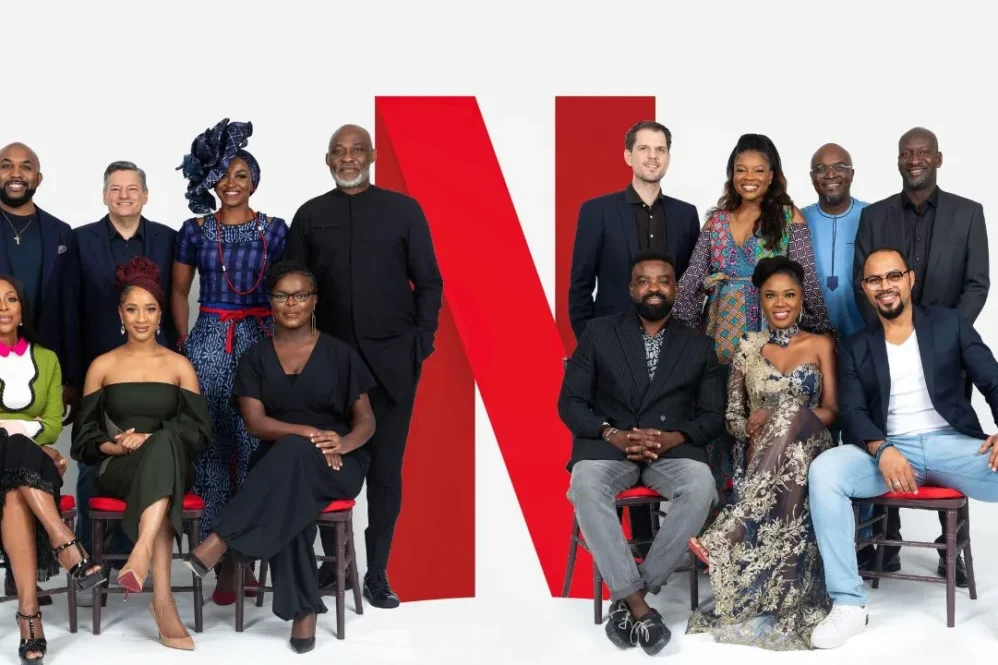
Netflix’s slowdown in Nigeria since late 2024 has repeatedly drawn me back to its operations in the country. The recent departure of Ben Amadasun invites a broader assessment of the company’s first decade in the country, seven years of which coincided with his tenure across multiple leadership roles.
Netflix officially launched in Nigeria in 2016. Ben Amadasun joined in 2019 and quickly rose through the ranks, becoming director of content for the Middle East and Africa in June 2022 and vice-president in August 2023. In 2026, a decade after the streamer’s launch, and just about 40 days after the merriment of Netflix’s tenth-anniversary celebrations in South Africa, news of his dismissal broke on October 20. His departure came amid a global restructuring that also saw senior content executives leave, as Netflix sought to address changing business priorities.
What has that decade meant for Nollywood?
Nollywood has seemed too big for Netflix to navigate, with its many filmmakers, production companies and untapped stories, yet small enough for the streamer to keep returning to a familiar circle of collaborators. For years, Netflix promised to discover African storytellers. Its Nigerian record raises the question of just how far it looked.
The latest high-profile exit provides an opportunity to examine that record against the ambitions he and his colleagues publicly articulated.
The Promise of a New Era
Netflix’s acquisition of Genevieve Nnaji‘s Lionheart, following the film’s 2018 TIFF premiere, was an early statement to establish itself as a premium destination. Amadasun joined in 2019 to oversee content acquisitions and co-productions, becoming director of content for the Middle East and Africa in 2022 and vice-president in 2023.
His ascent did not mean he single-handedly determined Netflix’s African strategy. Dorothy Ghettuba joined in 2019 to oversee original series, while executives including Nkateko Mabaso and Tendeka Matatu held responsibilities across licensing and film. Those teams operated within a global company whose budgets, commissioning priorities and commercial decisions extended beyond any one regional executive. Amadasun’s public responsibilities included sourcing talent and developing content partnerships, but the extent of his personal authority over individual greenlights and spending decisions is not publicly established. This is therefore as much an assessment of Netflix’s institutional record as of the ambitions its senior African content executive represented.
As part of the optimistic early atmosphere, in February 2020, Netflix co-CEO Ted Sarandos, then chief content officer, visited Lagos to meet filmmakers and announce the company’s expansion into Nigerian originals.
One of the most ambitious early projects was an untitled six-part supernatural series led by Akin Omotoso, with C.J. Obasi and Daniel Oriahi attached as co-directors. Produced by Rififi Pictures, the Lagos-set drama was to star Kate Henshaw, Ade Laoye and Richard Mofe-Damijo, among others. It also provided on-set training opportunities for emerging African film professionals through a partnership with Lights, Camera, Diaspora!
The production was suspended after a couple of days because of COVID-19. At the outset, Netflix was attempting an ambitious genre production while creating opportunities for filmmakers and technical talent beyond the most established directing names. COVID-19 derailed those early plans, although the extent to which the pandemic subsequently shaped Netflix’s commissioning appetite remains unclear.
By 2021, Amadasun was publicly articulating an expansive vision. In an interview with New African, he described his work as identifying outstanding African content and searching for original material, including scripts, story ideas and literary adaptations, that could become films and series.
A year earlier, he and Ghettuba had acknowledged concerns raised by Nigerian filmmakers in a YNaija interview, including the need for a stronger marketing presence, greater variety among creative voices and more programming across genres such as animation, children’s entertainment and family films.
Netflix’s leadership appeared aware of the industry’s expectations. The question was how fully those ambitions would translate into sustained opportunities.
A New Distribution Economy
Netflix brought Nollywood the prospect of substantial production deals and more predictable distribution revenue.
In 2020, it announced a multi-title agreement with Mo Abudu‘s EbonyLife, involving original series and literary adaptations. The following year, it agreed to a three-film partnership with Kunle Afolayan, beginning with Swallow, adapted from Sefi Atta’s novel.
Productions associated with this era included Anikulapo, Blood Sisters, Elesin Oba: The King’s Horseman, Far From Home and Ijogbon, alongside returning series and numerous licensed films.
Netflix’s involvement at this point took different forms. Some titles were commissioned for the service; others were independently financed before being acquired for exclusive distribution or licensed after theatrical and festival releases.
The Black Book, for instance, was acquired after production, while Glamour Girls secured an exclusive streaming deal after completion. For Maria: Ebun Pataki reached Netflix through a licensing arrangement facilitated by Okada Media. These deals provided distribution revenue and audience access, but were not equivalent to Netflix originating the productions.
According to its own socioeconomic impact report, the company invested approximately $175 million across sub-Saharan Africa between 2016 and 2022, including $23.6 million in Nigeria. The report identified 283 licensed Nigerian titles and three commissioned productions under its accounting definitions.
These figures predate part of Amadasun’s tenure and include activity before his arrival. They also illustrate why licensing hundreds of films cannot be treated as hundreds of original production investments.
Nevertheless, Netflix became an important buyer, offering producers an avenue for recovering investment beyond the uncertainty of Nigerian cinema revenues. For established filmmakers, streaming partnerships offered greater financial predictability, while licensing extended the commercial lives of independently produced films. At the height of the japa wave, Nigerian films had a clear second life in a digital post-theatrical window that reached many parts of the globe.
These were meaningful changes, even if they did not resolve Nollywood’s underlying financing and distribution problems, amongst other issues, depending on which filmmaker you queried at which event.
Who Actually Got the Opportunities?
An examination of Nigerian titles appearing on Netflix between 2021 and 2026, compiled by What Kept Me Up, identifies recurring relationships with established industry players, including Afolayan’s KAP Motion Pictures, Abudu’s EbonyLife and FilmOne.
Afolayan and Abudu, in particular, shifted much of their attention towards streaming partnerships before gradually returning to theatrical with Recall and Baba Segi’s Wives respectively, since Netflix scaled back its Nigerian investments.
The WKMUp dataset is a working catalogue rather than a complete inventory of Netflix’s Nigerian programming. Nevertheless, its identified original commissions and returning properties are heavily concentrated among KAP, EbonyLife and FilmOne (mostly as a middleman).
The rationale is understandable. Established companies offer experienced crews, delivery capacity and a record of managing large productions. Industry chatters point to productions that reportedly fell through or experienced prolonged and troubled production schedules. Still, the concentrated pattern at the top complicates Netflix’s ambition to discover new filmmaking voices.
Across the identified mainstream commissions, experienced directors overwhelmingly dominate. Afolayan, for example, directed the productions arising from his own partnership, never using some as opportunities for emerging directors.
Production companies exercise considerable influence over hiring and creative staffing, so Netflix cannot automatically be held responsible for every directing decision. Yet the companies a streamer chooses to commission inevitably shape who gains access to its resources.
There were, however, efforts to develop new talent outside these mainstream partnerships.
Netflix’s UNESCO-supported African Folktales, Reimagined selected six filmmakers from across sub-Saharan Africa, including Nigeria’s Korede Azeez, whose Hausa-language science-fiction short Halima’s Choice (produced by Kenneth Gyang’s Cinema Kpatakpata) formed part of the anthology. Each selected filmmaker received a $25,000 award alongside a $75,000 production grant.
The anthology premiered globally on Netflix in March 2023 but left the platform three years later, following the end of its licensing. Korede Azeez confirmed to us that the rights to Halima’s Choice, have since reverted jointly to her and Cinema Kpatakpata, with both parties currently exploring alternative distribution opportunities.
Between 2021 and 2023, Netflix also supported the Realness Institute’s Episodic Lab and Development Executive Traineeship, through which eight Nigerians participated in screenwriting and story-development programmes. They included writers Ayoade Adeyanju, Kehinde Joseph, Sandra Madu and Emil Garuba, alongside development trainees Ololade Okedare, Omotunde Akiode, Damilola Aleje and Mimi Bartels.
These programmes created concrete opportunities, but their longer-term outcomes reveal the benefits and limitations of connecting talent development to a commissioning pipeline.
Garuba, who participated in the 2023 Episodic Lab, developed The Wright Report, a Nigeria-set supernatural series about an investigative journalist pursuing paranormal mysteries while investigating her husband’s death. After three months developing the series bible and season structure, the project received a Netflix commission following his final pitch.
By early 2024, however, Netflix had informed him that the project would not proceed as part of a wider reduction in its commissioned African series slate. It had reached the full pilot-script stage. Garuba retained his intellectual property and has since continued pitching the project elsewhere.
“The Realness network has been more durable for me,” Garuba told What Kept Me Up. One relationship formed during the residency, with fellow participant Mimi Bartels, subsequently brought him into the writers’ room of 100 Reasons to Stay Single in Lagos, which premiered on MTN OneTV.
The programme’s influence extended beyond Netflix itself. Okedare, who participated in the Development Executive Traineeship, subsequently founded Emerge Story Company, through which she has organised story-development initiatives, partnered with Final Draft to provide software subscriptions to 25 African writers and convened the first Colloquium of African Screenwriting Guilds, bringing together representatives from Nigeria, Ghana, South Africa and Kenya.
Although her participation did not lead to a formal ongoing engagement with the streamer, Okedare credits the programme with shaping her professional development and opening international opportunities.
“Training is one part of the equation; access to projects, decision-makers, development financing and commissioning opportunities is another,” she told WKMUp, calling for more structured post-training support, including industry placements and project attachments.
Garuba and Okedare’s experiences point to the value of Netflix’s investment in developing African creatives, even as they expose the limitations of a programme whose commissioning opportunities depended on a single streamer’s continued appetite.
“A programme that places projects with one commissioner is only as robust as that commissioner’s long-term appetite, and when the appetite shifts, the pipeline shifts with it,” Garuba said, while admitting that it is a reality of any single-partner development pathway.
That distinction is central to Netflix’s legacy, so far. It invested in training talents, but the mechanisms for sustaining those opportunities proved less durable.
Other streaming arrangements demonstrated alternative approaches. Prime Video‘s packed slate included Nemsia and its involvement with the First Features initiative, which created opportunities for emerging directors. The commercial arrangements, not in any way identical, showed how relationships with established companies could support newer filmmakers.
Netflix’s preference for experienced partners may have reduced commercial risk, but the industry angst is whether the streamer sufficiently broadened creative access.
Did the Films Become More Adventurous?
The question of access also extends to the kinds of stories Netflix supported.
WKMUp’s working dataset identifies Nigerian titles spanning the familiar. Much of that variety came through acquisitions and licensing rather than direct commissioning.
Among about ten entries classified as commissioned originals or continuing original productions, including returning seasons, the identified stories were concentrated in drama, crime and historical or epic narratives.
Exclusive acquisitions also leaned towards crime stories, including King of Boys: The Return of the King, Glamour Girls, Shanty Town, The Black Book, Blood Vessel and Hijack ’93. Historical epics subsequently became prominent.
Genre alone does not measure creative ambition. Nor does this pattern prove that Netflix instructed producers to replicate commercially successful formulas. Audience demand, production economics and the pitches submitted by filmmakers may all have influenced its decisions.
Nevertheless, Netflix’s Nigerian commissions showed less breadth than its executives’ early ambitions suggested, particularly in animation, children’s entertainment and other less-established formats.
A revealing question is whether the company had sufficient appetite to take creative risks beyond the projects and collaborators it already knew could deliver.
What Came Back From The Stories That Travelled?
Netflix made Nigerian films more accessible internationally, extending their reach beyond the diaspora and established festival circuits. Productions including Oloture, Anikulapo, Blood Sisters and The Black Book found audiences across multiple markets.
But international availability, chart performance and lasting cultural influence are not interchangeable. Netflix’s rankings indicate viewing activity within its measurement system, not necessarily whether that exposure sustained international opportunities or broader cultural conversations.
Editi Effiong offers a notable example of what greater visibility could make possible. Following the international exposure of The Black Book, he secured a television film deal with Canal+ and established a relationship with American producer Nicky Weinstock, who is attached to the sequel of his revenge thriller.
International partnerships, however, do not always translate into completed productions. Mo Abudu has announced several collaborations with international companies over the years, many of which have yet to produce released projects or substantial public updates.
More recently, geographical availability has become another concern. Several Nigerian titles added to Netflix between 2025 and 2026 have been available primarily within Africa, according to territory checks in WKMUp’s tracking, while some returning originals retain slightly wider distribution. The regional restrictions complicate the assumption that distribution through a global streamer necessarily gives a Nigerian film a global audience. A global synchronous second window has since been missing for diasporan Nigerians.
When The Investment Slowed
The precise point at which Netflix reduced its Nigerian commissioning remains difficult to establish. Release calendars are an imperfect guide because productions may debut years after being greenlit.
Garuba’s account, however, places a specific reduction in Netflix’s commissioned African series slate in March or April 2024, months before the company’s November gathering in Lagos became associated with its slowdown.
By the end of 2024, reports of shelved or paused productions had become public. Netflix maintained that it was not exiting Nigeria, while Afolayan described a reduction in its financial exposure.
Subsequent accounts from filmmakers suggest a growing preference for acquiring completed films, particularly titles that have demonstrated commercial potential through theatrical releases. Such an approach would shift more early-stage production risk back to producers and financiers.
A related contraction was visible in Netflix’s Nigerian publicity operation. During its more expansive period, Netflix worked with communications agency Zebra Stripes Networks, organised press junkets and premieres, and supported major productions with substantial campaigns.
WKMUp regularly received press releases, programming updates and invitations. Its last recorded Netflix-related communication from Zebra Stripes came in November 2024, covering December programming and an invitation to the company’s Lagos gathering.
Since 2025, Netflix’s observed social media operation has become considerably narrower, centring on monthly title roundups, occasional release announcements, clips and rarer follow-up posts. The earlier volume of direct press engagement is no longer evident.
There is also a business case to consider.
Nigeria’s large population has not necessarily translated into a correspondingly large paying streaming audience. According to Omdia estimates reported in 2023, South Africa accounted for approximately 73.3% of Netflix’s sub-Saharan African subscribers, compared with Nigeria’s 10.5%. Netflix disputed the reliability of these third-party figures and does not publicly disclose comparable country-level subscriber totals, but the estimates suggest a significant difference in the countries’ commercial contributions.
Netflix’s own impact report offers another measure of that imbalance: approximately $125 million invested in South Africa between 2016 and 2022, against $23.6 million in Nigeria.
South Africa’s comparatively mature subscription market, broadband infrastructure and established production ecosystem offer potential commercial advantages. Nigeria, meanwhile, presents challenges involving consumer purchasing power, currency instability, payment access, internet costs and piracy.
The contrast was particularly visible in September 2026, when Netflix marked ten years in South Africa with an industry showcase, a substantial production slate and announcements of new partnerships. Amadasun was still publicly discussing the company’s commitment to African production.
Nigeria, where Netflix also launched in 2016, received no comparable publicly identified anniversary showcase or slate presentation. Netflix’s African ambitions have clearly evolved unevenly across markets.
What Survives The Netflix Era?
Netflix’s legacy extends beyond its catalogue and original commissions. Its impact report documented 52 scholarships for emerging West African creatives, grants to film schools and pandemic-related support for film workers. The company also supported post-production training at the KAP Film & Television Academy and provided funding to Terra Kulture for educational and cultural programmes.
Its productions and distribution requirements reinforced professional expectations around technical standards, post-production and delivery quality. More indirectly, the prospect of streaming investment encouraged parts of the industry to develop production infrastructure and higher-end facilities, although these investments cannot all be attributed solely to Netflix.
Technical expertise, professional relationships and training remain useful even when a streamer reduces its spending. But sustainability depends on whether opportunities continue after the training ends. Higher production standards require financing, while talented filmmakers still need companies willing to commission their work.
Nollywood’s longstanding problems with financing, piracy, distribution, unreliable audience data and uneven production standards were not created by Netflix. Nor could the company reasonably be expected to solve them all.
What Netflix possessed was the capital, reach and institutional influence to engage with those limitations differently.
The responsibility for that extends beyond Amadasun. His departure was part of a wider global restructuring, and Netflix’s regional strategy involved multiple executives and corporate decisions whose internal workings remain largely undisclosed. Still, the ambitions he publicly represented invite scrutiny.
The most consequential criticism is not that Netflix failed to perform magic on Nollywood. It is that, despite repeatedly presenting itself as a company searching for new African storytellers, its mainstream Nigerian commissioning relationships rarely appeared to venture far beyond a familiar industry circle. A market’s established producers are not the full measure of its creative potential.
Nollywood was never that small; dysfunctional, yes. The question now is whether Kaye-Ann Williams, who is taking over the regional content remit of the streaming giant following Amadasun’s departure, will stomp further into the industry than her predecessor’s operation did.
Become a patron: To support our in-depth and critical coverage—become a Patron today!
Track Upcoming Films: Keep track of upcoming films and TV shows on your Google calendar.

