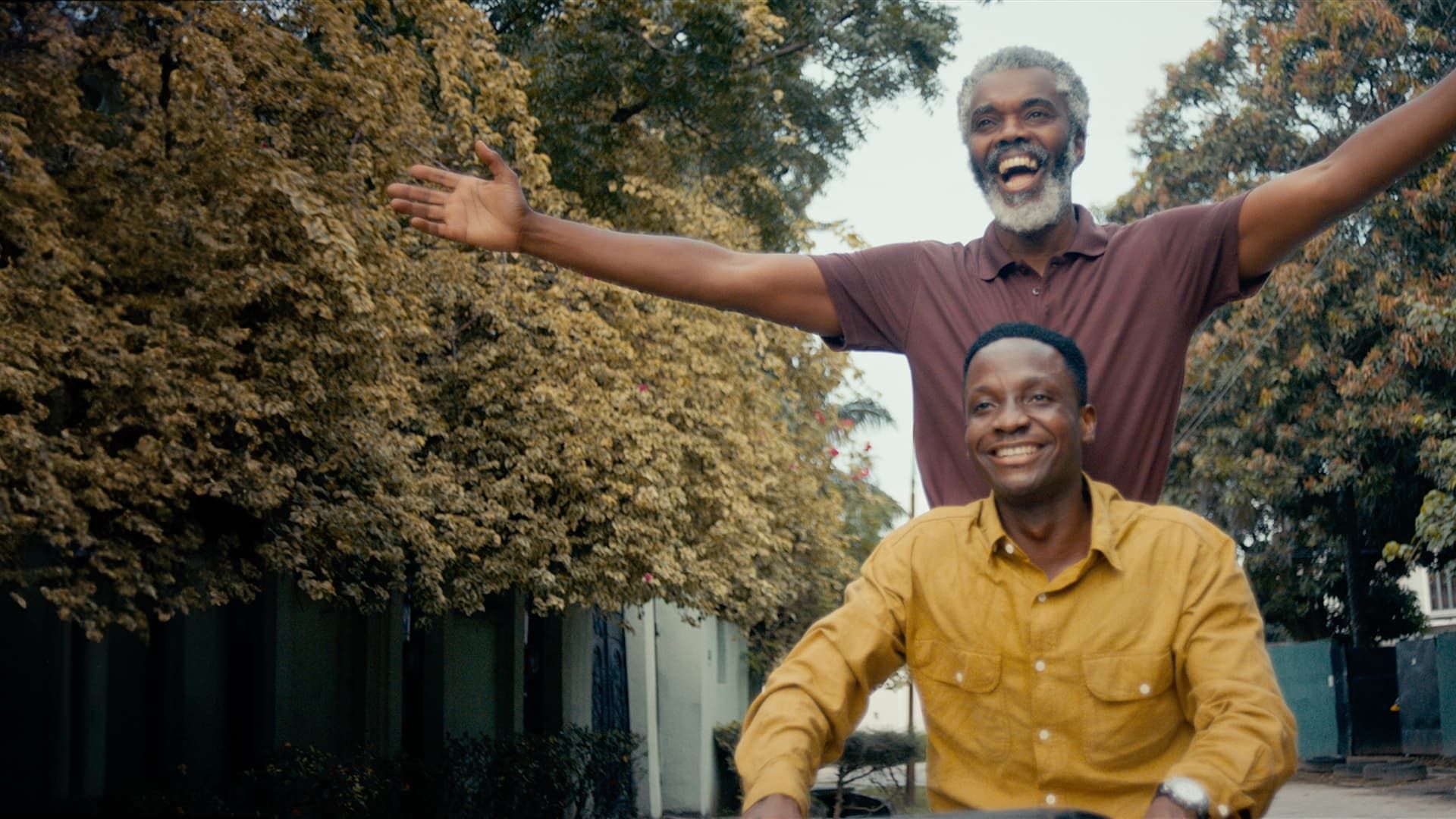

With A Land Apart, Bem Pever, in another collaboration with writers Emil Garuba and Michael Garuba, crafts a near-utopian Nigeria where agriculture is the source of national wealth. Global titans scramble for its singular agritech solution as the world struggles to recover from a global food crisis. At the centre of Pever’s alternate fiction is Dooshima Ahura, the secret daughter of a foremost Agripreneur, Dekera Ahura (played by Richard Mofe Damijo in a rather brief appearance). Following her father’s sudden demise, she inherits his empire, taking over as the CEO of AAIC. Her role places her at the centre of a geopolitical contest over who gets access to her father’s life-saving crop formula.

Even with a seemingly fresh premise, A Land Apart is entirely familiar in its narrative and scenario. A wealthy man dies; he wills a substantial portion of his fortune to an offspring of whom the rest of the family becomes aware only after his death; the “legitimate” family regards it an act of treachery; a family feud ensues. Yet this familiar narrative is staged with a conciseness and clarity that culminate in an engaging experience; that is, the film knows what it wants to say, says it engagingly, and sustains that engagement for most of its runtime. And if there is nothing new under the sun, then there surely is something to be said for knowing precisely what one wants to say and saying it well.
Mainstream Nollywood has built a reputation for political naivety, with many films showing little to no understanding of the political implications of their portrayals, and others treating the political as non-existent. A Land Apart, however, engages with the political on multiple levels. Most explicitly, this emerges through the geopolitical intrigue amongst the Americans, the Arabs, and the Chinese, centred on the AAIC-developed agricultural innovation: the soil-reviving AX-103—although the Americans harbour a different agenda. While this represents the film’s primary conflict, it doesn’t exactly expand it beyond the proposition that “the CIA has fronts and they’re dangerous.” In the absence of any insightful engagement with this conflict, its restraint takes centre stage. The film avoids exploiting the histrionic potential of the material for cheap dramatic effect—the sort of CIA-operation alarmism peddled by David Hundeyin.
The political emerges more interestingly in the film’s depiction of gender: autonomous female characters, unencumbered by patriarchal expectations. This is first expressed through its protagonist, the youthful Dooshima Ahura (played with charming presence by Princess Mufeedah), caught between high-stakes negotiation with international powerbrokers and a family feud, compounded by the life-threatening opposition from her indignant step-brother, Hameza Ahura (Adam Garba), who, believing himself to be the rightful heir to the Ahura empire, and caught up in a blackmail scheme with the Americans, goes to great lengths to reclaim his position and make the deal go in their favour. Dooshima’s autonomy is easily illustrated through two statements: one, when she responds to Hameza’s insistence on accepting the Americans’ offer that she would rather continue with their father’s policy of keeping AAIC’s technology beyond American reach; two, when she tells Madam Ngozi, “I am not my father” in response to the latter’s berating her for her father’s wrongs. She chooses. She rejects. She takes charge of situations.
Female autonomy finds a more mature expression in Madam Ngozi, referred to as the Matriarch of Zaki Biam Market (played with commanding elegance by the late Onyeka Onwenu), revered for her significant influence in the country’s agricultural trade and a core member of the AAIC board. Frequently accompanied by a group of women singing her praises, she is reminiscent of older women in Nigerian society who empower other women, especially widows, by providing support in the form of shelter, employment, or even a place within their household. Here, A Land Apart, proves itself to be class-conscious. This consciousness becomes explicit when Madam Ngozi attributes Dekera Ahura’s betrayal to him seeing her as an ordinary village woman, a reflection of his general disregard for ordinary people, and his failure to understand their indispensable place in the system he profits from.
The film’s editing lends a degree of fluidity to its rather precise narrative. Scenes are weaved, one into the other, through a sustained use of J-cuts, producing the feeling of a connected narrative world. The film’s cinematography (helmed by Shittu Taiwo) is measured, restrained, and almost imperceptible, assuming the role of an observer watching the narrative unfold.
A Land Apart has a large ensemble cast. Noteworthy mentions include Sam Dede (Gone) as Senator, the Ahuras’ Chief of security; Frank Donga’s deadpan appearance as Professor Tijani, a geeked-out agricultural scientist; Iverene Antieve as Awashima Ahura, Hameza’s wife who serves as personal assistant to successive CEOs of AAIC; and Daniel Etim Effiong (Blood Sisters) as Kersha Gande, a renewable energy professional with whom, from a business relationship with Dooshima develops into a budding romance (which many have come to expect when he is thrown into a film).
The performances are mostly strong across the large cast. But one cannot help but notice the theatricality of the film’s dialogue. The characters, when speaking English, talk in precise, almost rigid statements, bereft of the hesitations and digressions of ordinary speech— statements as concise as the film’s narrative itself. Whether this is desirable or not is a matter of aesthetic preference; it is Bem Pever’s world, and questions must first acknowledge the film’s internal logic. Certainly, it is a coherent and consistent world.
A Land Apart is a familiar yet engaging work of fiction. By applying existing narrative conventions to a fresh premise with an assured understanding of what needs to be communicated, and a certain precision, the film delivers a worthful experience. In a sense, the film makes the case that familiarity is not the problem with most of our films; imprecision is.
A Land Apart is a Sutoritera and Take 7 Media Productions Film, distributed by Nile, in cinemas from October 23.
Become a patron: To support our in-depth and critical coverage—become a Patron today!
Track Upcoming Films: Keep track of upcoming films and TV shows on your Google calendar.
Side Musings
- Onyeka Onwenu’s performance in this film is unrivaled. RIP to the icon.
- Nobody told Mr Pever that the helicopter shot was turning into a helicopter exhibition throughout post-production?
- Shoutout to David Hundeyin. He would have had a field day with this script.