Award ceremonies are always regarded as an actor’s biggest night. For the cast of Lady, that moment unfolded from a distance. Despite winning the Special Jury Award for Acting Ensemble at the just-concluded Sundance, and being described by the jury as an “electric ensemble cast,” the film’s Nigerian actors were unable to attend the festival in the United States due to visa denials.
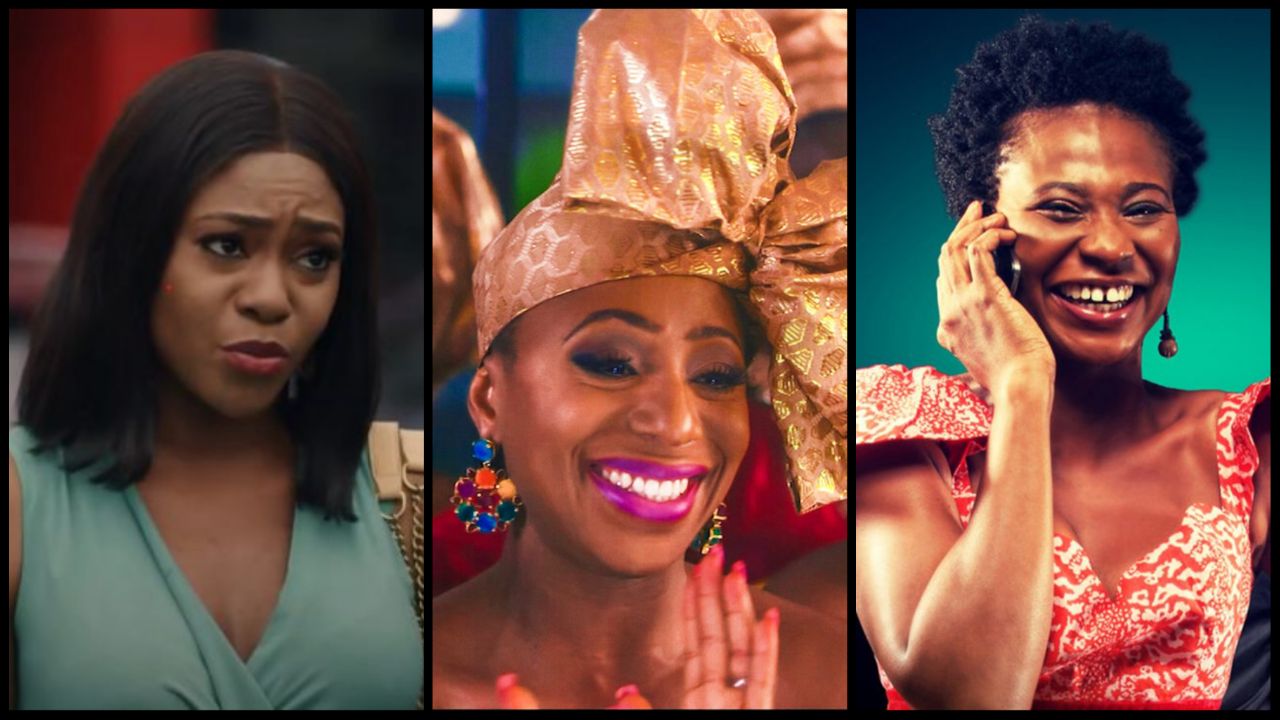
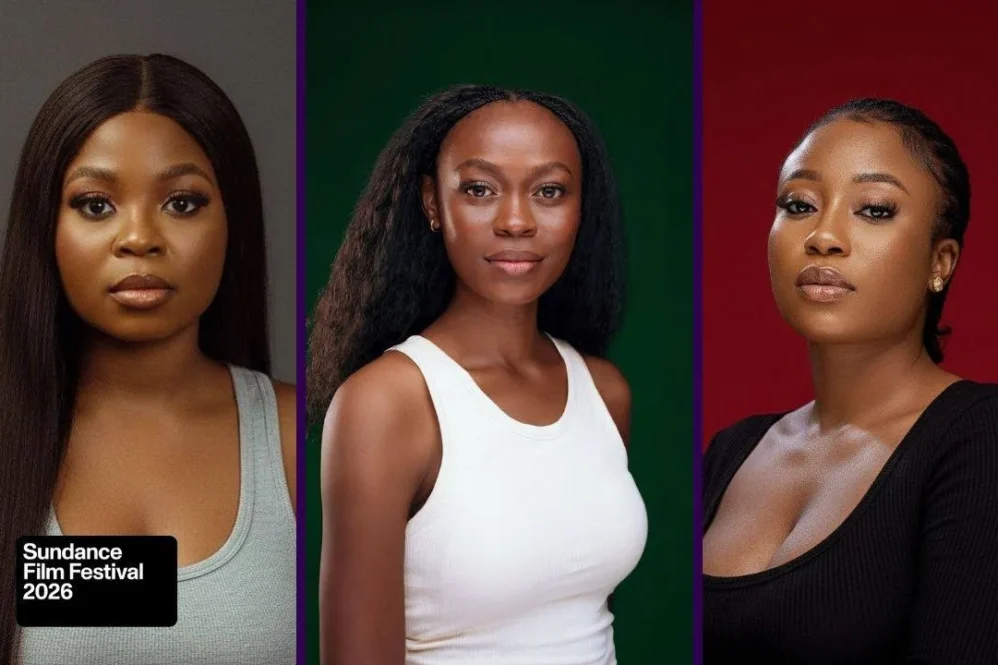
The news of Lady’s Special Jury Award on January 30 arrived the same way most of the film’s festival updates had, in a group chat shared with the director. “It felt like such a tremendous experience, though we were over 1000 miles away,” says Jessica Gabriel’s Ujah, the titular lead, who was stuck in Lagos traffic on the familiar mainland to island route as her phone buzzed. Amanda Oruh (who plays her childhood best friend Pinky) was at home, working on press materials and content. Tinuade Jemiseye (one of Pinky’s fellow nightlife sex workers) was at a friend’s cinema meet-and-greet at IMAX Lekki, where she froze, then cried, before fully processing the “bittersweet” moment later that night.
(Click to Follow the What Kept Me Up channel on WhatsApp)
“To be honest, I felt cheated and dehumanised, because it’s just a reminder that even though Nigeria is growing and we did this work with an amazing production team and cast, we are still seen as a third-world country,” Oruh admits, echoing her Twitter thread that had gone wide days before.
Their director, Olive Nwosu, whom they repeatedly describe as a “girl’s girl”, kept the cast closely involved throughout the film’s Sundance journey, sharing photos and videos right from their world premiere on January 22. While this was not the same as being physically present in snowy Utah (where the festival holds its final edition before its 2027 move to Boulder), it was how the actresses experienced their biggest night from Lagos.
In a virtual 2-hour conversation with the ladies of Lady days after the win, their emotions were mixed, but they remained filled with gratitude and joy about the global recognition, despite the lack of access. Their recognition marks another significant moment for Nigeria at Sundance, following Akinola Davies Jr.‘s 2021 win for his short film Lizard and the 2023 cinematography award for CJ ‘Fiery’ Obasi’s Mami Wata.
As more Nigerian films increasingly make their way to international festivals, many of our stars—especially younger ones—might not be able to attend physically due to restrictions on mobility and the difficulty of securing visas to attend prestigious global film events. This presents a structural barrier, familiar in other sectors as well where “Nigerian creatives continually lose opportunities abroad because of systemic issues”. But with the award, as the actresses put it, their art—and by extension, their talent—managed to break through the borders. “Knowing that Lady is doing this amazing thing for me and others made me feel better. I said to myself, ‘I might not be there, but my work has been seen. My talent has been recognised,’” says Oruh. “As much as I’m sad about not being there, I’m very glad that regardless of the restrictions I was able to be a part of something so beautiful that it resonated with people who don’t even understand my reality,” adds Jemiseye.
As African Film Press partner Tambay of Akoroko wrote in a recent dispatch: “Visa denial for African professionals in Amanda Oruh’s position becomes devastating precisely because there is no fallback of equal weight within the continent. If a German filmmaker misses Cannes, Berlin and other major international festivals remain accessible. If a U.S. filmmaker misses Sundance, Toronto, Telluride, or SXSW, comparable festivals across Europe and North America remain within reach. For most African filmmakers, missing one major festival can erase the entire international exposure window for that project, with career ramifications well beyond the life of the film itself.”
Well aware of the recent visa ban imposed on select countries by Donald Trump’s administration, Ujah, Oruh, and Jemiseye remained hopeful as they attended their interview appointments in early January. They were, after all, working professionals with a clear reason to be in the United States and they had come prepared.
All their documents were in order, from Sundance’s official invitation letter to confirmation of accommodation in Utah, alongside other required paperwork from the sales company. The production team had also prepped them extensively for the interviews. Oruh adds that she took additional steps on her own, undergoing extra interview preparation.
Unfortunately, the process unfolded much like many visa interviews at the U.S. consulate in Lagos. Some applicants were rejected the same day. Oruh, however, was not immediately denied, which left room for hope and prayers. About two days before Sundance kicked off, she was asked to submit additional documents, further raising hopes that approval might still come through. She has yet to hear back. Sundance ended on February 1.
“The country produces the conditions, the individual absorbs the damage,” I blurted to the actresses as I wrote in my review. Oruh agrees, “The truth is, politics and governance will affect everybody, rich or poor, big or small, talented or not talented.”
As young actresses navigating an industry with little to no structure, Lady arrived like a dream—almost a gift from the universe—during one of their many “emotional periods” of little to no work. Oruh was on the verge of quitting acting altogether last year after working only twice, which earned her just a bit over a million naira. All three speak openly about regularly questioning their career paths amid financial instability and doubt, a routine for a working actor.
The difficulty is compounded in Nigeria, where alternative jobs often do not pay enough to keep one afloat. Many actors juggle multiple side gigs, struggling to balance survival with the demands of their craft.
From the outset, they could sense the magnitude of what they were working on. The casting process alone stretched over 14 months for some of them, involving chemistry tests with multiple screen partners, unconventional auditions, and a pre-shoot bonding workshop in 2023 for all the women. Before and during filming, the cast also spoke with a physiotherapist in an unusual but telling gesture.
They point to the personal and professional impact of these measures, crediting the production team’s care and intentionality, especially given the film’s weighty subject matter.
With each new effort from the production team, they knew they were working with people who cared. Moreover, Nwosu’s leadership set the tone for everyone else. “Major thanks to her. Her process is amazing, and I think that was what birthed a wonderful performance for everybody,” Oruh says. Her approach created a strong sense of emotional safety on set, even during emotionally demanding scenes, where filming could pause so actors could release. “You already felt like it was going to be that project where you’re going to have to lean on the next person to deliver it,” Ujah adds.
Shooting, which took place in 2024, never ran beyond scheduled hours or stretched them into unplanned overwork, a practice that recalls discussions around My Father’s Shadow (another UK–Nigeria project) at the S16 Film Festival, where producer Funmbi Ogunbanwo spoke about standardising humane working conditions. For an actor, it is a rare gift to encounter a project that clarifies what should be expected from a career. Lady became that gift (roles that Ujah and Oruh almost missed) for the young stars.

Their chemistry made me assume that they had known one another for years, but they were quick to dispel that notion. They met for the first time on this film and, since then, have grown into sisters. That sense of found sisterhood defined the experience of Lady for them, and it is what ultimately shaped the film’s on-screen authenticity and bond, which, according to the actors, Nwosu was intentional about. “Imagine starting out a project with women that you probably just know from afar, and then you guys are rounding up the project, and you’re becoming sisters,” shares Ujah. “The community that we have built with this project and with these women is a dream.” Jemiseye adds, “These are my babes for real. I don’t think that I could have done it with anybody else.”
Of the three actresses, Amanda Oruh has the longest working career, spanning a decade. She holds a first degree in microbiology and trained through EbonyLife Creative Academy, alongside multiple acting workshops and one-on-one coaching sessions in Nigeria and abroad. Beyond Lady, Oruh has appeared in projects such as Riona and King of Boys: The Return of the King.
Jessica Gabriel’s Ujah graduated from the renowned Theatre Arts department at the University of Ibadan and later went through the Accelerate Filmmakers Project by Access Bank. Her previous screen appearances include We Danced and Danced, and Mother of the Brides.
Tinuade Jemiseye, who quit her day job nearly three years ago to pursue acting full-time, trained at Emem Isong’s Royal Arts Academy. She holds a first degree in English Language and Literary Studies from the University of Ibadan and a second degree in Literature from the University of Lagos. Her notable past works include Omera, and Baby Farm.
Oruh and Jemiseye are in closest narrative proximity to Ujah’s Lady—roles they both cherish—starring alongside Eva Ibiam, Precious Agu Eke, Fadesaye Olateru-Olagbegi, Agu Chineye Esthyraph, Bucci Franklin, and Binta Mogaji. Lady follows a determined taxi driver in Lagos who forms an unexpected bond with a group of free-spirited sex workers, drawing her into a world of friendship and self-discovery despite the risks along the way.
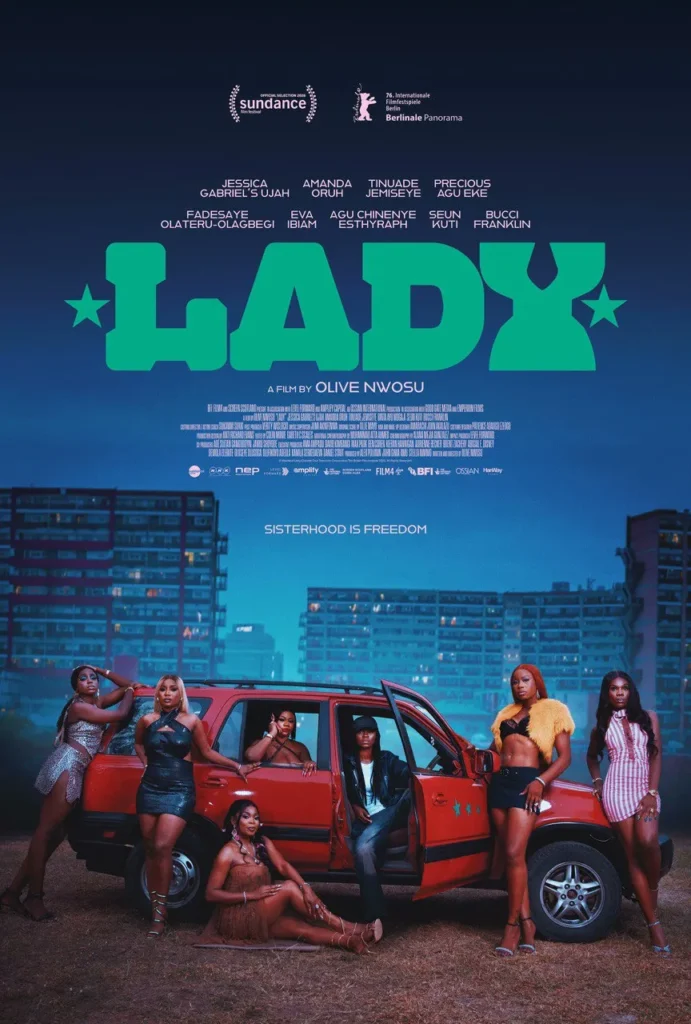
The film’s empathetic portrayal of sex work marks a conscious shift away from older Nigerian tropes that framed it as a moral lesson to be learned. They understood this more deeply after spending time with sex workers themselves, while the director also spent about two months researching and engaging with sex workers in preparation for the film. Here, sex work is presented through survival, the navigation of trauma, and, at times, plain choice, that “humanises” them, as Jemiseye puts it, rather than a “cautionary tale”. Beyond sex work, the film ultimately speaks to the experience of being female within a misogynistic society. “It was important to me that stories that humanise women are being told, and I’m a part of it,” says Jemiseye. Oruh adds, “Women are humans. We have complexities, right?” The actresses understood that this came with a responsibility to the women they were portraying, and to the weight of the film’s themes themselves. “Conversations need to change,” Ujah declares. “We’re not perfect, but we’re human, and we need you to see that.”
The film unfolds against fuel scarcity and simmering protests, with Lagos operating as a looming presence rather than a mere setting. For the actresses, Lagos is a character they have lived with all their lives. The familiar pressure, constant motion, and exhaustion are realities already known. The actors can slip easily into this because Lagos the character, with all its idiosyncrasies, is never far from them. No chemistry tests or bonding exercises are needed here. We have all lived it, inside this rumbling chamber of a city built to “fight every single stride we take, as we all try to keep our heads above the water,” Ujah says.
To fight or to flee Lagos is a question that sits constantly in the minds of young Nigerians. There is an emotional cost to imagining both departure and staying. I hold on to the differing responses of the three actresses, all of whom mention that Lagos still has something to offer them because Nollywood belongs here, and so do their life-long acting dreams. Those dreams include an industry with real structure, fairer and more dignified pay, and less secrecy. Even if it is not stated outright during the conversation, the country itself has to work first. A hope that Nigeria comes out of its “systemic problem at some point” and grows in influential ways that make mobility easier, so that its talents are not structurally or politically shut out of their biggest career moments.
The ladies anticipate the film’s next stop in Berlin mixed with uncertainty.
Become a patron: To support our in-depth and critical coverage—become a Patron today!
Join the conversation: Share your thoughts in the comments section or on our social media accounts.