
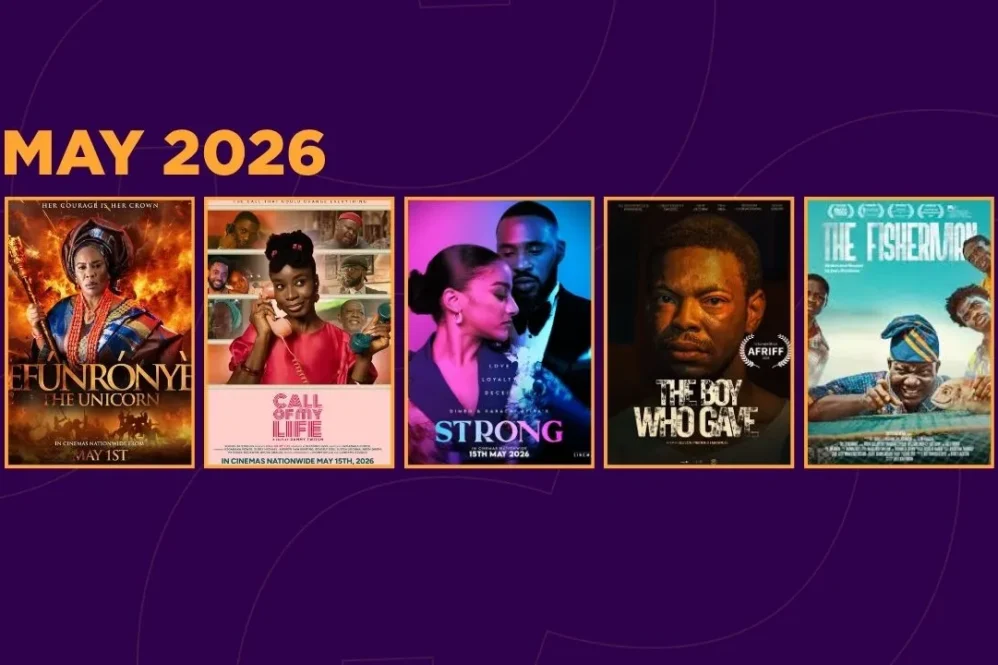
The logic behind a crowded May release calendar may not be exactly hard to notice even without peering eyes. It is also possible that when distributors and producers look at the April-May-June window, they see a run of market- and audience-friendly dates. Workers’ Day on May 1, the late-May Eid-el-Kabir window currently listed as tentative for May 27 and 28 in 2026, and Democracy Day on June 12.
In other words, the market is moving toward a stretch of weekends and public holidays that can keep cinemas busy along with the year-end Detty December boom. That is why 2026 titles such as Segilola, Efunroye: The Unicorn on May 1; Call of My Life, Strong, The Fisherman, The Boy Who Gave on May 15; and Okanjuwa! on May 22 sit so neatly beside other announced titles releasing in May.
FilmOne’s recent yearbooks show why this period has become more attractive in Anglophone West Africa Box Office. In 2024, April grossed 795.5 million naira from 212,619 admissions, May grossed 696.2 million naira from 172,076 admissions, and June boasted 907.8 million naira from 218,183 admissions.
By 2025, the same corridor was much stronger. FilmOne’s 2025 yearbook explicitly describes May as the strongest non-festive month of last year, noting that the result was supported by public holidays and a solid release slate. Although the admissions for May 2025 represents a post-2022 high for the selected month, it remains below the pre-pandemic figures, with 2019’s May holding the highest recorded admissions at nearly 440,000.
In 2025, April moved to 1.3 billion naira, while admissions rose to 242,262. May climbed to 1.64 billion naira and 299,647 admissions, June followed a similar path, grossing 1.33 billion naira, with admissions increasing to 238,617.
Compared with 2024, box office revenue between April-June 2025 was up by more than 50 percent with well over 20,000 new admissions. Accounting for the growth across both years should also include a comparison in the number of films released in that period. April to June 2024 saw about 15 releases in cinemas while April to June 2025 had about 22 titles.
Looking past the numbers, ticket pricing or inflation-adjusted revenue wasn’t the only change factor. The 2025 release slate became more appealing to audiences. Across April, May, and June 2024, the market showed clear pockets of strength, but not the same level of density or sustained momentum seen more recently in 2025.
(Click to Follow the What Kept Me Up channel on WhatsApp)
On the Nollywood side in 2024, titles like Ajosepo (257.2 million naira), Blacksmith: Alagbede (65.1 million naira) and Saving Onome (43.4 million naira) anchored April, while Funmilayo Ransome Kuti carried much of May with 157.1 million naira. By June, Lakatabu and Muri and Ko added 202.2 million naira and 136.0 million naira respectively.
Hollywood releases, however, provided much of the heavier lift across the same period. Godzilla x Kong: The New Empire continued its run into April, closing at 245.9 million naira. May leaned on franchise strength with Kingdom of the Planet of the Apes (170.8 million naira) and Furiosa: A Mad Max Saga (147.8 million naira), while June was driven by action, horror and animation; Bad Boys: Ride or Die (458.1 million naira), A Quiet Place: Day One (144.3 million naira), and Inside Out 2 (112.6 million naira).
Looking at 2024 numbers, you can spot how the April-June release timeline depended on three or four titles to truly have a say in the overall 2024 Nollywood box office report. 2025 felt more like a sustained relay race across that corridor, with momentum passing cleanly from one title to the next rather than resting on a single breakout.
On the Nollywood side in 2025, April to June held steady with the Easter holiday falling towards late April and giving some earlier releases a strong boost while some films positioned across multiple holiday windows with April as their starting point. Owambe Thieves closed at 205.6 million naira, Makemation at 89.9 million naira, and Aso Ebi Diaries at 77.1 million naira. That performance carried into May, where Ori: The Rebirth opened on May 2 and built its run to 419.6 million naira, while My Mother Is a Witch added 100.6 million naira. By June, the pace had not slowed as Iyalode reached 306.4 million naira and Red Circle’s 118.2 million naira.
Hollywood titles moved along with equal weight. Sinners broke out in April, accumulating 775.8 million naira after its release on April 18. May remained crowded with Thunderbolts* (217.5 million naira), Mission: Impossible – The Final Reckoning (372.7 million naira), and Final Destination: Bloodlines at 156.6 million naira. June continued that run with Ballerina earning 255.3 million naira and F1 The Movie closing at 158.9 million naira. Together, these films held attention, stretching their runs across weeks and sustaining audience interest within the window. Rather than peaking in one moment, they kept the window breezy, feeding into the same cycle of audience turnout.
The yearbook argues that theatrical success is increasingly determined by timing, disciplined programming, and the ability to hold audience attention beyond opening weekend. That matters for May because holidays can bring the first rush, but only strong word of mouth can keep a film alive once the holiday passes. You can see that clearly in some 2025 Nollywood runs. Ori: The Rebirth opened to 79.3 million naira and finished the year at 419.6 million naira. Iyalode opened to 81.7 million naira and went on to 306.4 million naira. Owambe Thieves started with 54.7 million naira and still closed at 205.6 million naira. Besides word of mouth marketing, a contributing factor to the revenue growth for these films are the dedicated audiences of each of their star actor-producers.
This is why the current 2026 clustering across various distributors feels commercially sensible. Efunroye: The Unicorn is arriving first on May 1, directly on Workers’ Day, with the advantage of a historical epic framing. Two weeks later, Dimbo and Karachi Atiya’s Strong; feature debuts Call of My Life, The Boy Who Gave, and Ghana’s The Fisherman share May 15. Then Zulu Oyibo’s sophomore Okanjuwa! follows on May 22, just ahead of the late-May holiday stretch.
The market could see a genuine stack of local titles trying to feed off the same public attention cycle. The upside is obviously stronger cinema traffic, greater visibility for local films, and the possibility that one audience spillover benefits another. The risk? Also obvious. These films are not only competing with Hollywood, they are competing with each other for screens, showtimes, publicity, and opening-weekend oxygen.
The Hollywood late April to June 2026 window is already shaping up to include major global releases like Michael, the long-awaited biopic on Michael Jackson; franchise-heavy films such as Mortal Kombat 2, The Mandalorian and Gorgu, Supergirl, and The Devil Wears Prada 2. These are titles already taking center stage across markets, with built-in audiences, heavy marketing, and the kind of spectacle that performs well in cinemas.
To industry observers, May carries a certain expectation. The calendar does part of the work by bringing people into cinemas through a run of holidays and long weekends, what happens after that first visit is where the real measure lies. Audiences are more aware of their options, moving easily between Nollywood titles and big international releases, and choosing what feels worth their time at that moment.
Become a patron: To support our in-depth and critical coverage—become a Patron today!
Stay updated: Track your favourite movies and TV shows directly on your phone calendar.




Interesting ellaboration