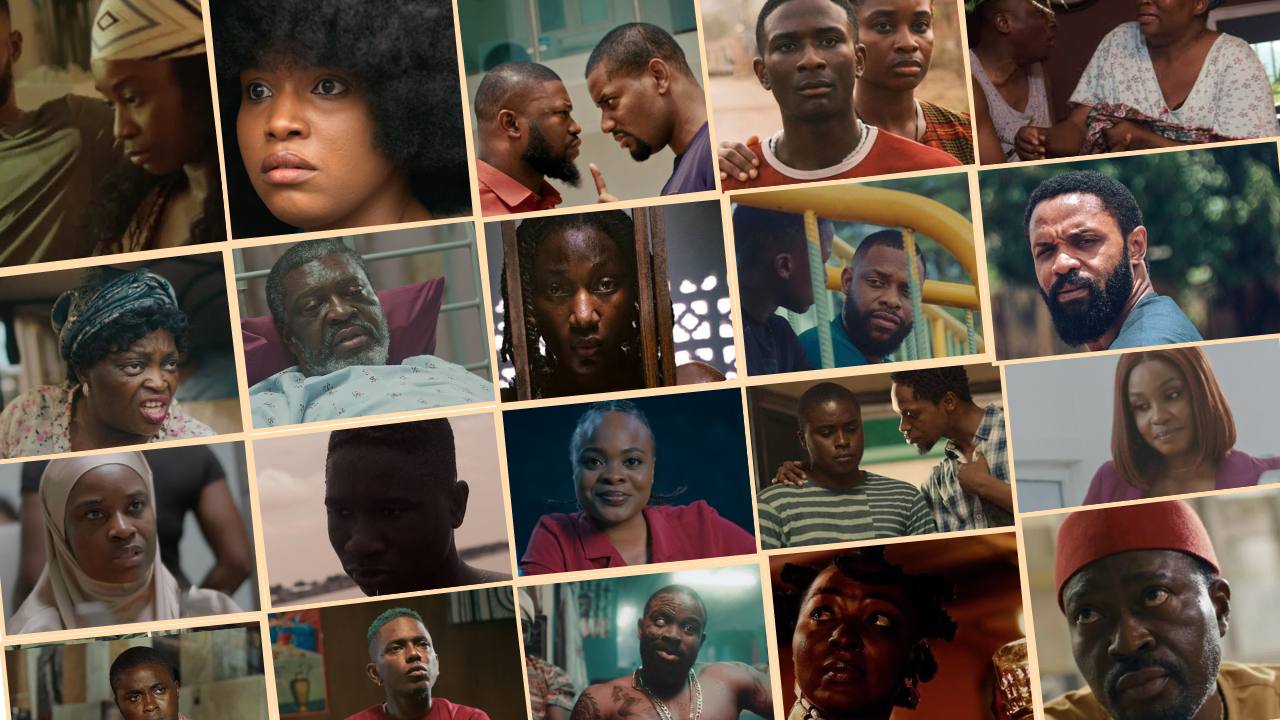

“One thing I appreciate about Nigeria the most now is how backwards it is,” Adebayo Oduwole says with a laugh. On the virtual call in mid March with his collaborative partner Praise Vandeh, the remark lands somewhere between humour and quiet truth. The two founders of Saving Cinema, a new community-driven short film screening initiative in Lagos, see Nigeria’s structural gaps as an unlikely creative advantage. When systems are still forming, they argue, it becomes easier to observe what has worked elsewhere and adapt those models locally. “You can take an idea that has flourished in a completely different climate,” Oduwole explains, “bring it here, tweak it to fit the Nigerian climate.”
Yet both filmmakers are careful not to romanticise imitation. Borrowing global templates, they insist, requires understanding the local realities that shape Nigerian film culture. Still, their thinking draws heavily from the playbook of the international creator economy, where filmmakers increasingly build audiences long before a project is released, by sharing their processes openly, documenting production online, and inviting audiences into the journey early. It is this philosophy of community-first filmmaking that underpins Saving Cinema.
Their thinking draws partly from observing how independent creators elsewhere are rebuilding audiences outside traditional distribution systems. They reference projects such as Creator Camp (a U.S.-based collective experimenting with grassroots self-distribution by mobilising online audiences across multiple cinemas) and Epic: The Musical (an online musical project that built a massive global following by sharing its creative process across social media before its releases began gaining traction on streaming platforms). Both examples illustrate a creator-economy approach where audiences are gradually assembled through transparency and participation rather than traditional marketing campaigns. Saving Cinema adapts this philosophy to Lagos as a community-first short film screening initiative at Magnificent Cinemas in Onipanu, an independent cinema space the founders hope to activate through monthly curated screenings and audience conversations.
Saving Cinema founders Vandeh and Oduwole are two close friends whose early lives unfolded in Nigerian cities without cinemas. Vandeh grew up in Minna, later studying in Ilorin before moving to Lagos, while Oduwole’s path took him from Lagos to Calabar and later Ibadan before returning to the fast-moving city. Their shared experience of growing up far from cinema culture shaped their conviction that watching films should not be a solitary experience.
The pair first met through a mutual friend who suspected they might make a good match—romantically. Instead, they discovered a creative partnership. Oduwole tends to arrive with sprawling ideas, while Vandeh quickly begins shaping them into something workable. “There’s nothing I love more than creating a pitch deck,” she says with a laugh. “I’m always pitching stuff.” As she explains, her role is often to help translate those ideas into something achievable. “Sometimes it’s not about shooting ideas down,” she says. “It’s just about shortening the scale.” That balance has since carried into their collaborations under For The Plot Films, including the short film When Tari Met Voke and now their most ambitious experiment yet in building a short film screening circuit in Lagos.
The idea for Saving Cinema emerged from a pair of cinema tickets. Oduwole’s mother, who has special perks with her bank, receives two complimentary cinema tickets each month—a benefit they realised late and now he has made a point of using. One afternoon, he and Vandeh decided to push the privilege to its limit by watching two films in one day, moving from one cinema to another across Lagos. In an economy where even a single cinema outing has become a luxury for many young Nigerians, the double feature felt almost indulgent.
Between screenings, the two joked that they were “saving cinema” simply by showing up. The line stuck. Not long after, Oduwole found himself at Magnificent Cinemas, an independent cinema space he had long known about but never visited. The surprisingly cosy ambience and the absence of a large crowd struck him. Sitting in one of the 4 screening halls, he began mentally counting the rows and seats (about 56 in total) and realised the space felt perfectly suited for something more intimate. “This just felt like somewhere I would love to do screenings,” he recalls.
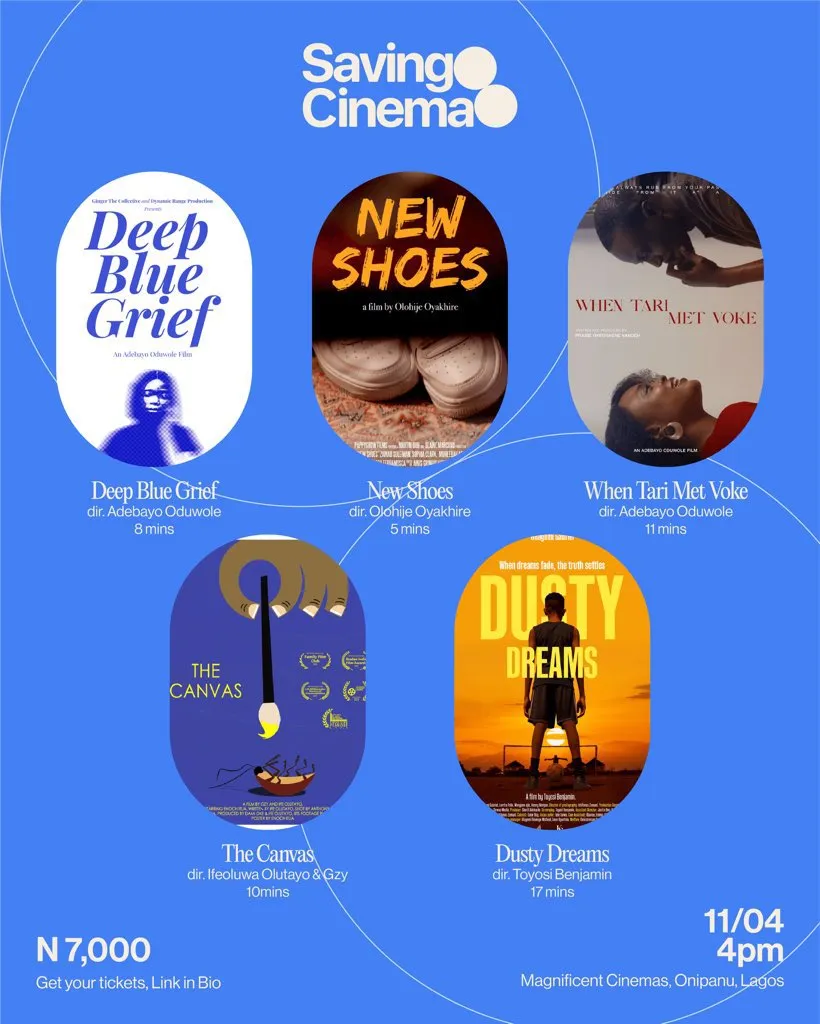
Saving Cinema will hold its pilot edition on April 11, screening 5 short films at Magnificent Cinemas (a founding partner alongside the duo’s For The Plot Films) for a ticket price of 7,000 naira. For the founders, the location matters as much because many of Lagos’ recurring creative gatherings take place on the Island, leaving mainland cinephiles with far fewer options. Set to be screened are Adebayo Oduwole’s Deep Blue Grief and When Tari Met Voke, Olohije Oyakhire‘s New Shoes, Ifeoluwa Olutayo and Gzy’s The Canvas and Toyosi Benjamin’s Dusty Dreams.
(Click to Follow the What Kept Me Up channel on WhatsApp)
The initiative also attempts to address a familiar cycle in Nigerian short filmmaking. Too often, films move from festivals to the occasional special screenings before ending up online or simply back on a hard drive. Many filmmakers never experience their work on a cinema screen. “They are usually limited to Vimeo and YouTube links, but I think they deserve to be seen on big screens too,” says Vandeh. Saving Cinema hopes to offer a different path with the big screen experience and followed by post-screening Q&As, audience discussions, and networking.
For Oduwole, the screenings also mean designing an experience that makes audiences feel they have received more than they paid for. Drawing on his background in experience design, he believes small details can transform a screening into something memorable. “Nigerians love spectacles,” he says. “They are going to come expecting one thing, so anything extra feels like a lot more.” That philosophy means Saving Cinema may occasionally incorporate surprise elements that extend beyond the films themselves.
The founders also see the initiative as something that can evolve over time. Future editions may introduce themed programmes or invite guest curators from their filmmaking and cinephile community to program lineups. In the longer term, their ambitions stretch beyond Magnificent Cinemas and could eventually grow into a broader network of independent screening spaces across Nigerian cities.
They are approaching the initiative with lessons drawn from more experienced filmmakers along the way. One influence is filmmaker Ema Edosio, Oduwole’s mentor and collaborator on When Nigeria Happens (which he wrote), who has become an important figure for young Nigerian filmmakers navigating independent paths. At a late 2025 industry gathering, for example, Edosio emphasised the importance of building an audience as early as possible, beginning from the moment a filmmaker releases their first work. Waiting until a film is ready to premiere, she suggested, is often too late. Instead, filmmakers should nurture communities over time, sharing their creative processes, maintaining newsletters, and finding ways to keep audiences engaged between projects. It is an approach Edosio herself now practices, including self-distributing some of her work through her own website to reach viewers directly.
Vandeh and Oduwole are also aware that the first audience for Saving Cinema will likely come from the communities they already belong to. Between them, those networks span an improv circle, rave and alternative creative communities, and a growing group of Lagos cinephiles who regularly seek out independent film events. That support, they admit, will likely make the inaugural edition easier to fill. The real test will come afterwards—convincing audiences to return consistently and attracting a steady stream of short films for future programmes. In many ways, Saving Cinema is an attempt to develop a recurring film club atmosphere centred on theatrical viewing, that in turn influences footfall at Magnificent Cinemas and general cinema culture.
Both founders are clear-eyed about the realities they are operating within. As cinephiles and filmmakers themselves, they understand the structural challenges that shape the Nigerian film landscape, such as limited distribution pathways, small and inconsistent audiences, and the fragile economics of independent filmmaking. Saving Cinema, Vandeh admits, is still an “experiment for us”. They are also conscious that similar initiatives exist, and they welcome them. “If there are like four different initiatives trying to save cinema, I’d be very happy,” Oduwole adds. For them, a healthy film culture will depend on many such efforts coexisting, each contributing in its own way to a sustainable cinema-going community.
They are deeply high on the participatory aspect. Filmmakers whose shorts are selected will receive a small token payment, modest, the founders acknowledge, but intended as an early gesture that their work carries value. Ultimately, Saving Cinema represents a small but deliberate attempt to contribute to a longer process, gradually nurturing the kind of audience culture and exhibition ecosystem that more established film industries have spent decades building.
For now, Saving Cinema runs on something closer to belief than certainty. Vandeh and Oduwole are balancing the initiative alongside day jobs and their own filmmaking careers, fully aware that the work demands time, energy, and patience with little immediate financial reward. There are no guarantees that the seeds they are planting will bear fruit for them personally. The payoff, if it comes, may well belong to the filmmakers and audiences who arrive later.
But that possibility does not seem to trouble them. After all, the idea itself began as a joke between friends watching two films in one day. Now, as they prepare for the first screening, they are simply inviting more people to come along. If enough do, the joke might slowly start to sound less like a joke. Maybe they really are saving cinema.
The first edition of Saving Cinema will take place at Magnificent Cinemas in Onipanu, Lagos, on April 11, with five short films scheduled to screen.
Become a patron: To support our in-depth and critical coverage—become a Patron today!
Join the conversation: Share your thoughts in the comments section or on our social media accounts.