
The highest-grossing Nigerian films are the comedies, family dramas, romances, and films that combine all three genres. So, when filmmakers go for these categories, nobody blinks. Many, like Omoni Oboli and Ruth Kadiri, choose romance as a niche. Funke Akindele, for instance, is an expert in message-y comedic family dramas. On the spectrum, Niyi Akinmolayan is visually ambitious. Then, we have Toka McBaror, who simply wants to tell “difficult stories.”
“If I’m given the option to choose,” he admits over a call, “I would prefer a film that’s not easy to make, something that would challenge my mind and help me reflect.” However, in Nollywood, as with many industries, filmmakers are constantly asked to choose.
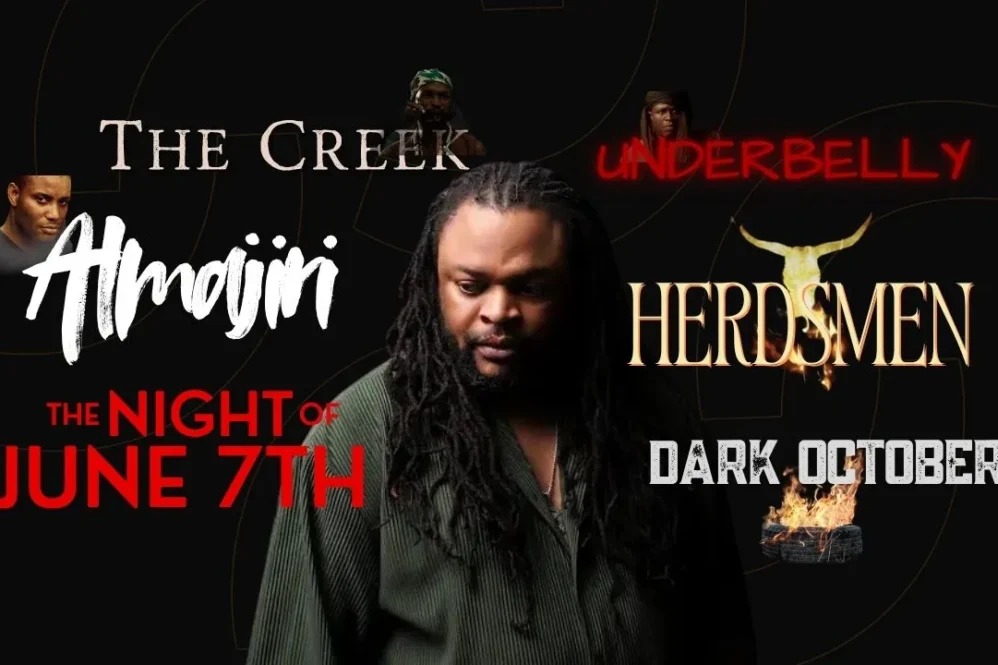
McBaror himself has dabbled in his fair share of feel-good films like Blogger’s Wife (2017) and the action comedy Merry Men: The Real Yoruba Demon (2018). But a closer look at projects like Kada River (2018), Underbelly (2021), Almajiri (2022), Dark October (2023), and one of his latest theatrical films, The Creek (2026), reveals a pattern: his stories often revolve around real violence and national unrest.
The director tells these difficult stories because of the deep desire to leave his audience with something. “Not necessarily a lesson,” he clarifies, “because I don’t want to sound like I’m trying to be that filmmaker with a social responsibility. I’m just saying that I would like to tell a story you will remember. So, if you’ve seen Kada River or Dark October, they are very difficult to forget. These stories will stay with you.”
Kada River is a romantic drama that centers around the 2003 pro-Sharia crises in Kaduna, where McBaror was raised. In fact, much of McBaror’s directing flows from the belief that a person’s upbringing, or the environment they grew up in, influences how they tell their stories.
“There’s a lot of fiction in Kada River, but I personally know the person that it happened to,” he reflects solemnly. “We grew up together, so it was a very personal story. It became more than just a movie for me.”
His familiarity with the North is clear in other films like Almajiri, The Takers, and the period drama Underbelly, because—despite his Niger Delta origins—Toka McBaror is a filmmaker forged by the region. Hausa is the language he stumbles into when he starts describing the upbringing that shaped him into a filmmaker.
“I watched a lot of films growing up,” he begins. “My friend’s father, Mr. Abdullahi Nuhu, was one of the only two people who had video in our area. So, he would bring Indian films, and we would watch. Some of them stay with you, like Sunita.
“There was also a lot of violence in our area, so the escape was to take us along to his office from time to time.” Those visits to Mr. Abdullahi’s job at NTA Kaduna exposed McBaror to the art of television.
First, he started with children’s shows, advertising, and editing. Filmmaking came later, after an unexpected encounter with veteran Obi Okoli on a movie set.
“I watched everything he was doing and thought, ‘I know all these things. I can do all of them.’ I just knew that this was what I was supposed to be doing. So, I put together everything I already knew and turned it into a film.” The outcome was Tales of Bante (2003), his feature debut. But McBaror soon realized that filmmaking involved much more than what he knew, especially when it was based on real events.
“When you’re telling a tragic story, it is a very spiritual journey,” he declares. “Before sharing somebody’s story, especially when the person is no more, you try to connect with the person’s spirit. I know these are not the kind of things people want to hear,” he adds reluctantly, “but something happened when we were filming Dark October.”
The Linda Ikeji production, Dark October, is based on the Aluu Four Lynching of 2012. It is a truly sad film because it is real. “Whenever we set up to shoot the scene where those boys were actually taken out and burnt alive,” the director reveals, “it would start raining heavily. That went on and on for days. But guess what? The exact day we were actually able to film it turned out to be the anniversary of the death of those boys.”
The average cinema-goer can hardly relate Nigeria’s societal horrors to the spiritual. Many mainstream filmmakers cannot seem to portray them at all. But McBaror has earned a unique perspective from bringing these unforgettable events to the screen. “On set, they would tell me, ‘Ah, no, we’ve checked the weather forecast, and it’s not supposed to rain today,’” he continues. “But once we were set up and ready to go, it would start raining. At some point, they said we should get a rain-maker. You know, those people that can stop the rain. But I could sense that those guys wanted to go on their anniversary.”
“So it’s a spiritual journey, not just for the actors—people are more familiar with this concept in method acting—but for the director. You need to be able to get into a particular headspace to paint the picture correctly.” If McBaror and his actors can connect with the spiritual, or deeply human, elements of these films; the audience will easily do the same. He describes this collaborative process as a core part of filmmaking.
“Everybody needs to be on the same page,” he remarks. “If one person is off, it can have huge consequences both on the production and physically. So, if you’re making a film that involves explosives, for instance, and you’re setting up charges, you have to let everybody know.” This kind of mutual trust is necessary on a movie set, where things are constantly changing.
“You could plan for one year that you’re going to paint this wall blue,” McBaror elaborates. “But right there on set, you may discover that the blue wall doesn’t work and green would be better. Sometimes, the producer would have told you they’d be giving you 30 rifles only for you to get to the set and see just 7.”
“Or they’ll say, ‘Oh, don’t worry, there’ll be a bomb suit,’ and it’s not there. You have to get the job done anyway. Otherwise, you’ll be called a difficult person.” The director’s examples—drawn from over 20 years of experience with filming challenging violent scenes—highlight the special power producers hold over the success of any production.
They also show how easily things can go south when creating a Nollywood action film, and are reminiscent of the struggles Editi Effiong faced while making his 2023 Netflix thriller, The Black Book, like the logistical challenge of transporting a 50kVA gen to Tarkwa Bay via barge, to light up a night scene. However, Effiong also served as a producer and therefore had more control over the project.
McBaror too has wielded this power before, with The Takers, Kada River, Fallen Angel, and Ikogosi, which he also produced; and one has to wonder if a director’s vision is best served when they also have a seat at the producers’ table, especially with Nigerian action movies.
McBaror’s increasing interest in this genre, sparked by those films he watched as a child, reflects in his filmography with the brutality of Dark October and Almajiri, his depiction of heist in Merry Men: The Real Yoruba Demon, and gunfights in projects like The Creek. What’s more, he is deliberately specializing in making such films.
“It’s not that I can’t make any other genre of film,” the director clarifies. “But I know that specialists earn more than any other person. If you walk into a hospital because of a bad headache today and they tell you, ‘Oh, there’s another doctor who specializes in treating headaches, though he’s more expensive,’ wouldn’t you go for the specialist if you had the money? So, why not specialize?”
The problem is that, as established, Nollywood is not an easy place to make action films.
Classics like Amaka Igwe’s Rattlesnake (1995) and Lancelot Imasuen’s Issakaba (2001) paved the way for this genre that leaves little room for technical flaws, in an industry like Nollywood, where MILT (Manage it Like That) is the order of the day and execution gaps are usually patched up with attempts at more compelling storylines. Because it is cheaper that way.
The sad result is that most Nigerian action films are notoriously criticised by local audiences for lacking scale, better fight choreography, special effects, and technical execution as a whole. McBaror, too, has faced such harsh criticism.
“We were laughed at when we started making these so-called action films in 2003,” he shares. “But we’re getting better gradually. I like to continue to harness and build on my last mistakes, and The Creek got a little closer to the mark.”
The Creek, his latest action thriller, tells the story of rival militias in the Niger Delta. Produced by Nicholas Adora David for WimPro Entertainment and starring Bucci Franklin, Shine Rosman, Kelechi Udegbe, Sam Dede, and Haitian actor Jimmy Jean-Louis, the Blue Pictures-distributed film grossed over 108 million naira at the box office, becoming one of the few Nigerian movies to cross the coveted 100 million mark this year.
It’s a special homecoming for McBaror, who hails from Warri. “I have never made a film about the Delta before,” the director confesses. “I’ve been back home before, but I didn’t grow up in the region, so we only hear about some of these things.”
This production gave him the opportunity to tell the world about his people, and the issues they face. Its high-stakes action sequences also showcase how far he has come in the genre. However, it came with a lot of hard lessons.
“The Creek taught me that it’s best to shoot the end of your film, or the most difficult scenes, before you even start,” McBaror reveals. “Or you will pay for it. I wish the film had ended differently.”
“Some of the locations forced us to change some parts of the story,” he recounts. “The writer (Emeka Jepherson) had to make some important creative decisions right there on set,” a pleasant change from the norm of changing scripts without consulting the writers at all.
While the exclusion of screenwriters during on-set script changes is not unique to the Nigerian film industry, our improvisation culture has made it far too normalized; increasing the risks of disputes, under more protective screenwriting contracts, and storylines that deviate from a film’s original creative voice.
“That is why it’s also important to get good people when you’re making a film,” the director adds, going on to praise the cast of The Creek.
“I wish every actor could be like Bucci, Kelechi or Uncle Sam Dede,” he says. “I wish every actor could be like Shine Rosman because they made it easy. We didn’t have the issue of, ‘Oh, I forgot my lines,’ because they were into it.”
He also recognises Deyemi Okanlawon as an actor that really digs into his scripts. But McBaror is aware that there are deeper structural problems at work in Nollywood. “These days, actors seem to be in a hurry to go somewhere else,” he observes.
“Maybe you’re filming in the rainy season,” he illustrates. “You have a contract with an actor that you are going to make the film in 10 days, but you’ve lost 5 days to rain. So, you meet them and say, ‘Can we readjust our contract to give me 1 or 2 more days?’ But they’re already booked for the next day.” This is the reality for most in the industry.
A lot of Nigerian actors are taking on too many jobs because they earn far below the high expectations people attach to their lifestyle. The downside, McBaror argues, is they won’t be able to give their best, or deliver the precision action filmmaking demands. “People don’t even read their scripts nowadays,” he says, “because they’re finishing from one set today and jumping into your set tomorrow.”
“The girl you’re calling Chichi today just played Motunrayo yesterday,” he continues. “She finished that job at 12 midnight, and she’s on your set at 7am to become Chichi.”
“There’s no way that person will come into that character fresh. The depth of that performance will be shallow.” The director reiterates the idea that good action films—–with great stunts, weapons, and explosives—–rely on a great deal of trust and precision from both cast and crew. Then, he admits, “That’s why I find it difficult to change a team when I’m making these kinds of films.”
Essentially, Toka McBaror prizes quality over most things because he intends to stick around for a long time. “I’m not in sync with anybody who feels like there’s a time you are shining, so you must continuously pump out movies during that period,” he says, particularly of actors. “As a matter of fact, actors have the longest lifespan in film.”
“You will still get work if you are a child actor, teenager, adult, or an elderly person. So, the ideal should be to position yourself by making good films.” This is the philosophy the director lives by himself. “This year alone, I have rejected more than six films,” he discloses.
“I looked at them, and knew, ‘If I do this one, I’ll make a caricature of myself.’ Sometimes, the script is good,” he explains, “but the producers don’t have the resources to pull it off.” It is clear that McBaror sees nothing wrong with being broke, for a while, to achieve what you want. He even thinks it might be unavoidable.
“It’s like going through the wilderness to get to the promised land,” the filmmaker remarks. “It’s mandatory. There’s no shortcut to it.” The kind of success he craves from filmmaking only comes as a natural result of years of practiced storytelling. So, it saddens him to see a sharp decline in the number of filmmakers who feel the same in Nollywood. Particularly, since there are still so many stories to explore in Nigeria.
The director knows— perhaps more than most— that some of them are politically inconvenient. “I once told a story that got me into trouble, and I had to leave the country for about a year,” he shares with a little hesitation. “The bottom line is if you make a film and there’s no reaction, I don’t think you have succeeded as a filmmaker,”
“It’s also terrible if people start laughing at a scene where you wanted them to cry and vice versa,” he continues. “The filmmaker’s point has to be properly expressed, because movies are propaganda machines.”
McBaror realizes that the film industry of any country shapes how they are perceived. He also thinks more people in Nollywood should use this influence to tell better stories. “Many people have never been to the US or seen an American soldier physically,” he explains, “but we have this impression that the American military is so powerful. It’s the same way we feel the UK must have all the technology in the world, because James Bond is a special agent from MI6. That’s because they have shaped our imaginations from films.”
“So, we must take Nollywood very seriously,” he says, “because movies are just that powerful. Nollywood, for instance, has created a longstanding impression that Nigerians do juju. Unconsciously, if you go anywhere, that’s the stereotype. It’s just now that these things are changing because we’ve started telling the right stories.”
Beyond telling the right stories, Toka McBaror would like to tell them the right way and, maybe, be remembered for it. “To be frank, everybody wants to be written in the history books but so many people have already been forgotten,” he muses.
“If you’re a filmmaker, sometime in the future, you would want somebody to pick up your film and say, ‘This story is still very relevant. Let me remake it.’ But I am not one with so many expectations. That’s why I don’t get disappointed.”
Right now, the director is more focused on the journey ahead. “I have not emerged yet,” he claims. “I am still discovering myself as a filmmaker and I want to continue growing by being curious, because even when you’re ahead of the pile in our little Nigerian film industry, you are still an upcoming filmmaker. There are still films you can’t make—even if they give you all the money in the world—because you don’t even know how to create them. You have not built the capacity for it.”
He describes The Creek as a much better action film than anything he has ever made, and hopes it sends a signal across Nollywood and to the world. First, about the film’s core message of the Niger Delta being one family.
“I strongly believe the water connects us, whether you are from Rivers or you’re Ijaw, Itsekiri, Urhobo or wherever you are from within the Niger Delta,” McBaror explains, wishing to see more stories from the South-South region, in particular. But he also sees The Creek as proof of his continued growth as an action filmmaker, forging ahead in Nollywood.
“I’m always trying to make the biggest film I have ever made and tell the best story I have ever told,” he shares.
There is a new wave of Nigerian action films rustling on the shores; with the upcoming Action Films Africa slate of movies by Moses Babatope’s Nile Media, Chee Kong Cheung’s Action Xtreme, and Idris Ella’s 22Summers production. The Black Book 2: Old Scores, produced by Hollywood’s Nicholas Weinstock (Severance), is also in the works. Likewise, Toka McBaror is currently working on something new.
“My next project is going to be even better than The Creek,” he says. “We’re in pre-production already, and I’m trying to out-do anything I have ever done put together. I’m even trying to out-do Hollywood,” he adds with a laugh.
“So, you can expect something like Black Hawk Down. Something that will make people scared of the Nigerian movie industry. This is why I want to specialize in ‘action films,’” the filmmaker concludes. “Yes, I can do any other genre, but when certain scripts come around, I want people to know that, there’s this guy—or there’s only one person—that can do this. I like that kind of stuff. I don’t just want to be everywhere.”
McBaror’s third cinema release of 2026 was slated to be the Linda Ikeji-produced The Night of June 7th, about the infamous Apo Six killings. Distributed by Nile, it was originally set to hit the big screen on August 28th, following a world premiere at the 2025 NollywoodWeek Film Festival, but is now awaiting a new date due to a halt by National Film and Video Censors Board (NFVCB), raising questions about censorship.
Become a patron: To support our in-depth and critical coverage—become a Patron today!
Track Upcoming Films: Keep track of upcoming films and TV shows on your Google calendar.


