
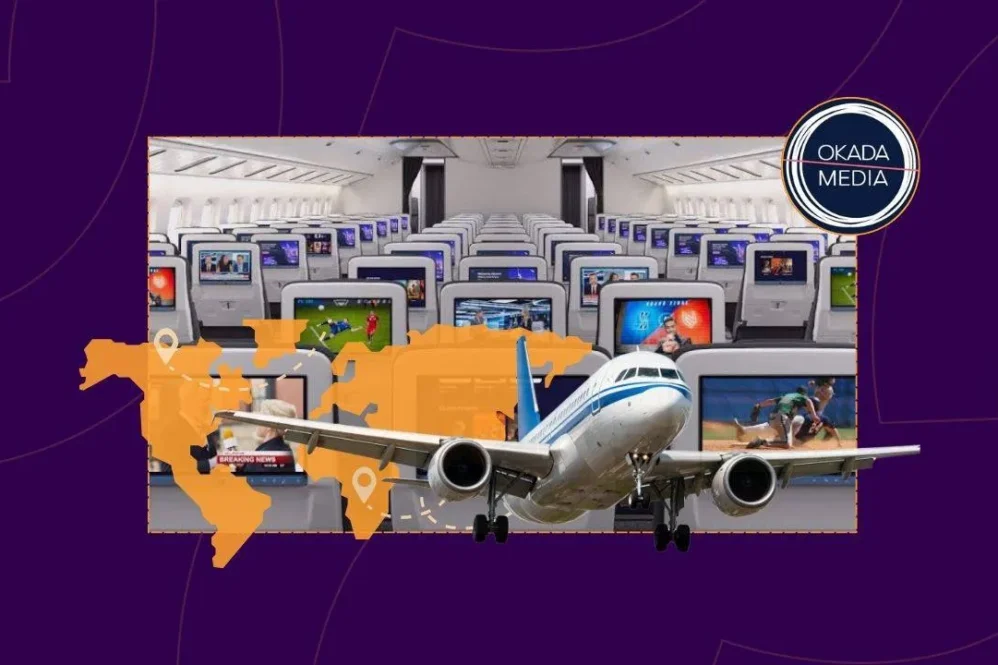
Streaming deals have dwindled. It has become a near-weekly chorus, if not on this publication, then across the wider industry. As distribution models shift and new platforms emerge, filmmakers are searching for alternative paths. Yet amid these changes, in-flight entertainment remains a distribution channel that has long existed but received little attention from most filmmakers—largely due to a lack of knowledge or understanding of how it actually works.
“Sometimes people don’t have airline deals in mind. You could also sign a contract with Amazon or Netflix and sign all those rights away,” says Serge Noukoue of Okada Media, speaking in the wake of the company’s late-2025 partnership with Nemsia Studios, as I sought to better understand the ABCs of in-flight distribution deals. Despite how visible in-flight entertainment is in our travels, there is a clear blind spot among filmmakers. On my own flights, African titles consistently appear in minimal numbers within airline catalogues. Yet in the air, almost everyone watches a film, even if it’s impossible to measure how many stay awake long enough to finish one. Still, it remains a channel where filmmakers are leaving significant money on the table, largely because it is rarely factored into rights strategies early on. This is a reality Okada Media recognised early.
(Click to Follow the What Kept Me Up channel on WhatsApp)
Okada Media is a distribution outfit best known for organising the NollywoodWeek Film Festival in Paris. Spotting an opportunity for both monetisation and visibility, the company began working seriously with airlines 3-4 years ago. Airline deals offer short licence windows and are typically non-exclusive and flexible, meaning films are not “trapped” in the way they often are on VOD platforms. “It’s not like you sell to Air France and then KLM is going to say, ‘No, I don’t want it’,” Serge reveals. In this sense, in-flight entertainment functions as a quiet but logical extension of film distribution. Crucially, however, if you want to sell your film to airlines like Emirates or Air France, you are not dealing with the airlines directly.
Through this work, Okada Media operates as a distributor between producers and the third-party agents that aggregate content for airlines. They do not deal with airlines directly. The third-party agents are responsible for scouting films and managing programming cycles, acting as the interface between distributors like Okada and the airlines themselves.
“The cycle is much shorter. Every two months or so they’re looking for new films,” Serge Noukoue explains. So, it offers a far quicker turnaround than cinemas or streaming platforms. Even so, only a small number of films ultimately make it onboard. Once interest does exist, what does an airline deal actually look like?
One key way airline deals differ from other film distribution agreements is the short licensing window. A film typically remains onboard for three to six months under an agreed flat-fee licence. There is limited room for negotiation, as pricing is largely driven by passenger data and interest. While these deals are rarely jackpot-level, their value lies in scale. The aim is not a single airline deal, but multiple ones. “That represents an opportunity, especially if you can multiply those deals, then at the end of the day it can really contribute to recouping your investment,” says Serge. In that sense, airline distribution offers a path to repeatable, stackable revenue streams rather than one-off paydays.
On a recent flight to Nairobi, I noticed that the African film library available onboard was markedly different from the one I encountered on my return journey less than a week later. With such rapid turnover, how do airlines—and the agents who programme for them—decide what stays and what goes within such a short window?
On a flight, it is difficult to tell whether passengers remain awake all the way through a film, often due less to the film itself than to general travel fatigue. So how is success measured? First, a passenger has to be interested enough to click on a title. Beyond clicks, airlines also track completion rates. This data is not typically shared with filmmakers, though it can be requested. In practice, renewal becomes the clearest performance signal. “If they’re coming back to keep your film, that means that people are really interested,” according to Serge. For the African films category to grow, African flyers must actively watch titles within it. But growth cannot rely on patriotic viewing alone. Broader passenger interest is essential, and that interest is often determined by presentation, an area where many films fall short.
I raised a specific instance with Serge. As a curious traveller invested in the industry, I decided to compare how African films are presented onboard with titles from other industries—particularly Hollywood, which dominates most airline catalogues. I scanned individual title pages, looking at the kinds of information meant to trigger interest: subtitles, language versions, synopses, credits, and overall metadata accuracy. What I found was striking. Several Nigerian titles were missing key information or contained incorrect details that could help a foreign passenger decide whether to click. On the flight to Nairobi, for instance, some Nigerian films had no synopsis at all, while general information in other languages—German, for example—was either absent or wrong. “Some people don’t really pay too much attention to this, but it’s quite important,” Serge explains. “If from first glance some things are missing or not up to par, you already put yourself at a disadvantage.”
I wondered, who failed to do their job in the distribution chain? For non-English-speaking travellers, accurate multilingual information is often the deciding factor. Addressing this gap, Serge explains that responsibility ultimately lies with the distributor, as airlines and their agents rely on the materials supplied to them. Rich, accurate metadata directly affects click-through rates; incomplete or incorrect information actively hurts discoverability. In-flight, first impressions matter even more. And beyond text, the film itself must also look good on a plane’s screen.
Airlines operate with specific technical standards, and format conversions come at a cost. Smaller screens place even greater demands on production value, making image quality more important than ever. Passengers often choose what to watch instinctively, guided by what looks visually appealing at first glance. When all these hurdles are considered, do airlines actively seek specific kinds of films? And does it matter whether a project leans fully commercial or more arthouse in nature?
When scouting for African films, airlines typically prioritise entertainment over arthouse, favouring vibrancy, accessibility, and strong image quality. It is therefore unsurprising that dominant markets such as Nigeria and South Africa remain high on their list. Beyond a film’s origin, however, travel-ready titles matter most—stories whose universality increases their value across borders. For many passengers, the flight itself becomes a rare moment to glimpse other worlds, and few mediums do that better than film.
This visibility often converts into something more tangible. Serge notes that viewers frequently send direct messages asking where they can finish films they discovered onboard, with airline exposure prompting searches on streaming platforms. In this sense, in-flight entertainment can function as a discovery funnel. For frequent travellers, airlines become a sampling space, particularly for audiences without consistent access to streaming services. As streaming deals continue to slow across the region, this additional channel of revenue and visibility matters more than ever to distributors and producers.
Filmmakers should not be overdependent on a single buyer, and the recent scaling back by streamers is proof of that vulnerability. Airline distribution offers producers a way to diversify revenue without being tied to exclusivity. “You can get five figures from one film on the airline circuit,” says Serge. “To get higher in that five-figure, you need to push.” He is also careful to stress that this is not replacement income.
In the case of Nemsia Studios and its exclusive output deal with Prime Video, not all rights were signed away; airline rights were left unlocked. This allowed the films to continue generating revenue through in-flight deals. Okada Media is acting as distributor for the production company, placing about 13 titles with airlines. Once again, airlines are an important supplementary channel. Notably, films can even premiere on airlines before they appear on VOD platforms, a detail filmmakers often overlook.
Serge also notes growing interest from non-traditional markets such as Vietnam, India, and Poland, as airlines increasingly chase diversity in their catalogues. This shift mirrors a broader trend visible across global film festivals, where African cinema is gaining more presence and attention because much of the continent’s storytelling potential remains untapped.
Film, in this context, becomes a powerful cultural conduit. Stories travel alongside food, fashion, and travel itself—often sparked by the simple act of discovering the right film onboard a diverse airline. The possibilities for cultural exchange are expansive. For example, recent Spotify data reports that Indonesia, Egypt, India, Philippines and Thailand are countries where Afrobeats has exploded since 2020. I imagine that listening to Afrobeats can lead to watching a film; watching a film can spark curiosity about cuisine, style, and place. Culture flows. Through in-flight entertainment, films—and the cultures they carry—can travel both literally and figuratively.
While airline deals cannot plug the industry’s larger distribution gaps, ignoring them costs filmmakers revenue, reach, and leverage. With the many pathways now available, distribution literacy is now a core part of filmmaking itself.
Become a patron: To support our in-depth and critical coverage—become a Patron today!
Join the conversation: Share your thoughts in the comments section or on our social media accounts.




1 Comment