
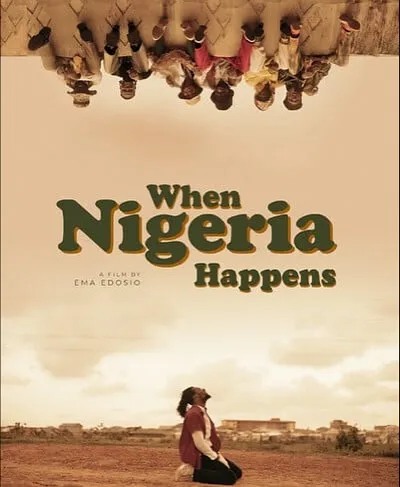
Nollywoodweek: In the final scene of When Nigeria Happens, we see how submission has been tortured into Fagbo as he mindlessly marches with a group of men, shorn of his former locs and despair sat on his face. Nigeria has happened to him and the film—part interpretative dance, part narrative feature—chronicles the chipping away at his personhood.
Directed by Ema Edosio Deelen (who co-wrote with Adebayo Oduwole), When Nigeria Happens elevates the cruel absurdity of a Nigerian existence through a struggling dance group slash quasi socialist commune trying to make it out of the trenches. It primarily focuses on Fagbo (played by Abella Domdom Dominic), the energetic leader of the troupe, and the stripping away of his self due to Nigeria’s suffocating nature.
(Click to Follow the What Kept Me Up channel on WhatsApp)
We’re introduced to the troupe dancing on the streets of Lagos, a pulsating techno soundtrack underneath. The camera is intimate with the roads and the people, yet those same people stop to stare — grounding and detachment held in the same frame. It carries this duality through the rest of the sometimes unevenly paced film, using dance to amplify emotional moments like when Fagbo’s mother goes missing and they’re unable to find her.
With this, When Nigeria Happens asks a lot of you when you come into it. For an industry whose audience has come to expect certain narrative comforts, it upends that with the way dance and movement propel it forward.
That movement, though, leaves most of the characters in the troupe behind. We only get true glimpses into Fagbo’s life because, to be fair, he’s the main character, but for a group that we spend most of the film with we know very little about them. The film’s form, a communal collective movement, is in tension with its individualized character focus. Despite that, the windows into Fagbo’s life are well constructed, his clothing is a constant rebellion and his love for Pocco (Ruth El Phygo Felix) is a fierce motivating force. We see it inspire and break him and a scene he shares with Senator Kalaro (the towering Alex Usifo) reveals the core of the rebellion and adds gravitas to the film’s ending.
Before that, we see the ways Nigeria does happen as the film chronicles the real trials of Fagbo. From his living condition, to his mother’s disappearance after he tries to get her medical care, to his run-in with the police meant to help him. We see the ways Nigeria is designed to break you. It’s this familiarity that permits the film to dance through moments in ways that would seem more puzzling in less capable hands. The film even presents a glimmer of hope for the crew when they’re hired for a music video by the artiste Evian (played by a surprisingly good Jidekene Achufusi in a small role different from his usual work) who has eyes for Pocco. This leads to one of the film’s more meta moments that could be read as the clashing of two systems, the ways their praxis holds a weaker position in a world that does not practice its theories: their belief in collective ownership is tested by a capitalist system that hinges on individual brilliance.
With movement direction by Qudus Onikeku, When Nigeria Happens asks more of the body than a conventional film and it sometimes delivers that. The chemistry of the group is felt most in their choreography and the pidgin they converse in is more passable than many other Nollywood films. There are moments it loses rhythm, but they often find it soon enough. This expertise continues in the way the film is shot, it’s continuously kinetic with the camera always catching up with constantly moving characters and framing through the window of their home by the ocean, emphasizing a hopeful freedom as the third mainland bridge dots the horizon.
When Nigeria Happens is speaking to the anxieties of a nation on the verge of collapse and it’s not doing that in a conventional language, this is both its strength and its weakness. Our cinema cannot continue to play the violins while the ship sinks and this is a worthy entry that gives our societal ailments names and reminds us that sooner or later, Nigeria might take the life out of our eyes.
Produced by Citygates Film Production, When Nigeria Happens screened at NollywoodWeek 2026. Currently self-distributed on Ema Edosio’s personal website.
Become a patron: To support our in-depth and critical coverage—become a Patron today!
Join the conversation: Share your thoughts in the comments section or on our social media accounts.
Side Musings
- All their names being street slang was a nice touch.
- The people part of the political rally refusing to answer him really drove home the point of how Nigerian politics ignores the masses.