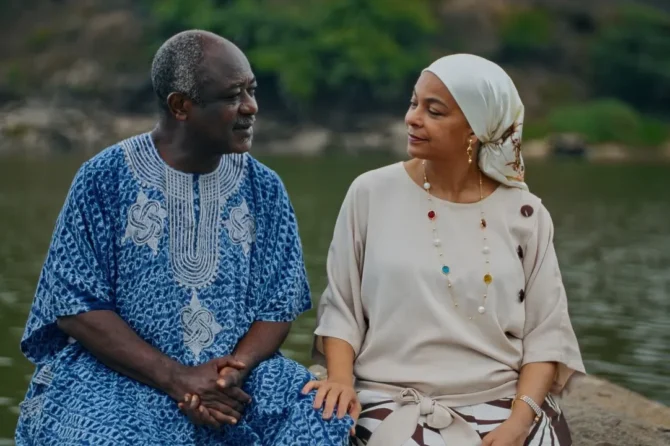
Nollywoodweek: There is a familiar thrill that runs through Batwing Unmasked. Not the thrill of a recognition of a hero (Africa has had many, and visual and comic artist Loyiso Mkize highlights Ororo as an example that existed long before Batwing), but the thrill of seeing that hero argued over, questioned, admired, second-guessed, and even resisted by the very people he is meant to represent. Thomas Letellier’s documentary is less about glorifying Batwing and more about opening a dialogue around him, or at least that is how it comes across to us. These conversations stretch across Dakar, Nairobi, Douala, Cape Town, Kinshasa, and beyond, with participants not exactly gathered in the same physical space or immediately aware of what their counterparts across borders are saying about the project in real time. The result is a film built on distance, but held together by a similar curiosity, the similar question of what it means for Africa to have its own Batman.
(Click to Follow the What Kept Me Up channel on WhatsApp)
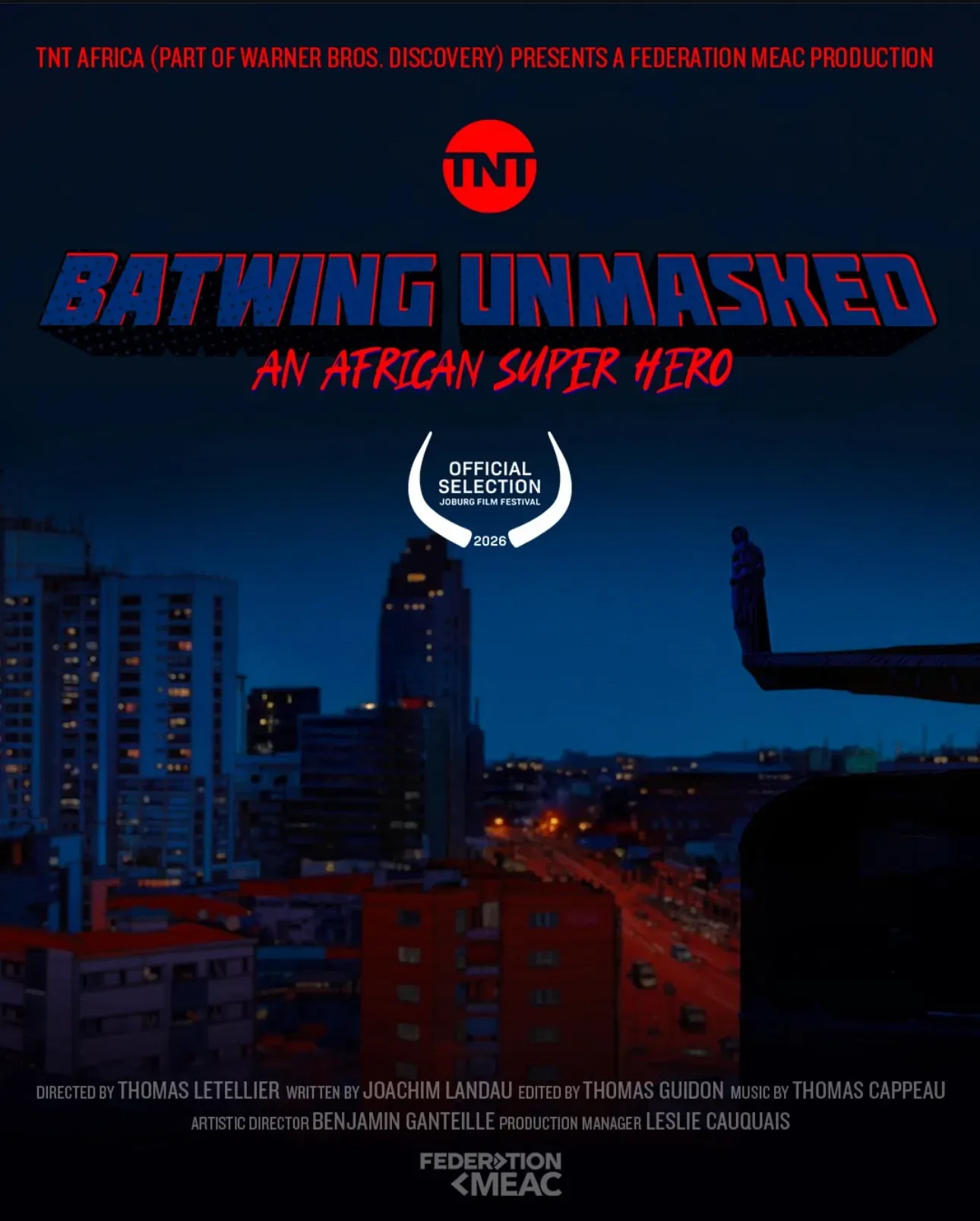
The Batwing of DC Comics, as the film reminds us about fifteen minutes in through the voice of its writer, Judd Winick, is first David Zavimbe, a Congolese police officer recruited into Batman’s global crime-fighting network. Armed with a high-tech suit gifted by Batman himself, Zavimbe becomes a kind of “Batman of Africa,” confronting corruption, warlords, dictators, international villains, and systemic violence across the continent. His story is marked by trauma: a childhood as a soldier, a life shaped by loss. Eventually, he relinquishes the mantle to Luke Fox (the son of Batman’s business manager Lucius Fox who is also an engineer and fighter from Gotham city) whose version of Batwing shifts the character’s trajectory toward a more global, technologically driven arc. It is a premise that merges familiar superhero mythology with an African setting, though not without complication.
It is these complications that Batwing Unmasked patiently excavates.
The documentary opens with scattered but thematically linked reflections. In Dakar, content and podcast creator Lamine Diallo recalls his childhood obsession with superheroes, hoping, at one point, that a spider might bite him and turn him into Spider-Man. Beside him is comic creator A.L.A.N who calls comics “an escape… a world to lose yourself in.” In New York, actor Chukwudi Iwuji remembers believing he could develop powers to take flight if only he ran fast enough.
As the conversations deepen, so do the strains. In Nairobi, filmmaker Likarion Wainaina (Supa Modo) defends the comic’s “darker” choices, arguing that superheroes require traumatic origins, and when one thinks of Africa in that context, it is usually one of two things: corruption or disease. He thinks disease was an easy, good choice. On the same table with him is producer Carol Kioko, who pushes back, arguing that “If this was 1987 when AIDS was rampant…” then maybe she would’ve understood that choice. She further argues that the story is set in 2011, and the decision to root David’s story in disease in a contemporary context is quite questionable, especially as there’d been scientific development in the management of AIDS that had spread through Africa at the time. Why, she asks in essence, must African narratives default to suffering? In Cape Town, actor Suraya Santos sharpens this critique by asking “Which superhero loses their parents to AIDS?”
Further into the documentary, viewers find that the character’s suffering becomes a serious point of contention. A.L.A.N suggests that David’s hardships edge toward excess, toward the “unreal.” Lamine adds that “heroes tend to suffer… but at some point, they get satisfaction… I feel like David never had that moment.”
Elsewhere, the film reveals fractures of a different kind. In Cameroon, Congo, and Senegal, participants question the authenticity of the characters’ naming: why does a Congolese family bear what sound like West African names. Visual artist Njoka Suyru likens it to “creating a show in Paris and giving the characters names like Wilson.”
Still, the documentary is careful to not collapse into outright rejection. There is admiration, too. Many participants praise the realism of the police scenes, the physicality of Batwing’s build, especially the suit itself, some saying that they prefer it to Batman’s. Even here, there is resistance. Lamine, again, wonders why the suit feels so detached from African identity. “Too high tech,” not rooted enough in aesthetics local to African culture. If not for the name David Zavimbe, he notes, the character could easily be mistaken for a “Jordan or Johnson.”
Joachim Landau’s strength lies in how he orchestrates these voices through his script. The film’s structure—cutting between countries, pairing some participants while isolating others—feels both fragmented and cohesive. The intermittent animation, briefly transforming the speakers into stylised cartoonish figures before returning them to their real selves, is a particularly effective device. It mirrors the very tension the film explores, the very aesthetics of comic books.
Visually, the documentary is assured. Clean compositions, thoughtful editing, a confident use of space between conversations. There is a clarity here that the comic itself, at least as described by its readers, does not always achieve.
Maybe Batwing Unmasked’s most visible achievement is that it does not try to resolve the contradictions it presents, but to allow them to sit, to rub against each other. The question of David Zavimbe’s disappearance, of why he gives way to Luke Fox, remains unsettled, with some seeing it as narrative convention and others as a troubling suggestion or succumbing of Africa’s irredeemability. Even the comic book writer’s own defence that the goal was “to change minds, not the world,” feels less like a conclusion than an opening.
Produced by Federation MEAC for Warner Bros. Discovery France, Batman Unmasked screened at NollywoodWeek 2026.
Become a patron: To support our in-depth and critical coverage—become a Patron today!
Join the conversation: Share your thoughts in the comments section or on our social media accounts.
Side Musings
- The Batwing suit is unanimously loved, but maybe that’s because, as Appolonia Otam quips, “you can’t ride a Batmobile in Douala.” After all, our roads are far too good for Batwing. You wouldn’t want him stuck in crazy traffic or dodging potholes.