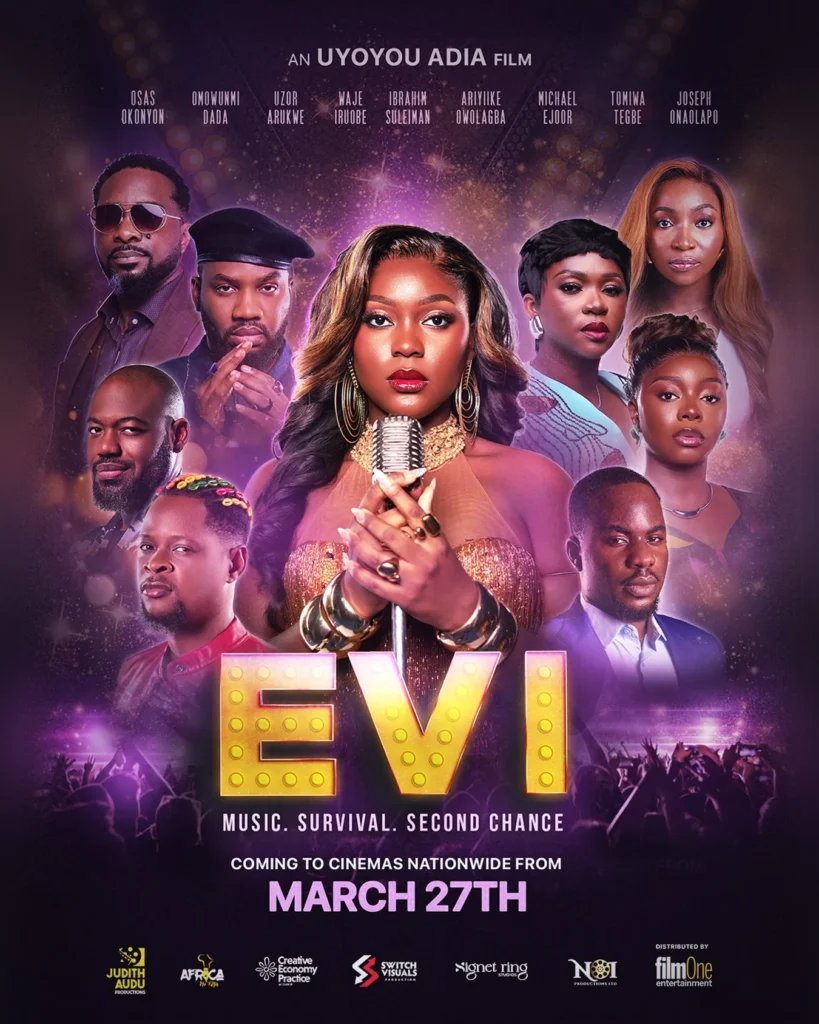
NollywoodWeek: As the internet has grown, we have found some familiarity with the machinations of the entertainment industry; people talk like record label executives, giving armchair expert advice on album rollouts and PR relationships and calculating streams. This is encouraged by our music reaching new global heights, with Nigerian projects charting around the world and tours stopping at every city except ours. Uyoyou Adia’s Evi arrives at a perfect time amidst all this, as it follows the fall of the eponymous singer whose label drops her and her struggle to rebuild her career. It attempts to take you behind the scenes of an artiste’s public persona, but unfortunately reveals nothing new, navigating its well constructed structure with a heavy-handedness.
(Click to Follow the What Kept Me Up channel on WhatsApp)
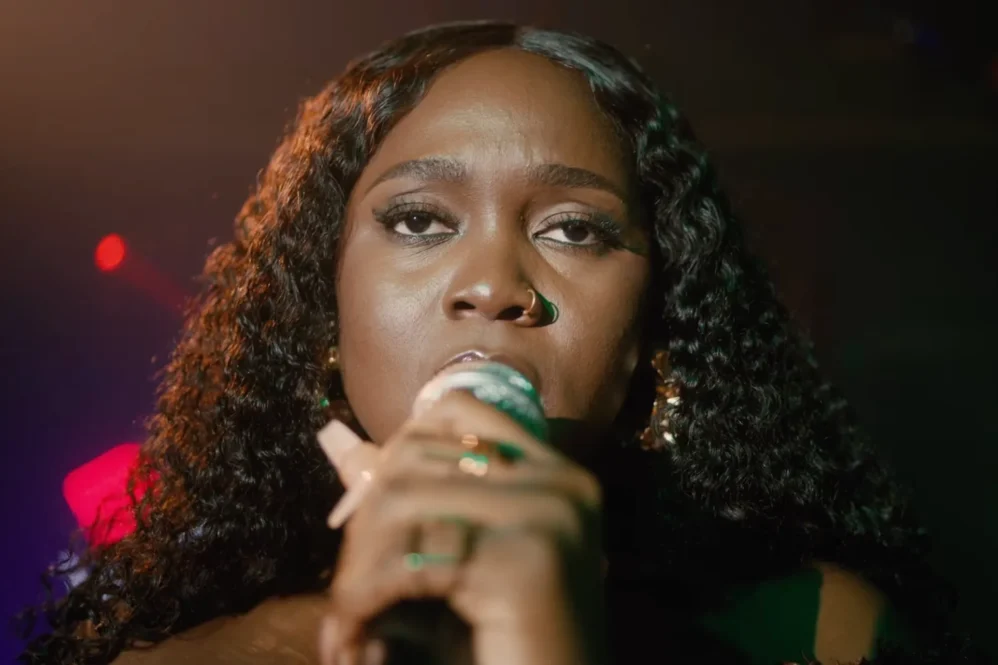
We meet Evi (Osas Okonyon) during a high energy performance of her song, “Evi The Superstar”. The presentation of an artiste within a film is subject to a double layer of scrutiny: has the film done enough to create a world where this pop star exists, and does this pop star present in a believable way? With Evi, there is a genuine effort that is stifled by overzealous vocal production and chaotic costuming. Her first appearance is her best appearance; the song is simple but catchy and her makeup is flamboyant enough for a performance of that sort. To crown it all, she struts down the stage with the carriage of a person waited after constantly. After that, we struggle to connect with the rest of the pop stars the film gives us.
From there on, we’re on a downward spiral with Evi. She’s dropped by her label, and her abrasive personality is revealed as an act the label has encouraged. This characterization confers her a perfection and naïveté that weakens the arc. We’re asked to empathize with her because she didn’t know better, when a more effective journey would have let her be a manifestation of the rot of fame. The film saves itself by having a clear plot structure: the main storyline follows Evi, supported by a B plot centred on a once-prominent manager, Kola, who broke out a major star but is now down on his luck, battling alcohol and gambling, and a C plot involving another music star, Dayo, whose soft public persona masks a darker, egoistic inner life. Sometimes the plots meet at important moments, propelling each other—Evi becoming Dayo’s muse and Kola’s gambling almost costing Evi a huge opportunity, but they fizzle out towards the end of the film.
Evi posits its most interesting idea with one of the plot points: the captured muse. Dayo (Ibrahim Suleiman) shows up in this film and drags everything into his orbit, his music is the most important thing in the world and inspiration rests in the hands of a beautiful woman he never lets out of his sight. As one woman leaves, Evi enters in a bid to save her career and where a subtle manipulative dynamic should have existed we get an overacted, repeated textual performance encouraged by subpar writing. He constantly repeats “you’re my muse” till it starts to grate and we lose the film’s best idea. With many Nollywood films there is a distrust of the audience that may be as a result of fear or lack of expertise. Anyway, this ends up dulling the sharpest part of the film.
On the performance front, we get best efforts all round that don’t translate all the time. Osas Okonyon (Makemation) in her debut lead role as Evi is selling the ups and downs of her character, she stands out when she performs a ballad at the bar she now works in. Distracting auto-tune aside, she drags you down to this low moment with tears and regret on her face. She shares many scenes with her best friend, Onome, played by Omowumi Dada (Meeting Funmi’s Parents) who perfects the supporting character role. On the other hand, we have Ibrahim Suleiman (Up North) as Dayo who doesn’t know when to reign in the extra and whose sinister reads as goofy. Uzor Arukwe’s Kola finds his footing as the failed agent turned gambling drunkard. His presence is guaranteed in any Nollywood film these days and fatigue is beginning to set in, but he buys himself some time with this role.
Where Evi falters is where Nollywood as an industry continues to falter. The sameness of the production design doesn’t confer any character to place and time. Evi’s fall from grace to sharing a flat with Onome carries no real visual effect on a viewer. The house has the sterile, distant polishness of new Nollywood sets, especially considering the fact that Onome works as a waitress in a bar. This isn’t helped by costume design that sometimes leans more towards Lagos wedding than afrobeats industry, and Ibrahim wears a top or blouse or shirt in one scene that can only be described as fascinating.
Evi, losing steam in its conclusion with unearned character redemption and a final song I’ve already forgotten, arrives at the plateau of afrobeats global dominance. Tems just performed with Justin Bieber at Coachella amidst other appealing Afrobeats to the World moments that have built over the years, and Nollywood has been asking itself how it can tap into this global attention on its sibling industry. This seems like an attempt at answering that, a fair undertaking that exposes the quality ceiling we must break if we want to influence beyond our borders.
Produced by Judith Audu Productions in collaboration with Switch Visual Productions, Signet Ring Studios and NOI Productions, and distributed by FilmOne, Evi premiered in cinemas on March 27. It had its international premiere at NollywoodWeek Film Festival 2026.
Become a patron: To support our in-depth and critical coverage—become a Patron today!
Join the conversation: Share your thoughts in the comments section or on our social media accounts.
Side Musings
- We find out the label was buying streams for Evi early in the film and it reminded me of all the artistes people have accused of using streaming farms.
- I liked that Kola’s gambling problem was portrayed using Whot. None of that oyibo poker, my man was trying to use “pick two” and “general market” to pay off his debts.
- There’s a scene where Onome was smoking a cigarette outside her job and I think we need to bring back the old Nollywood recipes because nobody knows how to smoke a cigarette in film anymore.