
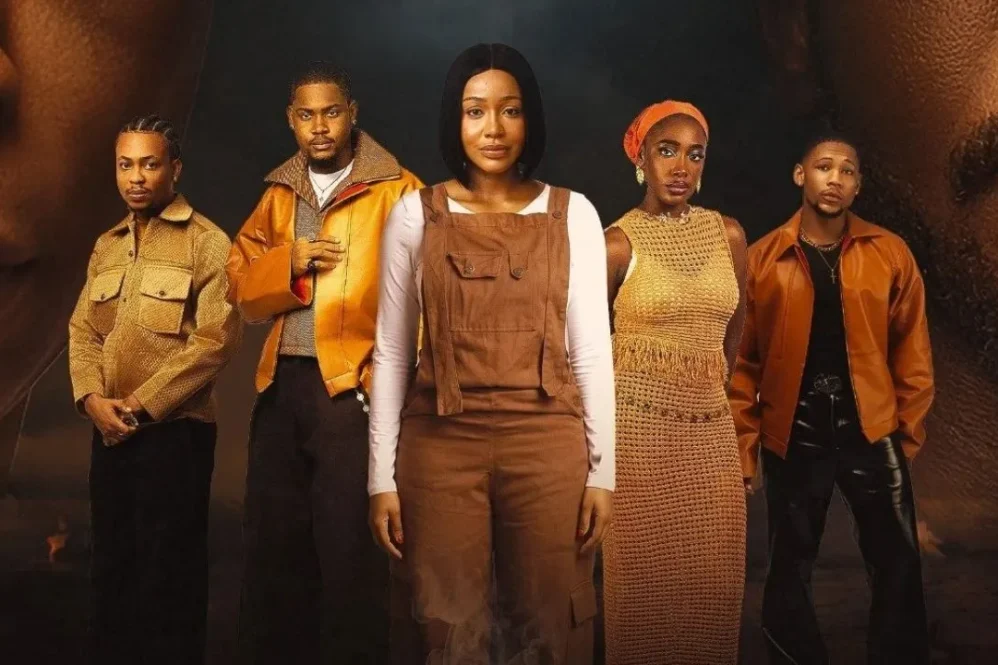
Within the expansive landscape of Nollywood’s self-anointed maestros and magic makers, Akay Mason is one of the interesting ones. When he’s not reaching for magniloquent concepts that grasp at nothing, as in Day of Destiny (2021), he is rendering familiar narratives with a fanciness that is enchanting only as sandcastles are to children, as in Ada Omo Daddy (2023) and Red Circle (2025). Other times, an Akay Mason film reaches for grandeur extratextually, as in the Ini Edo-produced A Very Dirty Christmas (2025)—better known for its CAN controversy than anything else. Akay certainly continues to conjure magic across his filmography; slight as its enchantment may be, it is magic nonetheless. In his latest, Five Figurines, he does what Akay Mason will do: reach for grandeur. What does he grasp?
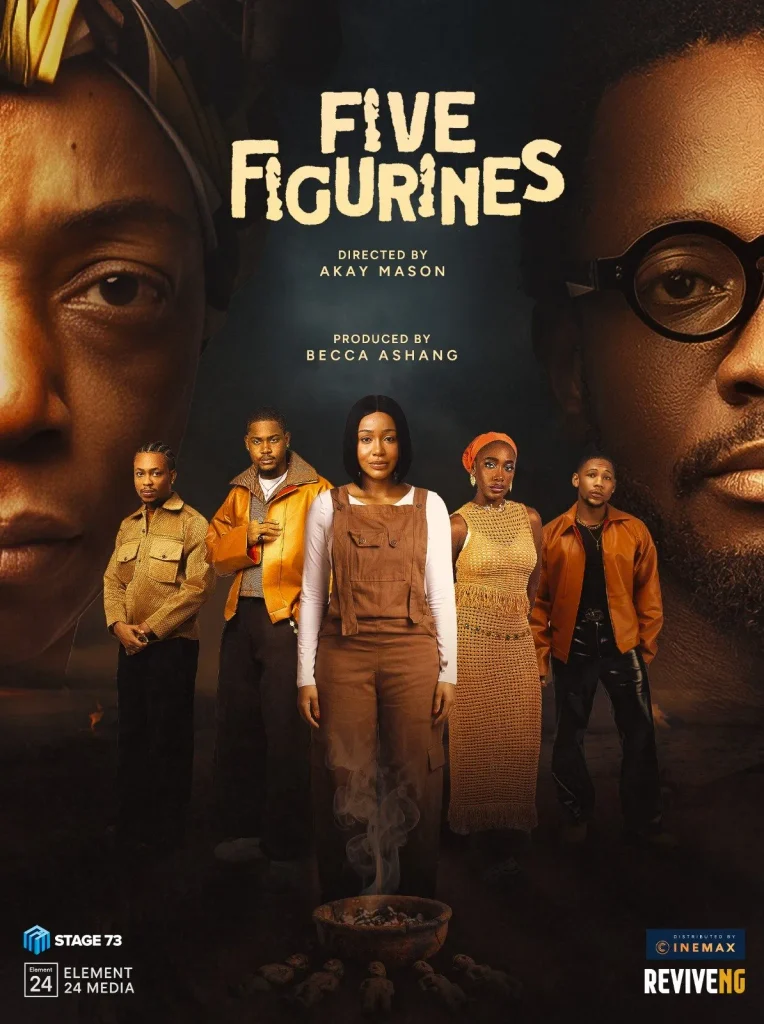
Contrary to what its title may have suggested, Five Figurines, written by Stephen Okonkwo, is not Kunle Afolayan’s The Figurine multiplied by five. In fact, from memory, Afolayan’s film may have had more physical figurines. Both films have figurines that can affect the material world, at some point center on students, feature a love gone wrong, and where Afolayan blurs the lines between the supernatural and psychological, Akay privileges the former. The film’s premise is quite simple. Ebi (Bimbo Akintola), an everyday woman, becomes bent on payback and wages war against a clique of Nigerian elites—and their children—for their involvement in the tragic cover-up of her son’s death. The elaborate building blocks of Akay’s newest thriller— a star-studded ensemble consisting of both veterans and the new school, a chain of vengeful murders, a bloody feast of worlds, a pageantry of sets—all compete for a greater sense of enchantment, as though to compensate for its lean but still entertaining premise.
Five Figurines takes no time to shock. Very early into the film, a stupid fight, as the film’s characters rightfully call it, ensues amongst six university students, but the immediately affected is Innocent (Chimezie Imo), who falls, hitting his occiput on a rock. From here on, all we have is Akay conjuring one magic after the other. But before Akay’s show, we become acquainted with a few things: Innocent is from a modest background and his lover Grace and her unfriendly friends are higher on the food chain as the ever-arrogant Richard (Clinton Joshua) puts it. Here, we know that a clash of social classes is certain. The elite will flex their mint-muscles to evade responsibility and save face; the common man will protest for justice, but in a nation such as Nigeria, where justice remains out of reach, injustice naturally takes its place. And it is precisely for this that Ebi—an archetypal, self-sacrificing sole-parent of an only child—becomes a Mephistophelian retaliator, abandoning her Catholic faith for a more reactive supernatural terrain. This trajectory is illustrated in a rather condensed manner. Surprisingly aware for an Akay Mason film, Ebi drops her rosary right before entering a coven.
Power, both material and supernatural, is a primary theme in Five Figurines. The film possesses a nuanced understanding of power dynamics, though it asserts those of the elite too didactically through its dialogue, doubling up on vocalized illustration where visual cues would suffice. We know the havoc politicians and the well-connected can wreak upon the everyman, so when Grace (Uche Montana) repeatedly references their status—these people are powerful—it begins to tell too much. But it understands the dynamics and illustrates nonetheless. The film also provides a useful analogy through Richard’s dialogue, where he warns Grace to tread carefully because her police commissioner father is low on the food chain. Here, power is thought to be predatory. The higher you are on the food chain, the more prey you have. Even so, it is worth noting that the film obscures the political landscape that its characters inhabit, but it can also be said in effect that it keeps its narrative focused. Much of what unfolds is a common phenomenon in Nigerian society. We already have context.
All that can be expected from the wrath of a mother whose only child has been snatched from her under unjust circumstances, and whom justice has forsaken, can be distilled in two words: ruthless, unrelenting. And Ebi’s ethos is thus: an eye for every eye that witnessed, but has remained silent. But how Akay orchestrates his world of moral complexities, psychological tests and supernatural justice cannot be apprehended merely by his filmography. Here, there is discernment in grandeur, restraint in flamboyance. He who enchants the child is beginning to attract its father’s curiosity. The supernatural is sacred, but not to the point of fetishism; that is, the physical interacts with it legibly, and yet retains its mystery.
Bimbo Akintola is Ebi and Ebi is Akintola. But since Akintola precedes Ebi, her embodiment of the character’s many dimensions deserves close attention. Most indelible is her menacing demeanour when she diagnoses Aisha Usman, the affluent mother of one of our six brawling students—“you are afraid”—and prescribes, “you should be very afraid.” Or her deadpan calm as she lurks around two funerals for deaths she had curated. Akintola moves across Ebi’s joyous, grieving, and brutal registers with remarkable fluidity, yet Ebi remains Ebi. She doesn’t stop being a powerless old woman whom the precarity of life has pushed to exhaustion; her material precariousness is merely compensated for an even costlier spiritual strength. She can be arrested and imprisoned. But she can also wreak havoc in ways uncommon to her material condition.
Equally interesting is rest of the film’s star-studded ensemble— including Ini Edo (Shanty Town), Odunlade Adekola (Elesin Oba), Ireti Doyle (The Origin: Madam Koi-Koi), Nkechi Blessing, Emeka Nwagbaraocha (Far From Home), and Gbubemi Ejeye (Farmer’s Bride). The performances mostly embody the weight of the narrative. When it doesn’t, it is functional. Our familiarity—or over-familiarity—with the performers does not dampen the seriousness of their performances, nor does their assumption of familiar screen personas. A star-stuffed cast poses the challenge of managing and integrating competing screen personas of established performers into a narrative-serving whole. A director’s achievement lies in resisting the urge to turn their narrative into a spectacle of celebrity, making its stars serve the film. Akay is not new to assembling an ensemble, only that this time it’s an interesting one.
Akay Mason’s films are marked by their colourful visuals. Although, very often they border on forceful and empty flamboyance, serving only a shallow perception of visual competence. As seen in the festive showiness of Mercy Aigbe-produced Ada Omo Daddy, incapable of concealing, as Nigerian critic Vivian Nneka Nwajiaku calls it, its “deadbeat fantasy” narrative and the suffocating blood-red setting of Nora Awolowo-produced Red Circle. The flamboyance in Five Figurines is present in the beguiling scene where Innocent appears to Esther in a dream, in the spectacularly choreographed death sequences, and in the entirety of its visual world. They are not less histrionic either, but they’re dramatic without being distracting. That is, they are employed convincingly to serve the narrative.
Five Figurines is Akay’s debut as a producer, and the feature debut of his Element24 Media banner, serving as co-producer, with Becca Ashang as main producer. This, more or less, suggests a greater degree of artistic freedom, and there surely is much excitement to find in an artist’s autonomy—or more precisely, in our case, a ”magic maker” making magic on his own terms, but it is too early to make big statements about Akay’s newly found creative freedom. At the same time, it is certainly no big statement to say that Five Figurines is Akay Mason at his most magical; his first that doesn’t merely think itself to be interesting, but is genuinely interesting.
Five Figurines is a production of Stage 73, and Element 24 Media, distributed by Cinemax in cinemas from November 13.
Become a patron: To support our in-depth and critical coverage—become a Patron today!
Track Upcoming Films: Keep track of upcoming films and TV shows on your Google calendar.
Side Musings
- He really made magic. Fake it till you make it kids.
- First time seeing an entire theatre audience genuinely satisfied after a viewing. Really looking forward to what he produces next through Element24.
- The last two films I reviewed have both featured Hausa matriarchs (the other being A Land Apart). Stay with me as I embark on a Nollywood Hausa matriarch watch.
- Number Five as a recurring motif in the film is well played.
- Adam Garba, yet again, plays a uniformed man capable of fishing out the truth when all else fails.
- Aisha Usman is such a good woman for trying to protect the other children, even after her own daughter kisses Ebi’s vengeance first.


