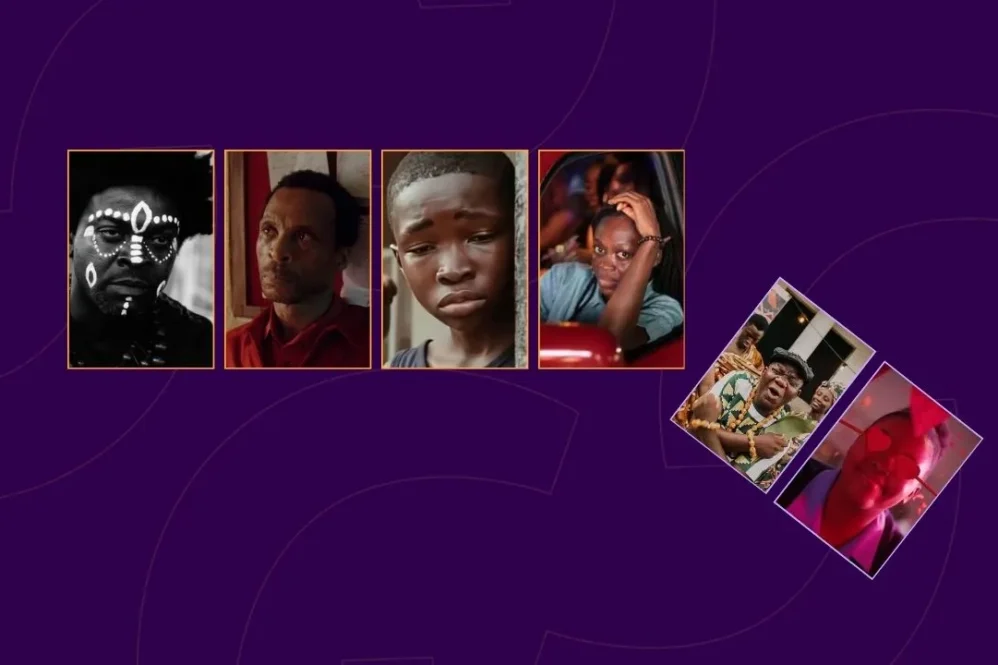
A girl with a big smile plastered on her face is surrounded by heart-shaped decorations. She is bathed in a warm, saturated red and pink light that evokes a romantic atmosphere. Heart-shaped props are held in front of her eyes like novelty glasses, and small heart confetti appears to drift through the air, the omnipresence of hearts and literal obscuring of the eyes seeming to comment on the all-consuming, blinding nature of love. This unbridled joy is precisely what makes Black Burns Fast so remarkable. A coming-of-age Afrobubble gum film that centers black joy in a queer high schooler is, by the standards of African cinema on the world stage, a rare occurrence. Directed by South African Sandulela Asanda, it screened at the 2026 Berlinale, showing the world that African films without heavy, grim themes can exist. My question is, why is this a rare occurrence?
African filmmakers have been persistently earning their place in the Big Five conversation, which include Venice, Cannes, Berlin, Toronto, and Sundance. A pattern emerges when examining the majority of films that have broken through, starting with recent Nigerian milestones. In 2019, Joel Kachi Benson’s Daughters of Chibok made history as the first Nigerian film to screen at Venice. Its subject was the mass abduction of schoolgirls by the terrorist group Boko Haram. At Berlinale, in 2020, the Arie and Chuko Esiri’s Eyimofe screened, a moving portrait of migration and the desperation it breeds. A black and white folkloric thriller centering themes of power and tradition, CJ Obasi‘s Mami Wata premiered at Sundance in 2023. And most recently, Akinola Davies Jr.’s My Father’s Shadow became the first Nigerian film in an official Cannes selection, a story set against one of Nigeria’s most painful political ruptures, the elections of June 12, 1993. The throughline is hard to ignore. Each of these milestone films carries the weight of trauma, politics, or social crisis. Joy, it seems, has not been considered a ticket in.
Looking beyond Nigeria, Sundance is one of the most frequented Big Five destinations for African cinema. Let’s consider what gets championed. Noah Deshe’s White Shadow (Tanzania, 2014) follows a child hunted for his albinism. Softie (Kenya, 2020) trails a political activist torn from his family. Sembene! (2015, Senegal) mourns a misunderstood legend, the known father of African cinema. The 2025 lineup offered more of the same texture: Khartoum, a Sudanese documentary set against the backdrop of war; How to Build a Library, rooted in the grief of what colonialism erased. And in 2026, Troublemaker, Kikuyu Land, Lady, and Birdie (a UK-US co-prod ) continued the trend.
These are films that are, by design, not easy to watch. It begs another question: is suffering the only lens through which African cinema earns recognition on the international stage? But the question doesn’t end there. What does this pattern reveal about how Africa is represented in global cinema? And perhaps more importantly, what does it say about what our own filmmakers believe the world wants from them?
This year at Sundance, I watched Paloma Schneideman’s Big Girls Don’t Cry (New Zealand). It is an unhurried portrait of a 14-year-old discovering desire, learning what it means to be wanted and to belong. It immediately brought to mind Sean Wang’s Didi (Sundance, 2024), an American coming-of-age film about a Taiwanese-American boy teaching himself to skateboard while quietly figuring out how to love his mother and navigate his new friends. Both films stirred something personal in me, like the time I sprinted ahead of my mum on the street so the cool kids wouldn’t clock me as a mummy’s girl.
Why don’t we see more and more African films like them at major festivals?
Where are our stories of joy, of how we love, aspirations untethered from survival or struggle, what we do when nothing tragic is at stake? Where are the films that trace our becoming, our curiosity, our navigation of class and ambition (even beyond pure lighthearted films), the way Parasite did for Korean cinema? Why does the lightness of our existence remain so absent from the world’s biggest screens?
One film that may have benefited from this lightness is Olive Nwosu’s Lady (a 2026 Sundance world premiere). From the opening, we are dropped into Lagos’ relentless hustle culture, and it is one of Lady’s passengers who best captures its philosophy: “Hustle? No be to take wetin you get, get wetin you want?” The film follows its eponymous lead (played by Jessica Gabriel’s Ujah), who seeks peace after sex work has irrevocably shaped her life, even as it continues to shadow her steps. For a while, the film honours that interiority— her unique experiences as a taxi driver in Lagos, her longing, the small dignities she carves out for herself. But when Seun Kuti’s revolutionary voice erupts onscreen, calling Nigerians to fight for their country, we are jolted out of the personal and into the political. The film, as film critic Seyi Lasisi puts it, becomes “a call for revolution.” And in answering that call, Lady leaves its most intimate questions unanswered. Does she ever find peace? Does she allow herself to desire again? The film withholds, turning instead toward the external, the city, the weight of a country that refuses to leave her alone. Her inner life becomes a casualty of the larger political world pressing in around her.
(Click to Follow the What Kept Me Up channel on WhatsApp)
The 2026 Cannes Film Festival, running from May 12 to 23, is no different. Of the three African titles selected for the Un Certain Regard official section, each carries the familiar weight. Ben’lmana, by Rwandan director Marie-Clémentine Dusabejambo, follows a survivor of the 1994 genocide. Rafiki Fariala’s Congo Boy traces the story of a Congolese refugee struggling to support his siblings through music amid a violent socio-political crisis. Moroccan director Laila Marrakchi’s Strawberries examines the exploitation of Moroccan women working as strawberry pickers in Spain. All three are urgent, necessary films. But they are also, without exception, films about suffering, and their collective presence at Cannes is less a coincidence than a confirmation.
Some exceptions do exist. Rafiki, the first Kenyan film to screen at Cannes, is at its heart a radiant film. A tender story of two girls falling in love, even if the political hostility surrounding queer life in Kenya casts a shadow over it. Ghana‘s The Fisherman (premiered at Venice 2024) offers a satire in which a retired fisherman partners with a sarcastic talking fish, using absurdist humour to interrogate the tension between modernity and tradition. Tunisia’s Where the Wind Comes From (premiered at Sundance 2025), a coming-of-age story about two young people who embark on a road trip and encounter a mix of challenges captured through a funny lens.
Then, there is Rungano Nyoni, a Zambian filmmaker who has found a way to hold seriousness and wit in the same hand in both I Am Not A Witch and On Becoming A Guinea Fowl. In her Cannes-premiered films, humour is not relief from the darkness, but the lens through which the darkness is examined. These films prove the range that exists in African cinema. The problem is not ability or imagination, but that these exceptions remain scattered and rare, in a conversation that should by now be more crowded.
A case can also be made that joyless films dominate festivals across the board, not just in African cinema. But there is a meaningful distinction worth drawing. Films like Jordan Peele‘s Get Out (Sundance 2017) and Celine Song’s Past Lives (Sundance 2023) carry serious subject matter–racism and the dislocations of migration respectively–yet neither is reducible to its premise. Get Out is remembered first for its cerebral body horror and its unsettling navigation of the metaphysical; the racial allegory deepens it without defining it entirely. Past Lives lingers in the memory as a meditation on love and its insufficiency, the immigration context present but not consuming. The serious African films that have made it to major festivals rarely afford themselves this complexity. Their entire premise: the genocide, the crisis, the exploitation, the bad government, if not radically experimental, is the film. There is little beneath the suffering, or at least, little that the world gets to see.
This is also not the full picture of what these festivals celebrate from non-African filmmakers. Killers of the Flower Moon, which screened at Cannes in 2023, is built around one of American history’s most devastating atrocities, the systematic murder of the Osage people, yet Scorsese uses that history as the foundation for a sprawling study of greed, complicity, and self-deception. The atrocity is the backdrop. And surrounding such serious films are lighter ones, such as Anora, a film about a sex worker and a fleeting marriage, which won the Palme d’Or at 2024 Cannes and swept the Oscars, taking home Best Picture, Best Director, Best Actress, Best Original Screenplay, and Best Editing. These festivals clearly hold space for the full range of human experience. Yet, African cinema, in the eyes of those selecting it, seems to occupy only one end of that range.
In a 2024 Guardian article, Oris Aigbokhaevbolo makes a case for African joy, arguing that the festival circuit’s fixation on suffering reflects the “narrowness of the western gaze,” not a failure of the films or their makers.
It’s a persuasive argument. But it’s worth sitting with yet another layer to the question: is the Western gaze entirely to blame? Consider what might be called for the purpose of this essay, the Festival Feedback Loop. Festivals have historically rewarded certain kinds of stories. Filmmakers, consciously or not, have taken note and shaped their work accordingly. Those films dominate submissions, get selected, and the cycle reinforces itself. Thus, the question worth examining is not whether these festivals are closed to joyful African stories, but whether we have simply stopped trying to find out.
But perhaps this singularity of our stories across major film festivals is inevitable. With most African countries mired in corruption and failed leadership, maybe these themes are simply how we process our reality. But if the fundamental purpose of film is to tell a story, is it too much to ask that our stories on the world’s biggest platforms show us simply living? Just being? And if such films were made —stories of ordinary joy, mundane heartbreak, everyday intimacy —would they even make it into official selections?
Many questions have been raised in this essay, and some answers may already be taking shape. At the S16 Film Festival, a growing community of Nigerian auteur-driven filmmakers is telling precisely some of the kinds of stories this essay mourns the absence of. Just last year, Uzoamaka Power‘s Siraam, a Zikoko coming-of-age film, traced a young woman quietly reckoning with what it means to become herself. Then, there was S.A.D Alaka’s About Sarah, an animated film termed as a “pretentious thesis on love.” These films are being made, and slowly, they are being consumed at festivals at home. They just rarely travel.
The most obvious barrier is craft. Strong stories that are not rooted in misery exist, but production quality, sound design, and the technical finishing that transforms a good film into a festival-ready one remain significant gaps. Yet pathways are beginning to open. The partnership between S16 and the Clermont-Ferrand International Short Film Festival—one of the most prestigious short film events in the world—saw four Nigerian indie filmmakers screen their work (and pitch) to an international audience. It is a nudge in the right direction. The Festival Feedback loop can break, but only when joyful African stories are not only made, but made well enough, and connected widely enough, to travel.
The pipeline between diverse local storytelling and international recognition is broken, not empty. And what is also needed is investment in training and infrastructure, in the kind of mentorship that may help an indie filmmaker with a great joyful story also become a filmmaker with the tools to tell it at the highest level. If that gap closes, even gradually, the stories will follow. And when they do, the question will no longer be whether African cinema can offer the world something beyond suffering and experimentals. The answer, like several other Black Burns Fast-esque films, will simply be on the screen, possibly landing wider and quicker distribution. Then, no one needs to “allow” us to tell our joyful stories, we simply have to create, as we’ve historically always done.
Become a patron: To support our in-depth and critical coverage—become a Patron today!
Join the conversation: Share your thoughts in the comments section or on our social media accounts.