Film Africa: History has always been unkind to women, and Damilola Orimogunje’s Dear Ajayi understands this, albeit in an overstated way. In his sophomore outing, which follows two estranged sisters “forced” to live together while caring for their ailing mother, the women are expected to give and give, until there is almost nothing left of them to give.

Ade (Bimbo Akintola), the elder sister, is the dutiful daughter, wife, and mother. A nurse and a devout Christian, she takes care of her bedridden mother, her children, and her husband, Daddy Abbey (William Benson), whose career as a painter has yet to provide the family with the kind of security he desires. There is a sadness about Ade that is immediately established in her first appearance, when she receives a phone call from someone whose identity we never learn. We do not hear the details of the conversation, but we see her face change from something close to composure to fear and then dread. It is a remarkable little performance, and the expression stays with her almost through the entirety of the film.
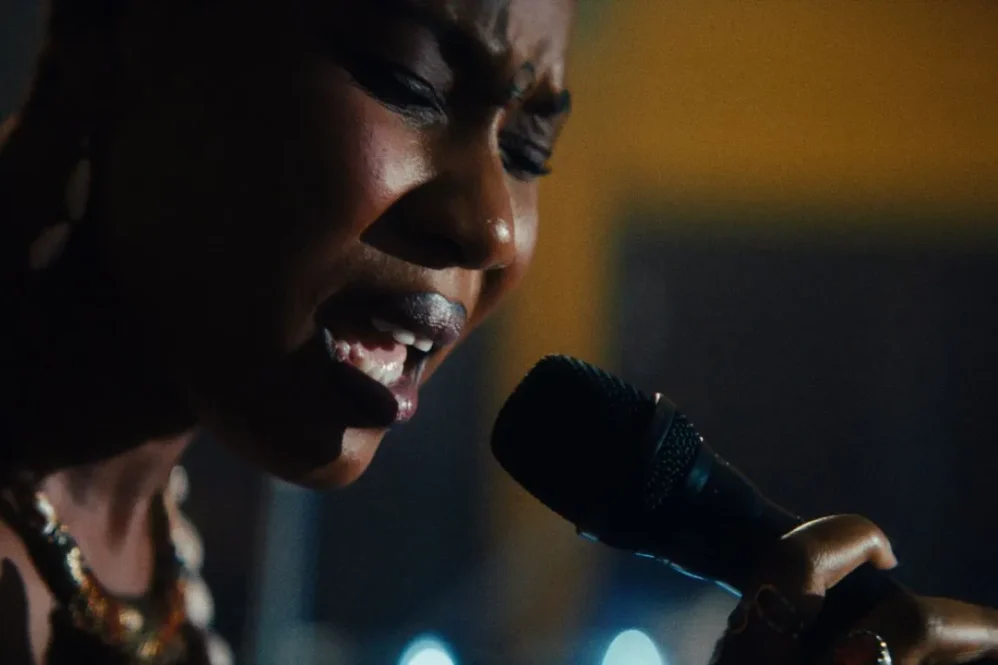
Her younger sister, Titi (Tosin Adeyemi), is a singer, a smoker, and the family’s supposed rebel. Where Ade has submitted herself to the demands of duty and religion, Titi seems to have chosen a life of her own. Much of what we learn about her inner life comes through her music, which is among the film’s most affecting elements.
Titi sings at a bar called Afro Republik, dreams of becoming a musician, and carries herself with the sort of defiance that makes people uncomfortable, until an unfortunate event with her supposed boyfriend ultimately changes the cause of her life, putting her in a different kind of confinement. But would this story be different if the assault did not happen? It seems the script is more committed to amplifying the many struggles of womanhood than it is concerned with examining the situations it raises.
Alhaji, a man who happens upon her after that incident, begins courting her, bringing her gifts, and inviting her out. Their relationship progresses quickly. Over time, Alhaji becomes abusive, but Titi eventually tells her sister that she would rather have an abusive husband than one who is an “infidel” (“yan ale,” a case of heavy subtitling as the film is mostly in Yoruba). It is a troubling admission, one that reveals how limited Titi’s choices have become.
The script, also penned by Orimogunje, occasionally undermines its own characterization of Titi. Presented as a rebellious woman hardened by experience and aware of the particular cruelties imposed on women, she initially appears self-assured and perceptive. Yet much of the time, she comes across as surprisingly naive. A good example would be the day she gives herself off to Alhaji. If this human contradiction is meant to reveal a deeper aspect of her character, the film neither shows nor “explains” it sufficiently, resulting in a portrayal that feels uneven rather than complex because it had all the runtime at almost 2 hours long.
Even the dialogue the film assigns to her rarely holds together, and nowhere is this more apparent than in the scenes where she attempts to showcase her intellect and passion for music. It is easy to get a sense that she comes across as a mouthpiece for information, a textbook reader of some sort. There’s a stiffness with the way the characters speak that feels unnatural. Here, Titi has just finished a performance and has joined her friends on a table where they’re having a conversation on the origin of music:
Titi: Music is not owned, Kofi. It is a living thing. It grows, adapts, and changes hands.
Lizzy snaps her fingers.
Titi (cont’d): It’s not about where it started. It’s where it goes.
Kola: Titi, that’s deep. That’s deep.
Lizzy: That’s deep? When I say it I am wrong, but when she says it, its deep.
Kofi: Well, delivery matters, Chale.
Bimbo Akintola’s “decaying” Ade, on the other hand, who is struggling with a different version of the same problem, doesn’t also seem certain of who she is. She’s a firm believer and holder, and the script saddles her with so many responsibilities that leaves little room to explore the real sources of her sadness and irritability. Why is she grumpy and withdrawn? Dear Ajayi seems to ask us to accept these traits as given.
So much time is spent on narrative redundancies that the film often loses sight of the very claims it seeks to make. It describes the sisters as estranged, but does so little to convince us of this dynamic. What exactly separates them? Why has their relationship deteriorated? The script offers few satisfying answers. If this ambiguity is intended as narrative restraints, it proves ineffective in Dear Ajayi. The film leans lazily on Ade’s judgemental nature, perhaps as an explanation, but even this characterization lacks nuance enough to make the sisters’ distance feel credible.
Orimogunje has spoken about wanting to capture the ordinary rhythms of Nigerian life: the simple, intimate routines of a household and neighbourhood. I am sympathetic to this approach. I like films that allow the everyday to reveal a story rather than making every scene serve an obvious dramatic purpose. Real life doesn’t set out with a plot in mind. Watching people repeat themselves, sleep and wake up, nurse resentments, avoid conversations, continue living, even when their lives are falling apart, is how the plot eventually happens.
But Dear Ajayi does not always know when to leave these moments alone and when to move beyond them. Many scenes, including the multiple encounters with a nosy nurse Cassandra (Chioma ‘Chigul’ Omeruah), feel as though they belong to a fuller account of domestic life that the film has not quite found a way to integrate into its central story. The problem is not that these moments are mundane. It is that their accumulation occasionally blunts the force of the drama. The film wants us to inhabit the ordinary, but sometimes it mistakes the presence of ordinary activity for the development of a character or an idea.
The result is a noticeable inconsistency in the film’s pacing, with scenes oscillating between moments that linger far longer than necessary and those that feel rushed, uninhabited.
This is not to undo the film’s considerable achievements. Its performances are sometimes compelling, its images and music quite memorable. I only wish the film had trusted its strongest elements more consistently. The emotional truths are already there. We do not always need another scene to understand what we have already began to understand.
In the end, there is emptiness, there is void, but also a smiling woman (who we never saw smiling that heartily through the film) and another who is beholding something we cannot see, as if peering into the future.
Dear Ajayi is a production of 209ine Films, Mayana Films and Death & Optics. It screened at the 2026 edition of Film Africa in London. It opens in Nigerian cinemas on November 13, distributed by FilmOne.
Dear Ajayi is Nigeria’s official submission to the 99th Academy Awards.
Become a patron: To support our in-depth and critical coverage—become a Patron today!
Track Upcoming Films: Keep track of upcoming films and TV shows on your Google calendar.
Side Musings
- By the end of the film, Titi has logged enough cigarette hours to qualify as a seasoned professional. Someone update her CV.
- Daddy Abbey’s poker face is generational
- Ade underestimated her options. A little tissue might have bought her five minutes of peace from that nurse. Then again, she seemed genetically incapable of staying quiet.
- We need to do something about how our indigenous languages sound in these international-facing films. Can it be more natural.
- Although Dear Ajayi is supposedly set in the 1990s, its treatment of Daddy Abbey’s seemingly inadequate earnings of 11,000 to 30,000 lacks sufficient economic context, while an NTA broadcast referring to Muhammadu Buhari as Head of State further complicates the film’s timeline, since he held that position only between 1983 and 1985.