
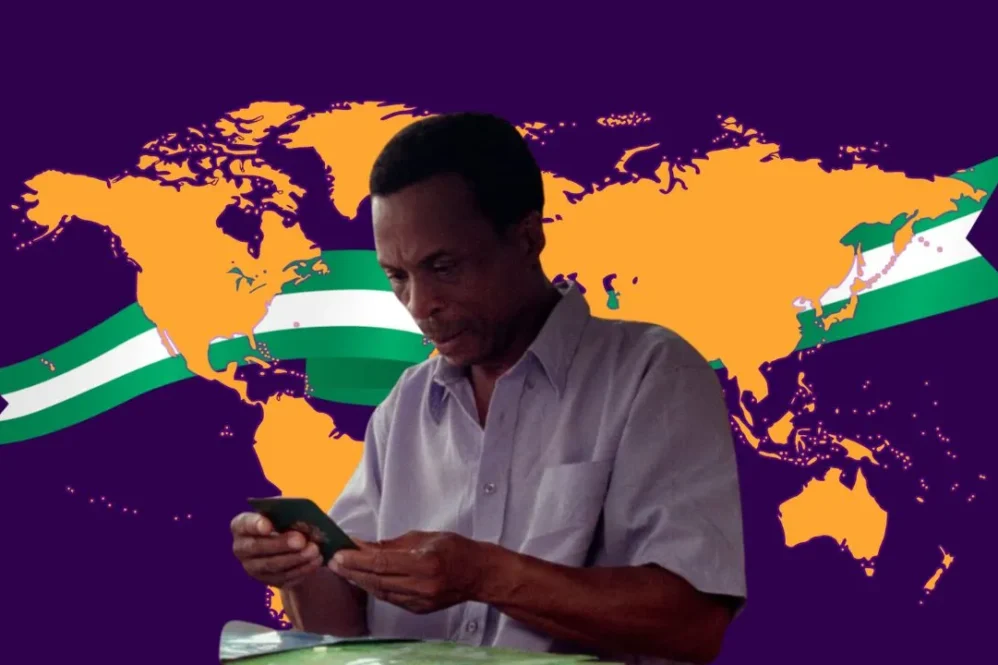
Imagine a young man in Lagos, hands calloused from fixing generators, staring at a passport like it’s a relic. He dreams of Spain—not the beaches or the football, but a place where the lights stay on and the bills don’t devour his wages whole. Or a hairdresser juggling two jobs, her pregnant sister leaning on her, both nursing the dream of Italy, a country they’ve never been before but believe would change their lives for good. These two individuals are at the heart of Arie and Chuko Esiri’s Eyimofe (This Is My Desire). But these aren’t just fictional characters; they are mirrors held up to a nation that has been quietly packing its bags.
In recent years, migration has become a more recurring theme in Nigerian shorts and feature films, inspired by the mass migration the country has also witnessed during these years. There is a word for it, Japa, a Yoruba word for “to flee” turned into pop culture lingo by Nigerians to describe this exodus. Films like Eyimofe (2020), Japa! (2024), A Japa Tale (2023), etc. and even Ike Nnabue’s documentary work No U-Turn keep circling back to this theme because the reality won’t let them go.
To understand why today’s films on this theme feel so heavy, we must look at what they replaced. In the “straight-to-video” era of Nollywood, migration was a fairytale, often glamorised. The protagonist boarded a plane to London or America and five scenes later they return with luxury cars, fashionable clothing, big houses to the envy and awe of people they left behind. All those diaspora tales painted abroad as the land of milk and honey, where hard work paid off in dollars and dignity. I think it was something of a wish-fulfilment escapist cinema, born in a time when foreign films flooded the Nigerian market, inspiring a generation of filmmakers who began to reimagine the American dream through the lens of the abundance and opportunities portrayed in those foreign films.
Today’s filmmakers expand the script. They don’t glorify migration—they interrogate it. In Eyimofe, migration isn’t a golden ticket; it’s a grinding, transactional ordeal. Mofe (Jude Akuwudike), the electrician, and Rosa (Temi Ami-Williams), the hairdresser, chase passports and visas, but Lagos itself becomes the true antagonist. Every kobo saved slips away to hospital bills, corrupt officials, family obligations etc. The film, shot on lush 16mm with neorealist intimacy, lingers on the textures of daily survival: the humid Lagos air, cramped housing, and the way opulence sits mockingly beside abject poverty in the same city. The dream of Europe is shown as fragile, often shattered before take-off. It’s a reverse migration story focusing on where people come from, not where they arrive.
Similarly, this sense of being “grounded” by the environment finds a Groundhog Day-style, comedic echo in Isioma Osaje’s Japa! (2024) for Inkblot. While Eyimofe uses grounded neorealism to show characters frustrated from migrating overseas, Japa! utilizes a satirical time loop to illustrate the same frustration. In Osaje’s film, the characters planning to migrate find themselves literally stuck in time, unable to move forward on their journey. It might have been the filmmakers intention to use that technique as a metaphor for the Nigerian condition: the harder you try to leave, the more the environment seems to conspire to keep you in the exact same spot.
The Japa wave in contemporary Nigerian cinema is diverse in its grief. These filmmakers are not just interested in documenting the migration experience; they aim to expose its enduring precarity and compel viewers to confront the impossible choices it demands long after departure.The audience is invited to engage with the theme by questioning why immigrants endure constant uncertainty and the threat of removal just to remain in a country that never truly feels like home. This struggle is exemplified by Isio in Dreamers (2025), Joy Gharoro-Akpojotor’s British film with a Nigerian lead character about a woman detained in the UK after years of being undocumented, and the Antetokounmpo family in Akin Omotoso’s Disney flick Rise (2022), who faced persistent deportation risks while migrating from Nigeria to Greece before the American NBA ticket. While these films are not Nollywood productions, the filmmakers share Nigerian heritage. They carry and translate even their lived experiences of migration into their storytelling.
On the short film side, Dika Ofoma’s A Japa Tale (2023) narrows the lens to the intimate, exploring how the decision to leave unspools the threads of a romantic relationship. When Dubem (Daniel Ngozika) announces his departure, it isn’t a victory; it’s a funeral for the life he and Emuche (Onyinye Odokoro) already have. Suddenly, the future is uncertain for these two lovers even though Dubem is convinced doctors are paid well in the UK. The push and pull between greener pastures and the ties that root us at home, romantic or otherwise, will resonate deeply with those who have already made the journey abroad.
And then there’s Ike Nnabue’s 2020 non-fictional narrative, No U–Turn, that probes the issues of identity, belonging, and migration. He captures not only the human texture behind the migration statistics but also the empty chairs at family tables, and children growing up on video calls. These works quietly preach in their different narrative landscape that leaving is always a hard choice, a last resort when all hope is lost.
Why does this motif keep returning? Because Nigeria has positioned itself as the antagonist to its own citizens. The lights go out, salaries stagnate, insecurity creeps, inflation bites harder, rendering salaries and wages useless. “No one leaves home unless home is the mouth of a shark,” the Somalian poet Warsan Shire writes in her poem “Home”. That line lands like a hard truth in these films. Home isn’t just a place; it’s a system that devours ambition, safety, and hope. Japa becomes survival, not a luxurious choice. These films show us the calculus: stay and fight a losing battle or flee and risk everything anyway.
Let me tell you something personal. A few years back, I sat with a cousin in his flat in Ikeja. He was a brilliant engineer, top of his class, but the constant power cuts meant he couldn’t run simulations for long without fuel eating deep into his pockets. He showed me his passport—thick, full of rejections. “Bro,” he said, “this country is like a beautiful woman who keeps slapping you every time you try to love her. The country we love does not love us back”. Months later, he Japa’d to Canada. His first year, he worked as a factory cleaner and complained often about his waist. But he would usually chip in “At least they don’t take light here.”
This story isn’t unique. And it’s why these films resonate—portraying what we are familiar with. Every year there is a neighbour, a friend, a sibling, your driver etc who has left the country in search of a better future abroad. These works speak in a new and diverse cinema language: slower, more observational, less melodramatic and experimental. They use colour, sound design, and long takes to let the weight of decisions settle on the audience. They offer entertainment as much as reflection. The filmmakers are saying: Look at us. See what we’re running from, and what we’re carrying.
Hence, migration as a theme stays on our screens because it stays in our hallways, our group chats, and our empty bedrooms. It is the conversation that never truly ends. These films do not need grand metaphors; they simply reflect the heavy, quiet reality of a people constantly preparing for a goodbye. We watch them because we recognize the exhaustion in the characters’ eyes as our own. They act as a witness to a deep collective grief—the mourning of a version of Nigeria that should have been. It reminds us that leaving is rarely a triumph; it is a survival tactic.
More japa-themed references: For further exploration of the migration narrative in Nollywood, films such as Kanaani (2023), Ijé: The Journey (2010), Japa (2025, dir. Adiukwu Daniel), Oloture (2019), Orah (2024) and Migration (2025) offer insights into the complexities of the diaspora experience.
Become a patron: To support our in-depth and critical coverage—become a Patron today!
Track Upcoming Films: Keep track of upcoming films and TV shows on your Google calendar.