Few things are better than a romantic comedy that keeps both of its promises. Very few things. (A plate of smoky party jollof, perhaps.) I suspect this, among other reasons, is behind the runaway success of Bluhouse Studios‘ Call of My Life, released in May this year. It’s also why When Tari Met Voke is such a delight.
The 10-minute short has two scenes. It opens with a party, the kind where berating the host’s favourite Romanian New Wave film is a bigger faux pas than outright insulting the food. The kind of party I’d be honoured to attend if I knew where they threw such things.
The camera finds one couple, among the sea of bodies, locked in each other’s gaze. A character narrates in voiceover: “I’ve always pictured a moment like this, dancing with my lover in a crowd.” Naturally, you’d assume it’s the woman in the couple speaking. But the film has other ideas.
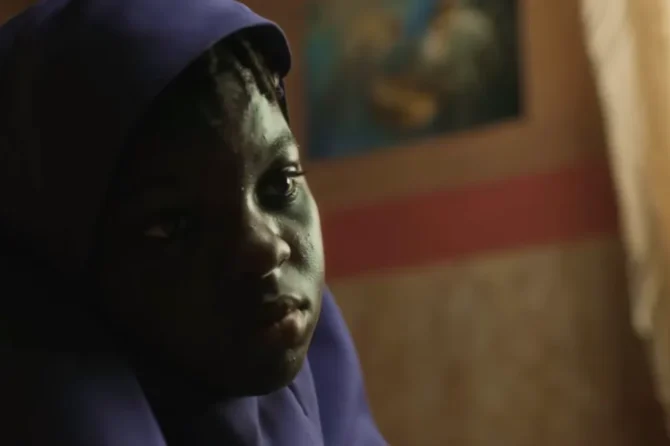
It cuts to an extreme close-up of Voke’s eyes as she watches the scene unfold, barely concealing her indignation. A moment passes, then two, then she storms off, shooting daggers at the dancing couple.
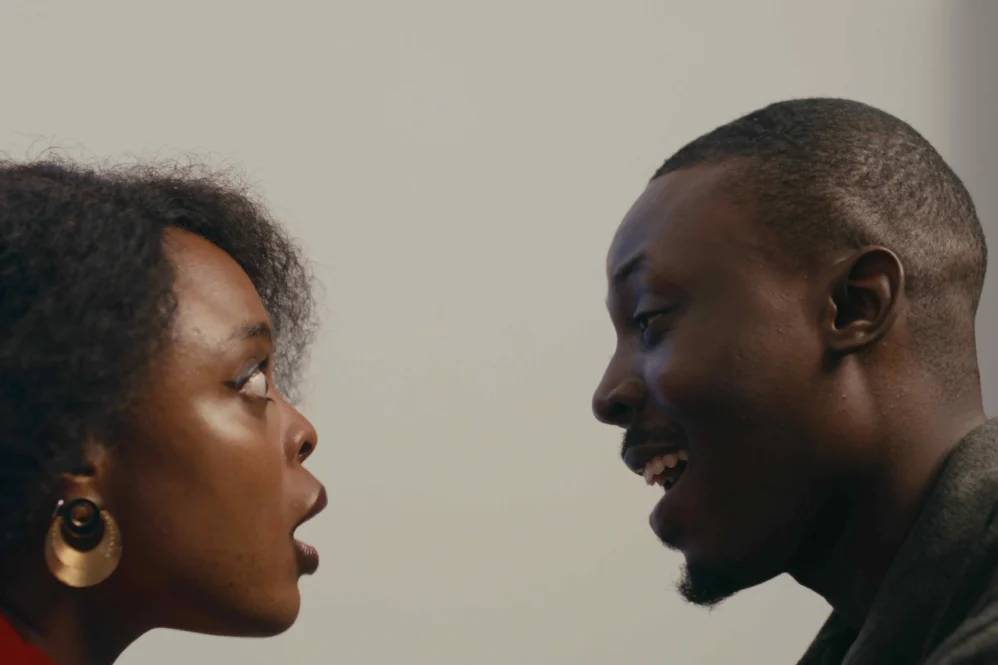
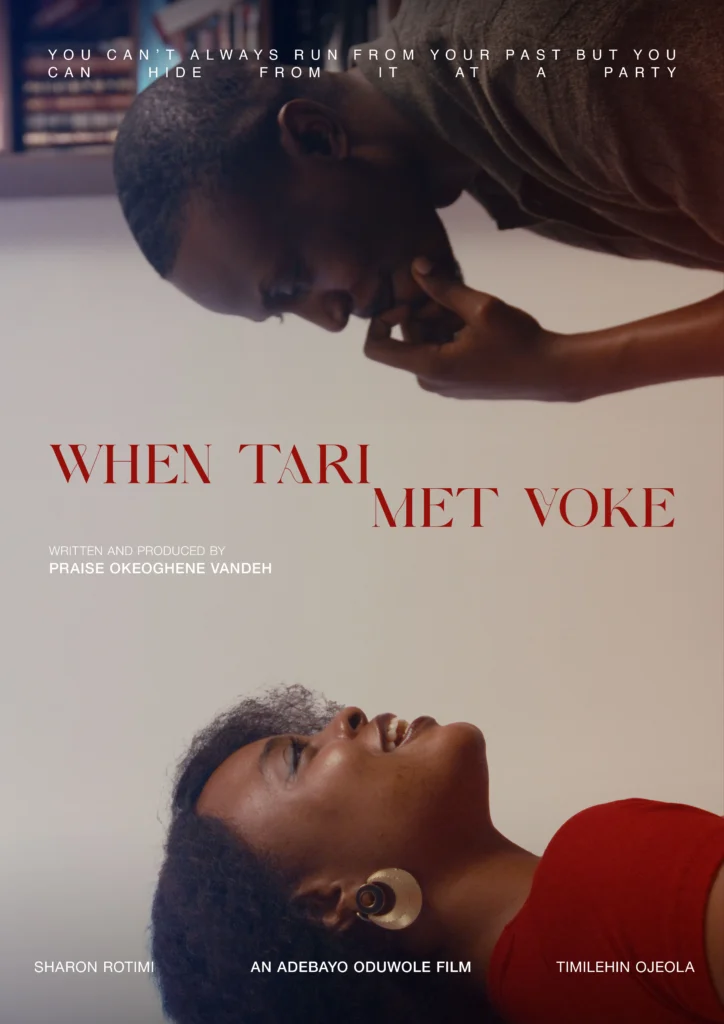
Voke (Sharon Rotimi) barges into a room and finds Tari (Timilehin Ojeola), alone with a book, hiding from the party. “I’m sorry, I thought this room was empty,” she says. “It’s big enough for two,” he replies. This is a meet-cute (the title tells us as much), and Voke, still furious that her ex has snagged himself a new belle, is not in the mood for one. That she ends up in one anyway is the film’s whole game.
I was reminded of Submarine (2010), directed by Richard Ayoade, a film brimming with coming-of-age tropes, which never feels like a joyless checklist of conventions. Ayoade makes his film a celebration of genre rather than a rote exercise in it.
This same spirit animates When Tari Met Voke. It is evident that director Adebayo Oduwole and screenwriter Praise Okeoghene Vandeh (doubling as the producer) are not mere students of cinema, but enthusiasts, true-blue lovers of the medium, eager to wear their influences on their sleeves without letting them overwhelm the story. For example, when Tari mentions that his favourite film is Love Jones (1997), whose central romance begins similarly, the film is winking at the audience; even the title is a play on When Harry Met Sally (1989), one of the defining texts of the romantic comedy. Genre conventions, it seems to argue, are toys in a sandbox; what matters is not that you use them at all, but how and why.
The screenplay strikes a balance between a naturalistic exchange and the kind of witty repartee expected from the main characters in dialogue-driven romantic comedies. Although the film shares the spirit of Richard Linklater’s Before Sunrise, or Raine Allen Miller’s Rye Lane, unlike those walk-and-talk romances, When Tari met Voke is set in a single location. What it loses by doing so is the opportunity to reveal information about the characters’ histories and personalities by having them interact with a living, breathing city. Instead, the setting is introduced through a passing mention in the dialogue: apparently, this is all happening in Ojuelegba.
The aphorism goes that the more specific you make a story, the more universal it becomes. What When Tari Met Voke loses by not setting its romance against the noise and belligerent indifference of Lagos, it gains by painting a compelling portrait of its characters, and in record time, too. We likely all know or have been a Tari or a Voke, meeting a stranger in the most serendipitous of ways and immediately hitting it off.
Of course, none of this amounts to much if the central performances don’t ring true. And Sharon Rotimi and Timilehin Ojeola, both known from AMVCA-nominated The Wives and The Yard, are able to convince us of Voke and Tari’s instant attraction, delivering their lines with the right amounts of awkwardness and teasing.
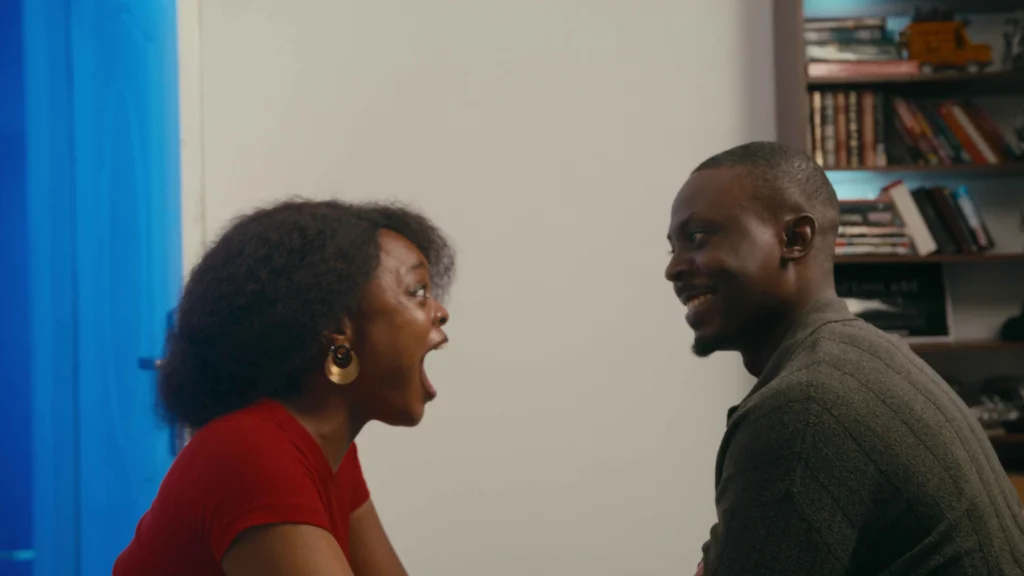
The directing puts even more pep in the film’s step. Adebayo Oduwole (writer on Edosio’s When Nigeria Happens) mirrors the energy of the scene and the characters with playful postmodern choices such as breaking the 180-degree rule and jump cuts that Godard would be proud of. These techniques draw attention to the artifice of the narrative, reminding us that we are watching a film. Why this works so well is because the rest of the film is already a clear homage to rom-com tropes. The title itself breaks the illusion that you are watching something completely new. For When Tari Met Voke, originality is found in pastiche.
Unfortunately, this is also the film’s biggest drawback. It doesn’t divert from its influences enough to carve its own path. This is especially obvious when it ends on a quiet beat that is less exciting than the premise. The film plays with genre conventions but returns to them without ultimately transforming them. The result is a film that understands the language of the genre well but stops short of saying something entirely its own.
Earlier, I made a case for well-rounded romcoms being on par with the most mouth-watering of Nigerian delicacies, and I stand by that statement, even when the romcom in question is about ten minutes long.
In When Tari Met Voke, the comedy is delivered with verve, the situation is compelling, and by the end, like a child seeing a rainbow for the first time, you want to tell everyone about it. I know I did.
Searching for the replay button, I had only one question: “How did they make something so simple feel so alive?”
When Tari Met Voke, a For The Plot Productions in association with Booze and Peppermint, and Dynamic Range Productions, premiered on YouTube on July 5, 2026.
Become a patron: To support our in-depth and critical coverage—become a Patron today!
Track Upcoming Films: Keep track of upcoming films and TV shows on your Google calendar.