

The Bible, like any other text, exists to be adapted and retold. Its stories are constantly updated for language and context. The King James Version for the purists who want little lost, The New International Version for those who want context in an updated language, The Message for the pastor trying to belabour some point in his sermon, and now Remi and Nneoma for those craving a retelling of the Ruth, Naomi and Boaz story in Rivers State, Nigeria.
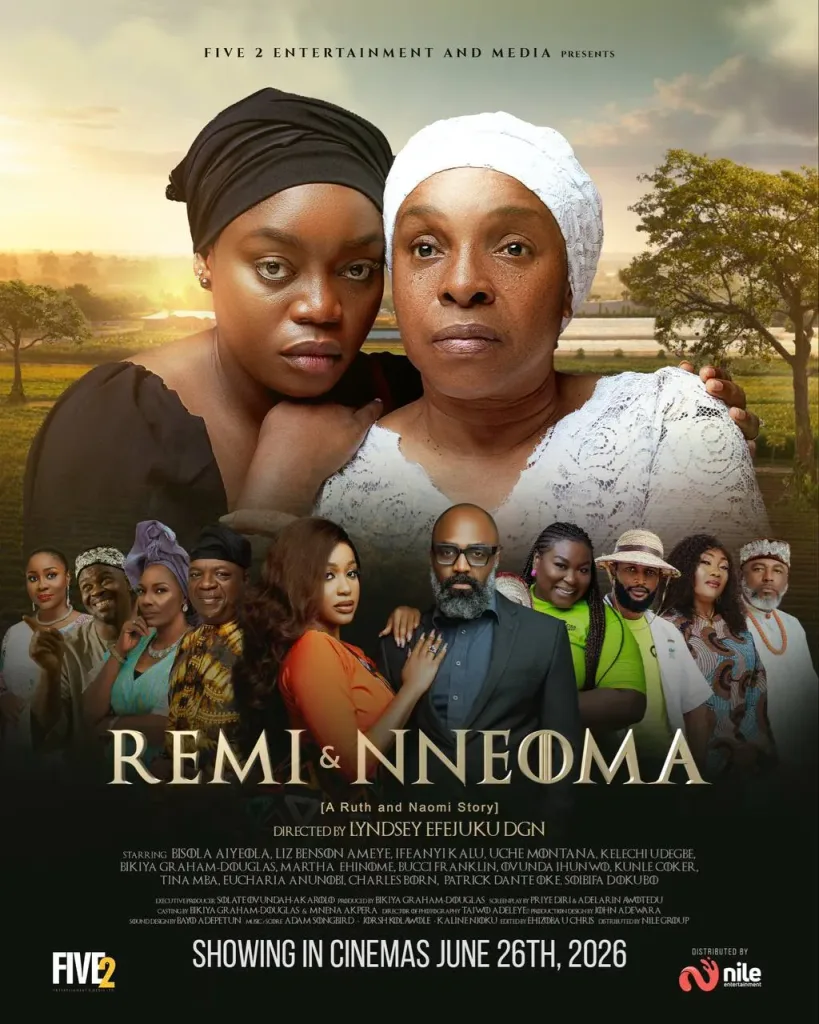
Directed by Lyndsey F. Efejuku (The One For Sarah), the story follows Nneoma and mostly Remi who decide to stay back in Nneoma’s town as they navigate a new life of grief following the tragic loss of their husbands. It presents an updated story in name, location and context but tries to retain the same unwavering devotion and faith of the original. That balancing act brings with it a familiar tension of biblical adaptations: audiences know the end of these stories, so the only real question is what a filmmaker does to reach that end. Remi and Nneoma often hesitates, wary of straying too far from a text many audiences hold sacred.
The film has reverence for its source material which ironically stifles it, especially in performance. Remi (Bisola Aiyeola) shares a scene with Nneoma (Liz Benson Ameye), where she has to make the pivotal declaration that she has decided to stay back with her instead of going back to Ibadan. The dialogue is lifted almost entirely from the Bible and the actors wring out an unevenly dramatic performance from the moment as if to obviously wink at the audience in case the names and story aren’t enough adaptation clues. Bisola (Sugar Rush) is steady most of the time but the script gives her no space to be anything but resolute and speak in biblical platitudes. Liz Benson (Diamond Ring), on the other hand, starts in a moving performance of grief that falls apart mostly due to story issues.
This makes the rest of the film seem like an exercise in hyperawareness. It never quite steps into the newness of the story it is telling despite the updates in characters and dynamics. Remi is given a best friend in Hachikaru (Bikiya Graham-Douglas) and an antagonist in Oma (Uche Montana) while Bucci Franklin (To Kill a Monkey) is somehow part of the film in a forgettable appearance. These updated elements often seem like oil floating on water, never fully incorporated in the film’s story. Even with Nneoma’s loss of faith that is shaping up as contrast to Remi’s steadfastness, it goes nowhere real after the scene she shares with a minister from her church. This reluctance might be because the film doesn’t want to unsettle its audience with doubt, but every Christian will tell you that those moments exist.
The love story at the centre is given no chance to sprout. Ifeanyi Kalu as Ovundah (a name nobody in the film can agree on the pronunciation) is adequate in a role that requires a perfectly boring man. He owns CSS farms, a large corporate entity, in an update of Boaz and the best we know about him is that his company is in a bit of a financial problem. There is enough potential conflict in the build up to Remi and Ovundah. It is a love story of uncertainty because it lies on the border of taboo: she is a widow in his family and he is a widower. Unfortunately, the tension that exists between them has no sparks. It is performed on a structurally faulty foundation: their interactions never dig deep as if the film’s faith is solely in our knowledge of source material.
To incite the tension, the film decides to take the easier route by creating a villain in Oma, Ovundah’s operations manager, and her mother Chetachi (the one-note Eucharia Anunobi). She performs on a plane of constant seduction, the whore to Remi’s Madonna, and in the end we see her go crazy for love—it’s a trope as tired and old as the Bible itself. Even with her introduction, the film could have taken a more complicated route with the complexity and familiarity of a man torn but Ovundah is cartoonishly oblivious and the story is bludgeoned into melodrama.
The film’s coasting on the original story seeps into the filmmaking that doesn’t inspire. All we get are aerial shots of the farm in a way that feels like advertisement, the rest is shot in a kind of Nollywood standard base level style. No signature colour palette, framing that does enough to move things forward and absolutely no stylistic finesse. Its most interesting ideas are in the setting where Rivers State tries to come to the forefront for the setup of a tribal clash that fizzles out quickly.
Remi and Nneoma culminates in a half-hearted critique of traditional burial rites, where Kelechi Udegbe (Collision Course), in a bafflingly bad performance as Nyesom, galvanizes the community leaders in a ploy to take Remi as a wife. From there on we get multiple endings, where all the side characters are suddenly remembered and the awkward execution fails to build a new world for an old story. In the end, this version of Ruth and Boaz is enamored by its origins in a way that closes off its evolution.
Remi and Nneoma is a Five 2 Entertainment and Media production distributed by Nile Entertainment, in cinemas from June 26, 2026.
Become a patron: To support our in-depth and critical coverage—become a Patron today!
Track Upcoming Films: Keep track of upcoming films and TV shows on your Google calendar.
Side Musings
- Uche Montana, what a woman. Let her go to Port Harcourt and pick any man she wants.
- Martha Ehinome is in this film briefly as Oprah before she goes back to Ibadan, much to think about.
- In the original story of Ruth, she lays at his feet in the field and I was so curious to see if and how the film would execute it but they sadly avoided a literal interpretation.
- The film happens across a little over one year but somehow feels like it happens in two weeks.




I like uche montana films