
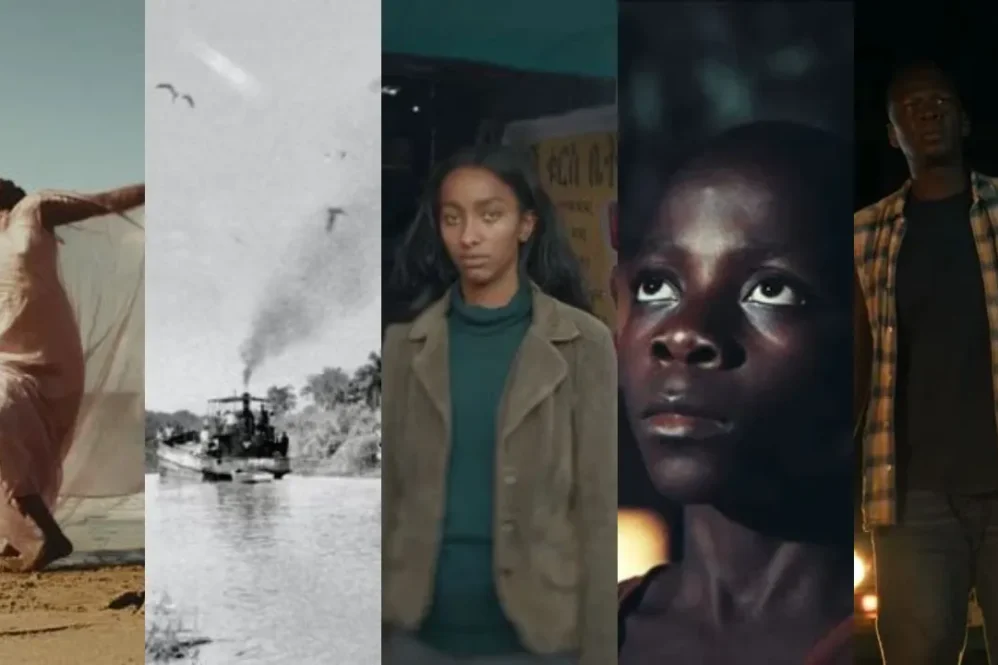
The following five short films screened as part of the 2026 Locarno Open Doors, taking place from August 5-10, 2026. The five directors were also invited to take part in the Open Doors Directors programme. The broader 79th edition of the festival ran from August 5-15, 2026.
Concrete Moves (Senegal)
Concrete Moves begins with the memory of a lighthouse. The narrator and director Fagamou Fama Ndiaye paints a memory of the vastness she witnessed on a school trip, “it was immense, it was free,” until her awe is interrupted by a snake that disperses the wonder. This small story is placed on the coast of Dakar where concrete interruptions have taken over the natural vastness she witnessed as a child.
With a series of static shots of monotonous modern buildings anchored by narration, the director mourns the transformation that has alienated the place from nature. Each shot is an effective indictment: contrasting the packed towering buildings with the empty skies, the small old houses against the menacing housing units, the usefulness of hands making cloth and food against the builders of these invasive structures.
It’s a familiar African story grappling with what is lost when supposed modernity is gained. With dance and music in the second half of this film, the director pays homage to the forest that might have occupied that space. In a restrictive dress, a dancer is framed by a large window, concrete units in the background, as she twists and turns as if attempting to escape from this change.
With a laser focus, strong sense of place and a narrative injected with the grasping formlessness of memory, Concrete Moves somehow ends up asking: was the lighthouse the first sign of this modernization?
Time To Change (Portugal/Angola)
A film, many times, asks you to see. With Time To Change, it is asking you to see and hear (with sound design that is haunting, cracking and breaking) as black and white archival images of colonial era exploitation and big game hunting in Angola stack on each other.
Its visual energy feels like being put inside of a camera and forced to be a witness to these colonial atrocities. It zooms into the faces of these white men and women being served by black people—their cars ferried across bodies of water and their umbrellas held in the scorching sun. The photographs of victory with big game like leopards and crocodiles are given an eerie aura of carnage with the screeching, grating sound design.
It’s effective in the film’s short run time, subverting images of victory into ones of carnage, before finally settling into a dull drone of destruction as fire engulfs the land. Pocas Pascoal takes these pictures—worn dull by an overexposure to their exploitative history—and haunts them with sound in a film that revels in bleakness.
sKINs_ADDIS ABEBA (Ethiopia)
In sKINs, Rediet Haddis Yalew studies the place—Addis Ababa—as a witness to the people. Separated by sections, it starts with intimate footage of older women drinking tea and talking before moving to the younger generation, commenting on political movements and change. Despite the sectioning, it is often a tad difficult to follow. The many touchpoints leave sections unfinished and the narration feels like a monologue that runs parallel to the film instead of in tandem with the visuals.
The experimental film seems to be ruminating on how a place is often the only witness to change. People grow old, die and move, but a place is somehow undergoing and witnessing the change at the same time. And the film poses questions to Addis Ababa, examining its history and honouring its people. Deep into the film, we see the screen busy with subtitles, doodling and dialogue tags; it’s a visual grappling with many histories, adding textures to the thesis being examined.
In the end, we go back to the women from the beginning talking about the younger generation, as the film’s frenzy settles on the people being the reason a place exists.
Submergido (Mozambique)
In Submergido, the bond between a father and a son is so strong that it transcends distance and realms. After Amarildo disappears during fighting in Cabo Delgado, his family grapples with the rumours of him joining the insurgents while his son finds a connection to his missing father.
The film, directed by Ariel Añez, examines what war leaves behind and the familial cost of personal duty to a nation. His wife asks what exactly she will tell her son, not simply because he might be dead but also because of the rumours surrounding his disappearance. A father should be a hero whose death can be an act of myth making but not for Amarildo whose journal entries we hear at the beginning of the film. He has killed people to restore balance, like the first days of the creation story. But we can never return to that perfection—war is already in the world.
When his brother brings her the news of Amarildo’s disappearance, he assures her that her husband will be back, citing the journal Amarildo left behind. But the only return we see of him is a figure in the corner of a room, haunting his son.
The moody visuals and shaded lighting give the film a subtle horroresque energy as the son wanders round the house, following a father he may not have seen in years. Anchored by believable performances all round, Submergido spiritually tints the effect of war on a small family. It lingers in silence as the camera moves within a home that will continue to grapple with the legacy of a man they might never see again.
Submergido won the AFP Critics Prize at Locarno.
Goat (Kenya)
There is a trippy sequence in the middle of Goat, directed by Judy Kibinge, where we see a sort of spiritual rebirth and across-the-cosmos transformation of the main character. It hints at the film’s interesting core idea but also diagnoses the film’s uneven problem.
The film follows a couple, Suki (Sheila Munyiva) and Benjamin (Brian Ogola), who come from the city to a remote goat farm to get a discount on goat meat from a local butcher—understandable journey, to be honest. During the trip, Suki finds herself drawn to a tree that wants to collect a debt she doesn’t know she owes.
The performances that anchor this story do little to sell the believability—the conclusion of the film needs you invested in Suki and Benjamin’s love story, and a lack of chemistry prevents the romance from taking off. Sheila Munyiva and Brian Ogola never quite rise to the spiritual calling of the narrative; when fear and curiosity are demanded they muster their best efforts that are sometimes inadequate.
This inadequacy spills into the story that speaks of a debt we never see or understand. Suki is the main victim of this narrated debt but not much more is explored except the painfully obvious foreshadowing in her hair styling. The film, inspired by Kenyan folklore, lends itself to these creepy sequences that hinge on nothing: we see a set of twin girls that lurk around the farm and somewhat guide Suki but they feel like convenient narrative tools. Subtlety and clarity are tools every film should wield: knowing when to colour and shade moments, especially of this genre. But Goat leaves you more parched than satisfied.
Where it does satisfy is in the expert direction. The camera moves smoothly, capturing the vastness of the remote area they are in and the sludginess of the farm. This also helps to transition the film from mystery to romance to horror without major tonal abrasions.
In the end, Goat can be generously read as the price a woman must unknowingly pay once she returns to a culture now foreign to her, but it rarely probes beyond that.
Become a patron: To support our in-depth and critical coverage—become a Patron today!
Track Upcoming Films: Keep track of upcoming films and TV shows on your Google calendar.