
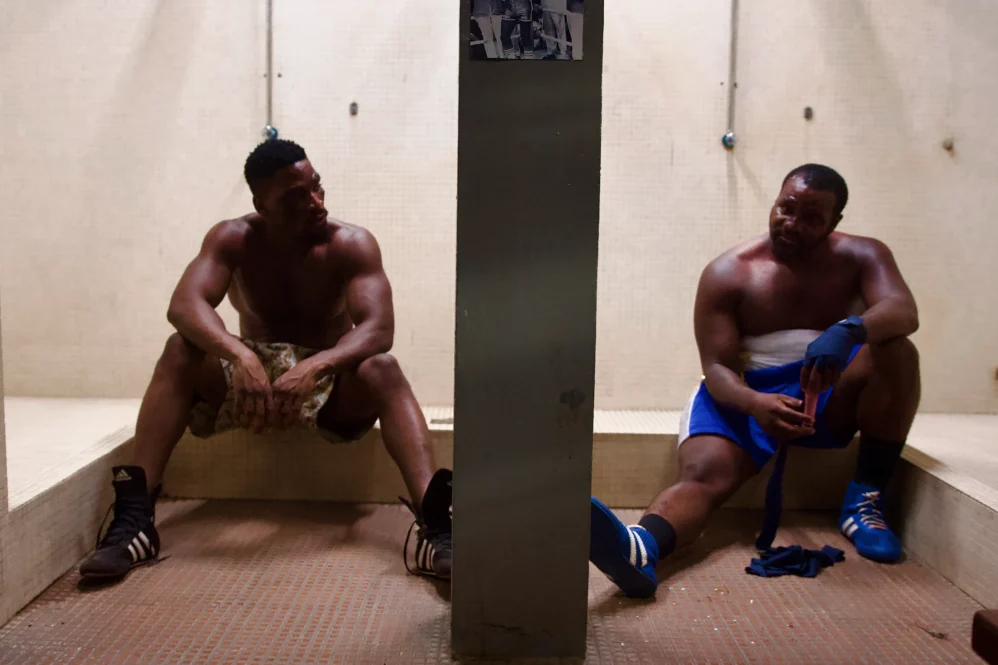
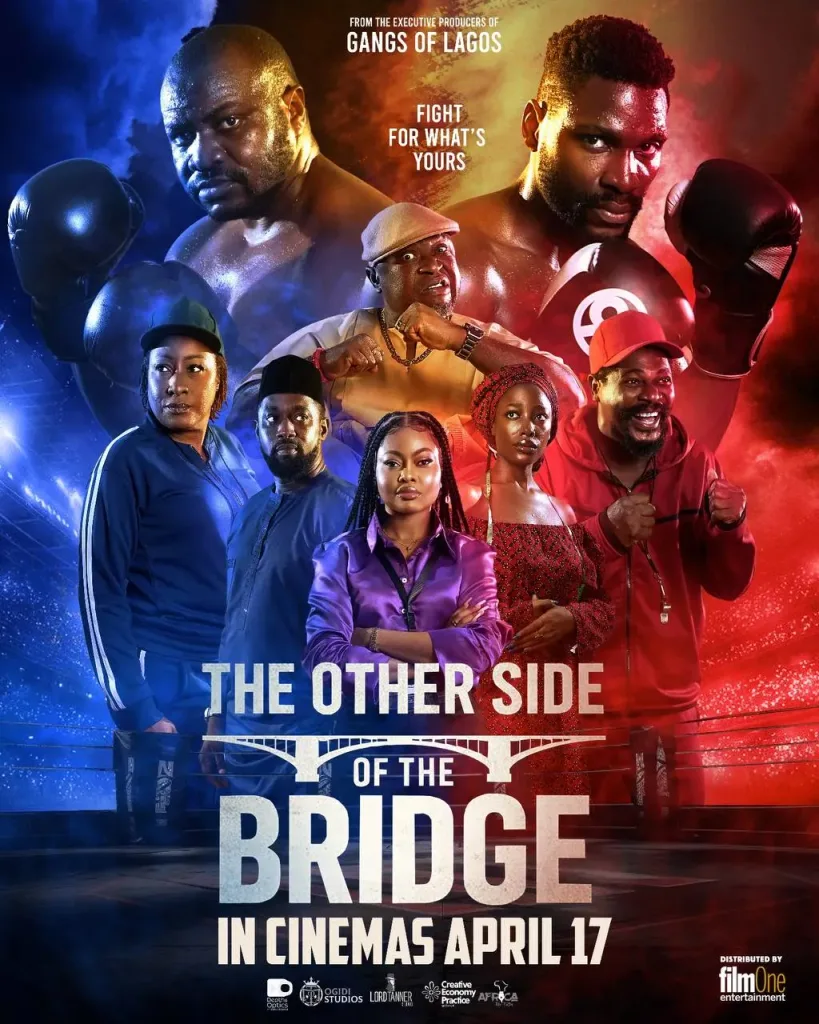
In Fiyin Gambo’s The Other Side of The Bridge, class tensions find their outlet in the clashing bodies of Tobi Bakre and Demi Banwo in a story that follows two boxers from opposite backgrounds competing for personal stakes that define survival for one and legacy for the other. It is a film that tries to meld the brutal physicality of boxing with the abrasive relationships between the haves and have nots, but all its layers end up like oil and water.
(Click to Follow the What Kept Me Up channel on WhatsApp)
Tobi Bakre (Brotherhood) plays Farouk, a struggling boxer in the slums of Lagos with his signature verve. We meet the character in kindness—training the local kids in the art of boxing—and follow him through the rest of the film as he attempts to use his fists to break free from his circumstances, for his wife and unborn child. He sells his fate with the best performance in the film; his face carrying doubt, fear, anger, despair and hope. He shares a scene with Olarotimi Fakunle (Gangs of Lagos), who plays his Coach, Mo, where he’s coming to terms with a betrayal; a visible well of anger builds up inside him that we see calculated bursts of. It’s a pity nobody else matches his performance most of the time.
Demi Banwo (The Blood Covenant) is Femi on the other side of Third Mainland bridge, wallowing in a more affluent part of Lagos. He’s mourning a loss we don’t know yet and going to work in person for the first time in months. Slowly, we discover his absence from boxing for five years since his mother got sick and how her death has kept him from work. It’s a compelling story that isn’t matched by compelling acting; there’s an incompatible juvenile energy for the character that Demi brings to the film. It could be a deliberate attempt at making Femi an ajebo which lands flat many times. He finally returns to boxing at the behest of former coach Bola, the adequate Ireti Doyle, and the trajectory is set for his clash with Farouk.
This trajectory is unfortunately riddled with obstacles that keep the film stumbling. The crux of the film’s story hinges on the dissonant backgrounds of the main characters but we never truly delve into it save a few passing mentions. Femi’s father (played by the commanding William Benson) is called a corrupt politician at least twice but that tension is never addressed and we settle for an unearned moment between Farouk and Femi at the end of the film. When we’re given some access into the motivations of both characters, it’s easier to see Farouk’s narrative—poverty is enough motivation.
With Femi, it’s a bit more complicated and requires a sharper study the film never offers. He’s a rich kid that supposedly has everything and at first returning to boxing is a bid to save his old training gym. He could easily write a cheque and the film would be done in ten minutes but we’re introduced to a new motivation in his late mother. But the hard work isn’t done with her, she is a spectre of convenience, an unbelievable motivating absence that leaves a letter with his coach that feels too specific to the moment. As if that isn’t enough, a love story is brewing between him and Fatima (Teniola Aladese), a sports journalist with unexplained ties to Farouk; this is the most undone part of his motivation and the nonexistent chemistry doesn’t help.
Another obstacle the film faces is the way the lack of scale meets the muted visual style to create an unexciting boxing film—arguably its biggest sin. The supposed huge Titans Boxing Competition never feels big despite how many times the characters remind us. The arena feels small and the press conference is awkward. The one training montage we get is a split screen and a dream and the bloody brutality that makes you wince in a boxing film is sparse.
The one time we get a good fight is when Femi finds himself on Farouk’s turf after a date and they get into a street brawl; it’s bloody and tense with pent up rage and clashing egos.
The Other Side of The Bridge resolves itself in ways you’ll expect, everybody wins one way or another which feels like an affront to its thesis. It offers nothing new within the boundaries of its narrative—the body is a tool for survival for one and self actualization for the other, the bridge remains but at least one character has crossed over with his fists.
Produced by Depth and Optics Productions, Ogidi Studios and Lordtanner Studios, and distributed by FilmOne Entertainment, The Other Side of The Bridge premiered in cinemas on April 17.
Become a patron: To support our in-depth and critical coverage—become a Patron today!
Join the conversation: Share your thoughts in the comments section or on our social media accounts.
Side Musings
- Nollywood films love making women journalists and then doing nothing with them.
- That one body builder they brought in to play a boxer was acting like he was going for the opposite of an Oscar.
- Boxing taps into something primal in men that partake and I almost never felt that here.


I have not watched the new 2026 movie!!! But from wkmup review, i have the picture in my mind… 8/10 soft bias action in very good filming… But, Lets see about it later.