
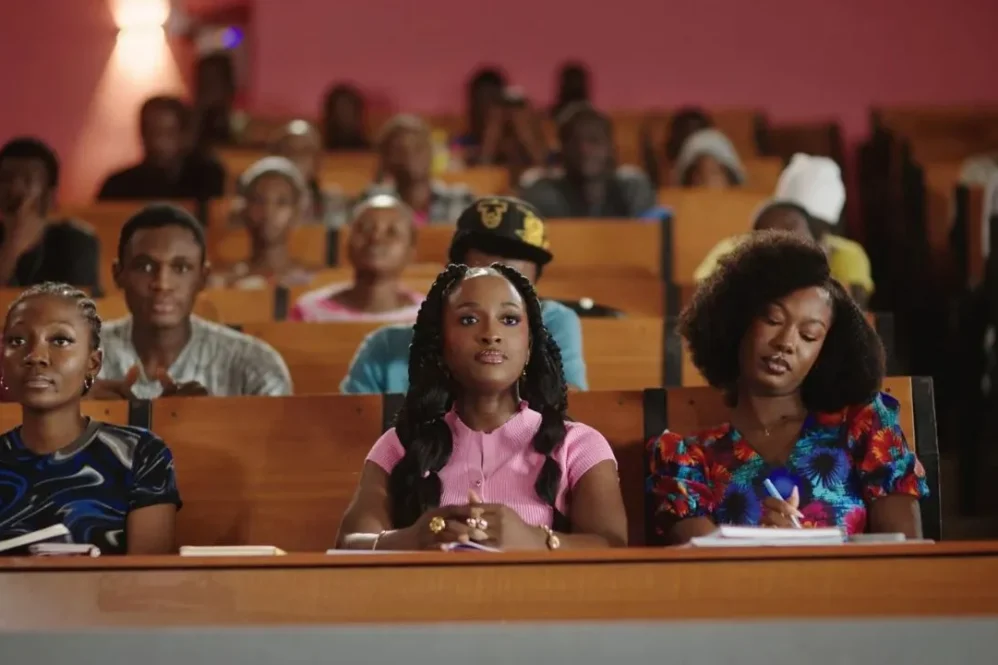
In Tele X Zikora, there is an awareness of the beats that make a romance film work. The first meeting, the push and pull, the moment of interest, the conflict and the resolution. It shows a deliberate attempt at crafting a swoony tale of young love between two people from different backgrounds trying to make it work. The scene is set in Lagos Metropolitan University, through the eyes of Zikora, a transfer student from Houston who forms a bond with Tele, a star student struggling with his mother’s death. Their whirlwind romance is strained by the conflict in the way each of them navigate the world. It’s a film set up for success but the awareness of what it needs to work doesn’t translate to the story well enough.

In her most ambitious feature yet, former film reviewer Adenike Adebayo-Esho (Summer Rain) shows an effort in the Mike Afolarin and Genoveva Umeh-led story for which she also helms the writing. The core story of Tele and Zikora figuring out their love while clashing on the role social media plays in their dynamic is carried by a tactile chemistry between Genoveva and Mike. From their first meeting, there is a consistent buzz that exists between them that fluctuates through all the emotions of falling in love. That energy between them is utilized by director Adebayo-Esho. She makes us miss them whenever the story shifts to side characters and crafts moments like the almost kiss at the party that are bursting with tension. The conflict at the centre of their relationship is not the most interesting one because the film tries to serve it as some philosophical debate about the presence of social media in our lives, lacking finesse, but Mike and Genoveva make you ignore whatever qualms you have.
When the film does try to push the story forward, we get scenes tacked to each other with no cohesiveness and a friend group jammed with characters that never breathe. There’s a scene at the basketball court that tries to introduce the water festival where Tele and Zikora have a defining moment and it stumbles through dialogue that ends with one of the characters awkwardly mentioning the festival before a quick cut to them shooting waterguns at each other. Other times the film feels rushed, keeping pivotal incidents off screen, almost like important moments were left on the editing floor. We see Kiki (Gbubemi Ejeye), Tele’s best friend, attempt to kiss him in one moment but we never really know the lore that grounds that incident, and then a second love interest, Oba (Olumide Oworu), is given to Zikora with no tension at all that lacks in the weight of the choice it tries to create.
All of this happens because Tele X Zikora tries to stuff all of young Nollywood into its story. The group that rounds the story is the who’s who of that generation: Chimezie Imo, Tomi Ojo, Emeka Nwagbaraocha, Kayode Ojuolape Jnr, Kanaga Emmanuel Eme, Akintoba Adeoluwa, Angel Unigwe, Olumide Oworu, Gbubemi Ejeye, Toluwani George, Mallum Arik, Eronini Osinachi, Etta JoMaria and Wonuola Lanre-Akinremi. One can consider the film a sort of statement or a reintroduction of these talents who want to show they can hold a film down with their cultural power. This results in plot points that go nowhere: Muna (Tomi Ojo) and Tega (Kanaga Emmanuel Eme) who have a more interesting relationship conflict are forgotten by the film’s ending, and acting that’s only strong from the main couple and weakens as more characters show up. The film’s supposed strength in numbers ends up weakening the narrative with every actor marking attendance in scenes that could have been cut with no repercussions and back stories that could have been strengthened with a disciplined focus on the main couple: the way incidents with Tele and Zikora’s parents might have informed their approach to relationships is resolved hastily and sloppily.
Where the strength of Tele X Zikora does lie is in curating the visual feel of its story. Scenes are lit and shot with intention—even though some close ups give too much shadow to faces—and colour is utilized liberally, keeping the narrative’s romance core. To draw a line from early 2000s Nollywood, Tele X Zikora plays in the same university territory as the campus films of old with an updated moralizing. Before, we would maybe learn about the perceived dangers of sex work but now, we learn about the dangers of social media.
Tele X Zikora closes out in an open ended way that one might appreciate. It doesn’t go for the grandest gesture, but grounds the reality of both characters’ futures in a conclusion that leaves you longing but not frustrated and maybe that’s how we can look at the future of Adenike Adebayo-Esho and the gang she put together. There’s much to be desired in this film, but the promise it shows is enough to believe in these young people making their way through a volatile industry.
Tele X Zikora is produced by Imagine Media and MayDay Studios. It premiered in cinemas on October 23, distributed by Cinemax.
Become a patron: To support our in-depth and critical coverage—become a Patron today!
Track Upcoming Films: Keep track of upcoming films and TV shows on your Google calendar.
Side Musings
- Transferring from Houston to Lagos is a very brave choice considering that LMU might have been in ASUU, what if they went on strike?
- This might be the hottest Mike Afolarin has looked in a movie.
- So many random older Nollywood actors popped up in this film in what seemed like unnecessary roles.
- Olumide Oworu wore a fit to the museum with Zikora that should have remained on the runway of Lagos Fashion Week.