Bimbi’s husband is good to her. He compliments her cooking. Assists where needed. Apologises when he hurts her feelings. Promises to get her a new phone after she complains that he has given his old one away. There is nothing in the marriage that immediately suggests the kind of domestic unhappiness usually used to explain a husband’s infidelity in films. Jude is not cruel. He is not neglectful. He does not behave like a man who is waiting to escape his marriage. All of these makes We Must Begin Again, Together, Ade Sultan Sangodoyin’s 18-minute short, quite unsettling yet ordinary.
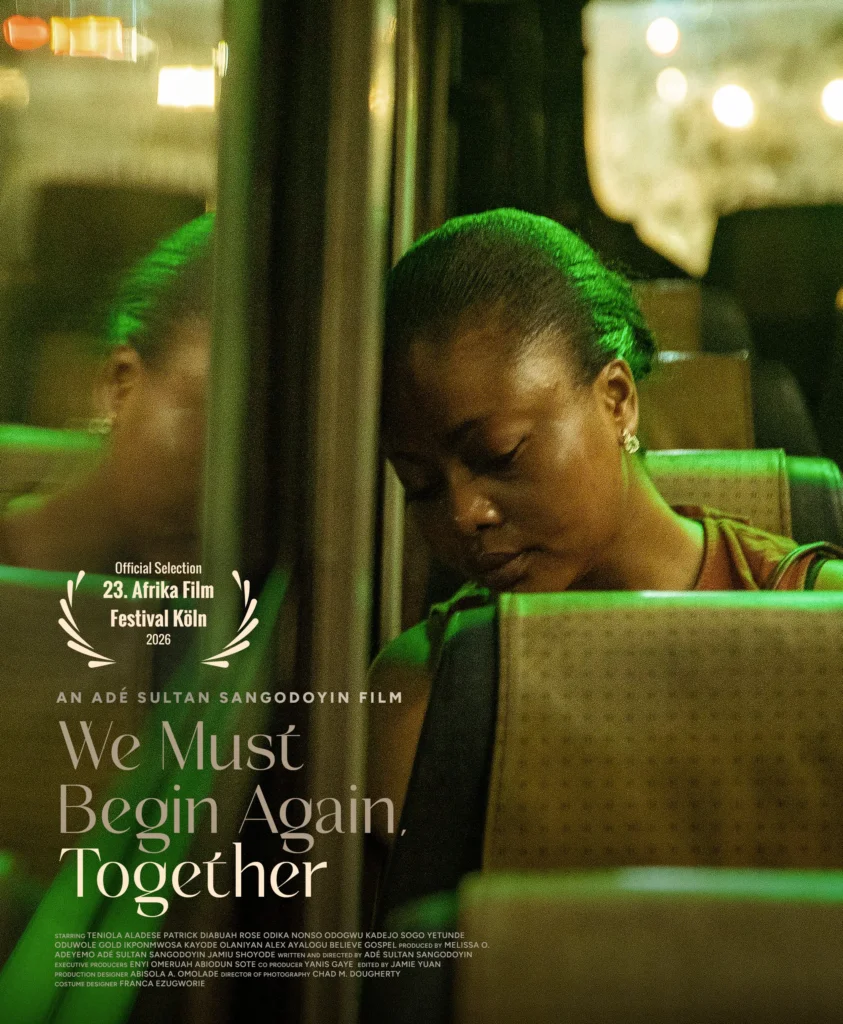
Bimbi (Teniola Aladese) is in her tailoring workshop, working (albeit morosely) with what appears to be her assistant. Her phone pings. It is a group chat where women are discussing their husbands, cussing the ones they consider bootlickers and who they bootlick with. There is a link. Bimbi opens it.
A news presenter is reporting that a guest house in Oyo State has been shut down and that two men, Jude Edet (Patrick Diabuah) and Junior Ojo (Kadejo Sogo), have been arrested by the police for “suspected homosexual, gay acts.” The report cuts intermittently to images of the men being led away by the police officers.
There is a wedding photograph in Bimbi’s workshop. In it, Bimbi is wrapped in the arms of her husband. Jude is that husband.
It is a remarkably efficient introduction. No further explanation needed, and Sangodoyin understands that that is all he needs to give out.
From here, We Must Begin Again, Together becomes a film chiefly about the things people know without saying or being told. Bimbi and Junior attend church together. The congregation is seated in a column, but they are separated from everyone else (except for another woman in the far end) in a different column. The priest praises the generosity of the Ojo family. Afterwards, a lady walks Mrs. Ojo to her car as she advises her that “Her husband being illiterate” does not excuse what has happened or the consequences thereof, and “you have to tell them to stop coming here. There are other churches around.”
No further sermon about religion and queerness as we have it in Nigeria today is needed. The conversation towards the car is enough.
This restraint runs through almost everything Sangodoyin (also credited as writer) does in this film. When Bimbi first notices her husband looking at a well-built male construction worker at their property with what appears to be unmistakable attraction, she says nothing. She simply watches him, scared with that knowledge. Later, when she recognises a similarly adorned phone she had once seen in her husband’s hand in her brother’s possession, she does not confront him either.
The phone is decorated with cowry shells. Earlier, Bimbi had asked Jude if it was new. He had told her he had sent the free promo one that came with the original to Ene, a relative in the village who had been asking him for a phone. Bimbi had asked whether he did not think she might have liked it herself. He apologised and promised to get her another one.
Now the same phone is in her brother’s hand, and some things are obviously not adding up. It rings. He answers. Bimbi watches. He shuts his laptop, gets up, and leaves almost immediately.
Her face tells us that something has connected.
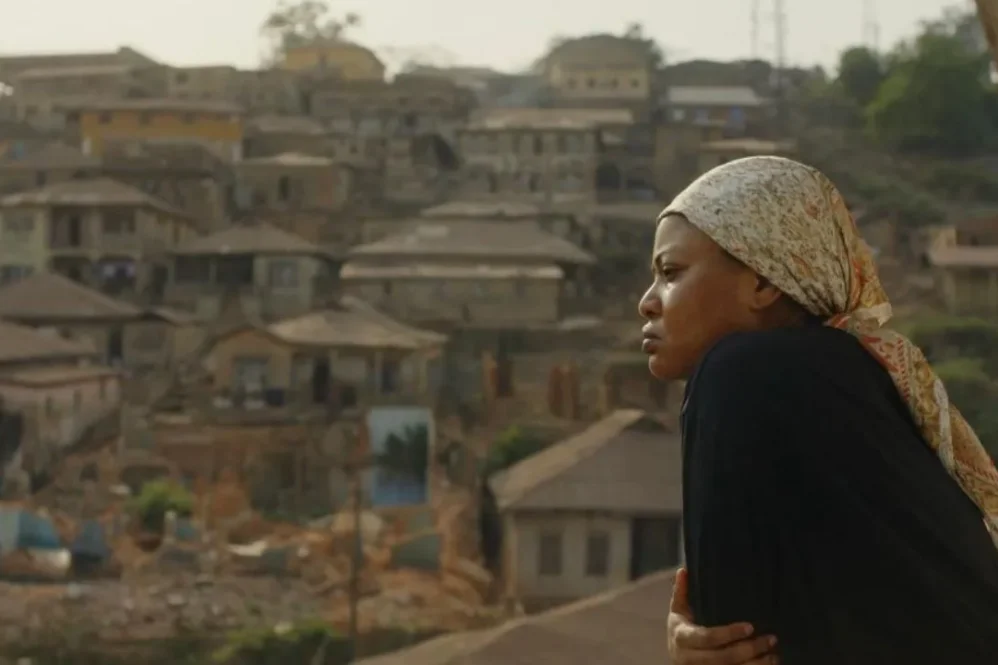
This is where Aladese’s performance becomes particularly impressive. Bimbi is rarely given the luxury of saying what she feels. Her body does it for her. Suspicion lingers amidst glaring certainty. Fear arrives just at the right time. Even when she eventually goes home and finds Jude sleeping on the couch, she says nothing. She walks into the bedroom, sits on the bed and sends a WhatsApp message to her brother: “The three of us need to find a way around this. Please come tomorrow. Let’s talk.”
There is no outright confrontation but a woman trying to make sense of a life that may have been truthful in some ways and deeply concealed in others.
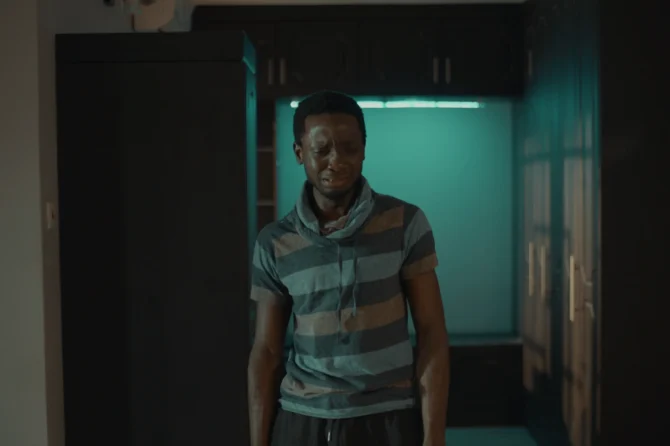
The script is equally careful with Jude. Patrick Diabuah (Banana Island Ghost) plays him just with the right amount of precision required for a man of his kind. From what the film shows us, he has been a decent husband to Bimbi. There is a blatant refusal to follow the easier route of making his sexuality the explanation for everything wrong in their marriage. His attraction to men exists alongside his affection for his wife, which makes the situation more difficult. The question is not simply whether Jude loves Bimbi. It is whether love can survive the parts of a person that marriage, family, religion, and society have made impossible to speak about. One sees it in the film’s title. We Must Begin Again, Together.
The film was four years in the making, with Sangodoyin repeatedly returning to the screenplay before shooting in Ibadan in 2025. It is also conceived as a proof of concept for a feature-length film, which perhaps explains why the short occasionally feels like it has deliberately left some doors open. Sangodoyin has described the project as being concerned with the possibility of making room for empathy, “not only as individuals, but also as a community.”
Sangodoyin frequently places Bimbi at a distance from the camera, allowing wide frames and long shots to hold her inside the spaces she inhabits. One who’s in sync with Abbas Kiarostami’s and Bela Tarr’s cinema style might quickly link them as influences to Sangodoyin’s We Must Begin Again, Together.
There are other details that the film introduces without entirely explaining. Bimbi is in a constant state of deliberation. Her repeated attempts to reach her mother. Her mother’s refusal to be reached. The possibility of another abortion, which Bimbi discusses with her doctor while contemplating the risks. Her relationship with her brother. The film gives us fragments rather than a complete psychological biography.
For a film of eighteen minutes, this is both its strength and its gamble. The timeline is not always immediately clear, and some of the emotional relationships are left deliberately underdeveloped. What happened that led us to where we currently are? How much is happening that is happening post- or pre- the arrest? How much do these characters know of each other?
While this restraint is better understood as the film’s design, and while restraint is itself an effective tool in storytelling, too much of it can undermine the very effect it seeks to achieve.
We Must Begin Again, Together, produced by Ominira Studios and Emperium Films, had its world premiere in the “Queer Voices I” programme at the 23rd Afrika Film Festival Köln alongside Dika Ofoma’s Obi is a Boy, both Nigerian representatives.
Side Musings
- Imagine what Bimbi wants to discuss with her brother and husband is not the end of the marriage, but how the three of them are going to share it.