
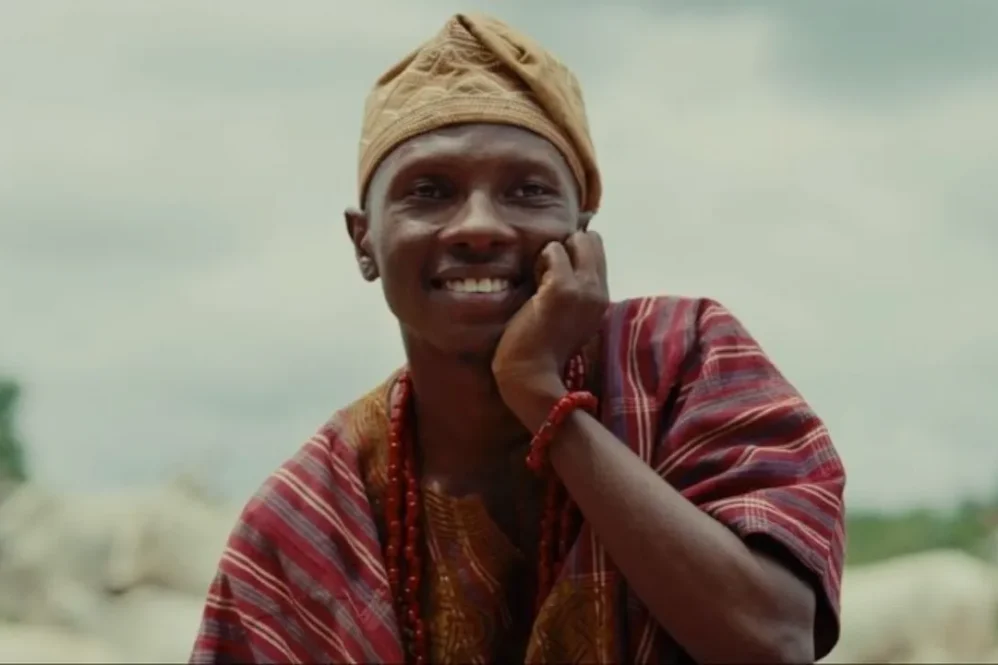
Editor’s note (August 30, 2026): This review has been updated to remove a reference identifying Adeboriiku as the baby shown in the film’s opening scene.
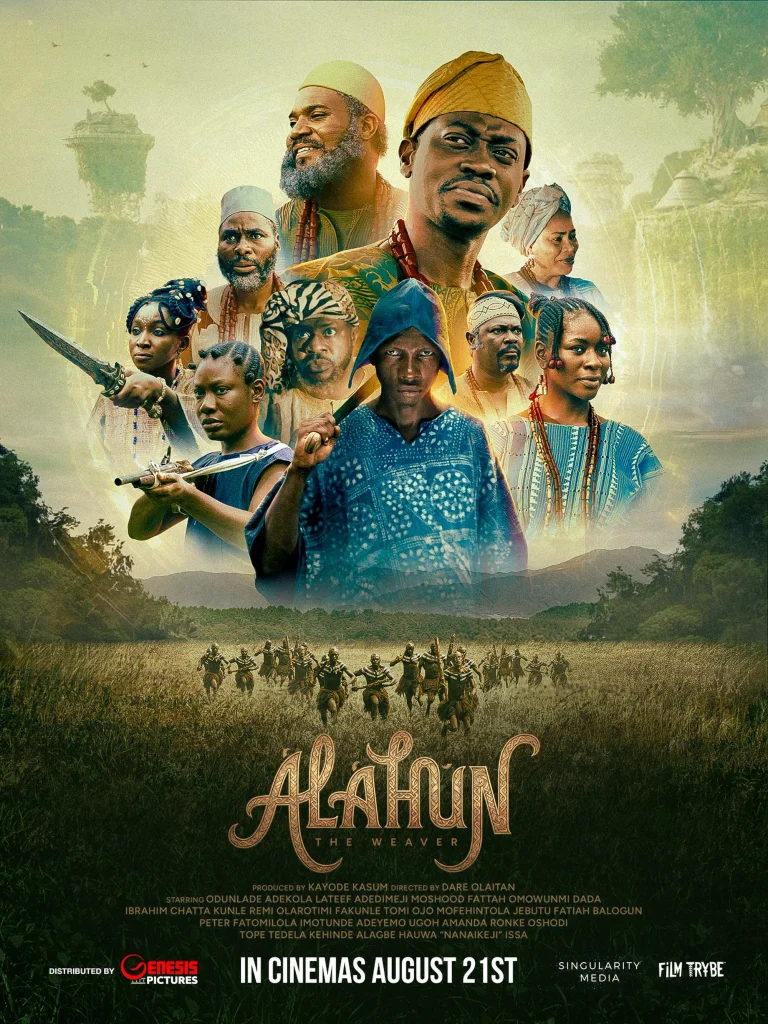
Dare Olaitan returns to the director’s chair with Alahun: The Weaver, a Yoruba epic adventure filled with spirits, mythical creatures, and an unlikely hero at its centre. The film asks many questions, such as what the measure of a true hero is, and how love can transcend societal limitations.
I am no stranger to Dare Olaitan’s work. I mostly enjoyed Ile Owo (2022), although it appeared to be a triumph of style over substance, and I practically begged anyone who would listen to see Carmen Lilian Ike-Okoro’s Egun (2024), a nail-biting psychological thriller and satire of corporate shenanigans which he co-wrote with Kayode Kasum.
News of Alahun coming to cinemas in August greeted my ears with joy. What’s more, it was in a genre I couldn’t wait to see him put his spin on: the jaded Yoruba epic. The film opened on Friday, the 21st. I saw it twice. Once on Saturday and then again on Sunday as something of a control experiment. The rest is history.
The story begins with a prologue on a haunting night. A woman goes outside with a baby, peering into the darkness, wondering what disturbance has roused her from sleep. Unknown to her, an ill wind has blown into town, bringing with it an army of vile spirits. These spirits are apparently searching for the princess of spirits (Omowunmi Dada) and they ask the woman if she has seen anyone of the sort. When she replies in the negative, they convince her to join their search. Falling under their spell, she lays the crying baby on the ground and follows these mysterious figures into the night.
This prologue is chilling to say the least, mostly because of how calm the spirits appear. Never raising their voices above a polite suggestion, they are able to abduct an able-bodied woman, separating her from the child. They are also made out to be properly intimidating: riding on horseback, in a nightmarish array, shrouded in ghostly lighting. This is probably my favorite shot in the entire film. The director is no stranger to crafting haunting visuals and veering into horror by way of psychological thriller. If you asked me what a Yoruba epic from Dare Olaitan would look like, I’d probably describe something close to this first scene: humanity coming face-to-face with their frailty at the hands of the preternatural, and the existential dread that follows. So far, so good.
These spirits who go around abducting young women form the main antagonistic force of the story. The synopsis of Alahun is as follows: In Irepewole, Adeboriiku is a basket weaver born to the kingdom’s greatest warlord. When his betrothed, Princess Olajumoke, is taken into the spirit world by the Demon King, he sets out to save her. His journey through forests, masquerade realms, and trials forces him to choose between power and love.
Growing up is tumultuous for Adeboriiku (Moshood Fattah), who is beset with illness after illness. His father, Balogun of Irepewole (Olarotimi Fakunle), is instructed by a herbalist (Peter Fatomilola) to keep him away from danger and far from the battlefield. Adeboriiku grows up, not a man of war, to his father’s chagrin, but a basket weaver, the Alahun of Irepewole.
Other characters populate this world, such as Olajumoke (Ugoh Amanda), the princess of Irepewole and Adeboriiku’s love interest. Her father, the king, is played by Ibrahim Chatta (whose film village supplied the sets and props for the film); Olórì is played by Faithia Balogun (Efunroye), and even Kunle Remi (Anikukapo) shows up as well as Odunlade Adekola (Elesin Oba) who has one scene as a warrior who wants his son, Odépàdéórò, to marry the princess instead of Adéboríikú.
Alahun is your standard epic film fare; classic hero’s journey. A character is in a “normal” world, they get a call to adventure, then cross the threshold into multiple trials. They have a “dark night of the soul” where all hope seems lost, and they have to fight for triumph, returning home changed for the better. The story, following a tried and tested template, should work for the most part, but Alahun, juggling many ideas, never truly compels or entertains.
The first issue is with its pacing. The story takes too long to get going. Yes, epics are expected to be long, but there’s a difference between having something to say and stuffing a story with bloat to create a sense of grandeur. Think back on the synopsis again. An unlikely hero sets out to find his lover, the king’s daughter, after she has been kidnapped by the Demon King. Why then does this demon not show up until about forty minutes in? Even when the princess eventually gets abducted, the story drags its feet like a child stalling on the way to school.
Adéboríikú doesn’t leave Irepewole until an hour into the story. Bear in mind that this is a 130-minute feature. If your main character only begins to fulfill the promise of the premise at the midpoint of your story, then your first act is a tad too long. I am all for unconventional storytelling structure (especially as a self-proclaimed fan of Christopher Nolan and his plot stylings), but they have to work to be justified or else they defeat the point.
So, what, you ask, does the first hour entail?
Well, to start, there’s the set up of just how in love Adeboriiku is with Olajumoke, and how much she doesn’t care for him or his advances. There’s also a lot of tension between him and his father. The Balogun has never been able to fully accept his artistic pursuits. Returning home one evening, he sees Adeboriiku plaiting the hair of one of his maidservants (whom he is also in love with) and his anger is unparalleled. The king also berates Boriiku for doing the same with princess Olajumoke. In this town, their view of masculinity has no space for qualities they’ve deemed effeminate, unfit for men. We are also introduced to Odepadeoro (Imotunde Adeyemo), who, in a ploy for Olajumoke’s hand, convinces the king to let him marry his daughter if he is able to rescue her from the Demon King. So, we have a parallel character to Adeboriiku. Where our main character is motivated by his genuine love, Odepadeoro only wants the princess as a means to an end: more power, a higher status.
These are all compelling subplots to explore, but the story seems to want to take the least efficient route to its destination. Here’s an example. The Demon King (played by Lateef Adedimeji royally hamming it up) comes to Irepewole to buy baskets from the weaver. Adeboriiku finds out that he is not human when he notices that his leg, which appears normal to everyone else, is actually decaying and rotting. That same day, Olajumoke goes missing. The king sends for the Balogun. He leaves for the palace. Adeboriiku, fearing the worst, gets on his horse and leaves too. At the palace, the king is distraught, blaming the princess’s handmaid for her disappearance. The Balogun arrives. They lament the tragedy and decide that he will lead his men to retrieve her. Adeboriiku wants to tell everyone that the person who took her is not human, but he lets his father send him home.
When the Balogun returns, Adeboriiku finally recounts what he saw and his father is livid, saying, why did you let us waste a whole day ruminating, or something of the sort. I almost couldn’t believe my ears. Then they return to the palace where Odepadeoro mentions his conditions to the king. Guess what? The king tells him to go home, then takes a day to think about it, before inviting him back to the palace. One would think a king whose daughter has just been captured by a strange being, whose Balogun was only just berating his son about being too slow to offer up crucial information, would be quick to respond to such a request, severe as it appears. But no, the scenes keep piling up, and even though they’ve acknowledged that time is of the essence, the narrative can’t get them out of Irepewole fast enough to begin their quest.
Eventually, Adeboriiku bids his sister goodbye and heads for Igbó Abàmì on his way to Ìlú àwón Ebora. Again, this is where he is supposed to face untold horrors and come out on top after much struggle. Classic hero stuff. Half the movie has been spent delaying this journey, but I still hoped I could get a lot out of it. Unfortunately not. I wrote this in my notes: “The worst feeling to have when watching an epic is the distinct feeling that you have seen all of this before.”
The most prominent part of the score is a melody echoing “ìfé aláìlégbé” throughout the film. Basically, Alahun might be an epic adventure on the face but its heart is supposedly really with the romance subplot. And I have to disagree. The story has a lot of good ideas, but the screenplay fails to stage situations that effectively dramatize them and create much thematic resonance.
What about the performances? Imotunde Adeyemo (The Herd) is the standout in this ensemble piece. Perfectly cast as Odépàdéórò, his scenes are electric. Moshood Fattah (Battle on Buka Street) is compelling as well, knowing when to lean into Adeboriiku’s quiet strength and when to match his father in a chest-thumping match. However, he, like the rest of the cast, never manages to escape the occasionally clumsy line delivery or baffling character motivation.
By the climax, I was tired of the movie beating me over the head with its message, of the unjustifiable length, of the clunky exposition and uncompelling drama. Spoilers ahead: after so much build-up, the central conflicts are resolved with surprising ease. The film also takes its sweet time ending, trying to tie the ends of the romance subplot I didn’t believe in for a second, mostly because of how overstated it all was. Example: when Adeboriiku gets to the forbidden forest, he is rescued from a band of thieves by his handmaid (remember her?) who presumably has feelings for him. He tells her that he’s on his way to rescue the princess. Crestfallen, she replies that she’d hoped he’d come after her instead. He says what they have cannot be, thanks to the laws of the land and whatnot. All of this is delivered in glorious monotone, with little romantic tension to speak of. This issue also came up in Osamede, which I reviewed last year. If you think portraying romance on screen is hard, try doing it as a subplot in an epic setting and observe how wooden things can truly be.
We go to the cinema to see things we haven’t seen before. That’s supposed to be the appeal of a big screen, creating a larger than life experience both in content and presentation. I kept on waiting for that moment of wonder while watching Alahun, but it never came.
In this interview, Olaitan discusses his influences, the process, and all the effort that went into making this film; for instance, Adeboriiku’s incurable illness is supposed to be sickle cell disease. It is such an insightful glimpse into the filmmaker’s psyche. Anyone who can manage to make feature films in Nigeria on time and within budget must be on some level a miracle worker. Far be it from me to begrudge the output in a medium and an industry I admire so much. Both times, my cinema had in attendance groups of people (on dates, family outings, friend hangouts) who were eager to see the film and seemingly engaged throughout. But at the end, no one clapped. Not even me (and I’m the annoying person who always does whether anyone else is or not, no matter if I’m the only one in there or if it’s a packed screening).
Alahun: The Weaver has a lot going for it. The VFX rings true (there are over 400 effects shots and they took their painstaking time putting them together), the cinematography makes brilliant use of the space and color to instill a sense of wonder (especially at the abode of the Égúngún), and the actors are clearly enjoying themselves. However, as always, nothing escapes the black hole of a poorly paced, unfocused screenplay. To my utmost dismay.
Alahun, produced by Singularity Media and Film Tribe, and distributed by Genesis, premiered in cinemas on August 21, 2026.
Become a patron: To support our in-depth and critical coverage—become a Patron today!
Track Upcoming Films: Keep track of upcoming films and TV shows on your Google calendar.
Side Musings
- Faithia Balogun has two scenes in this film. They’re both pretty early on in the narrative. So, when her daughter, the princess, goes missing, you’d expect her to be worried along with the king. Nope. She is nowhere to be found. Doesn’t show up past the first act. If you somehow missed the first thirty minutes of this film, you wouldn’t know she was in it.
- The reason the above is extra baffling is that other famous actors have cameo appearances. Odunlade Adekola, Kunle Remi, Tope Tedela, all show up at different points for just one scene. It’s likely that scheduling conflicts or budget constraints prevented Faithia Balogun from having multiple extensive scenes. In that case, maybe someone else should have been cast? I kept on asking myself, “Did I miss something? Did the Queen pass away offscreen? Why isn’t she lamenting her daughter’s disappearance as well?”