
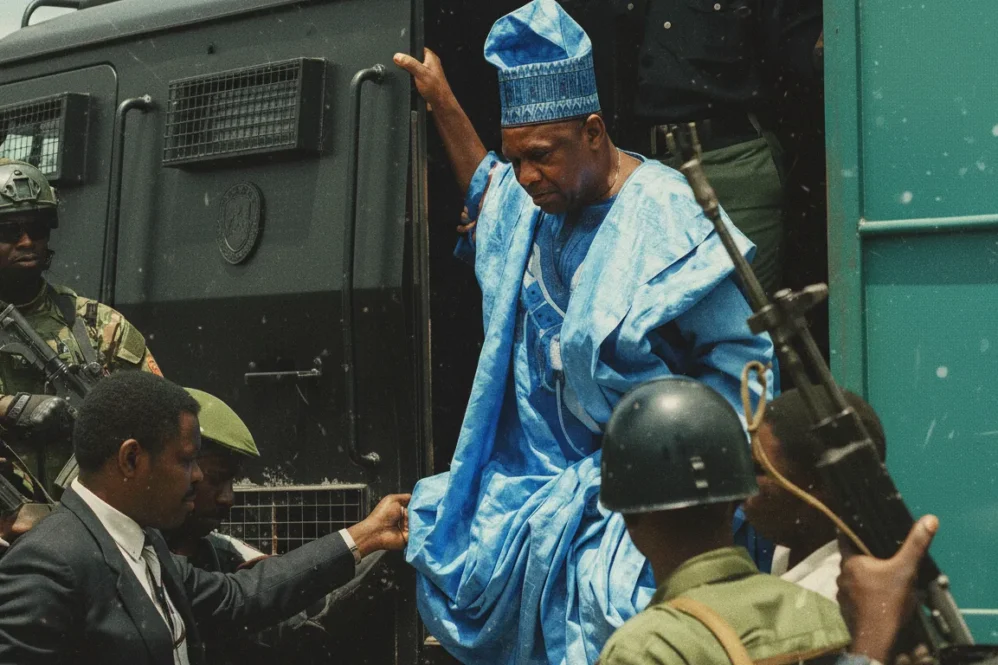
Hope, they say, is a very, very stubborn thing. It survives military coups. It survives broken promises. It survives politicians campaigning the language of change and turning around to enforce the language of power just after being elected. Sometimes, it survives even nations. But what happens when an entire people see hope in the shape of a philanthropic man, and then watch that very hope dragged away from them? What remains of hope itself?
These are the questions that MKO, Ose Oyamendan’s investigative documentary on Chief Moshood Kashimawo Olawale Abiola, Nigeria’s June 12 election, and the political crisis that followed, asks, albeit indirectly. Rather than offering definitive answers, the film assembles decades of memories, testimonies, accusations, denials, and grief, leaving many of its tensions and traumas unresolved. MKO is at its strongest when exploring this uncertainty, though its broader attempt to situate Abiola’s story within a larger history of Black political sabotage is not always equally convincing.
(Click to Follow the What Kept Me Up channel on WhatsApp)
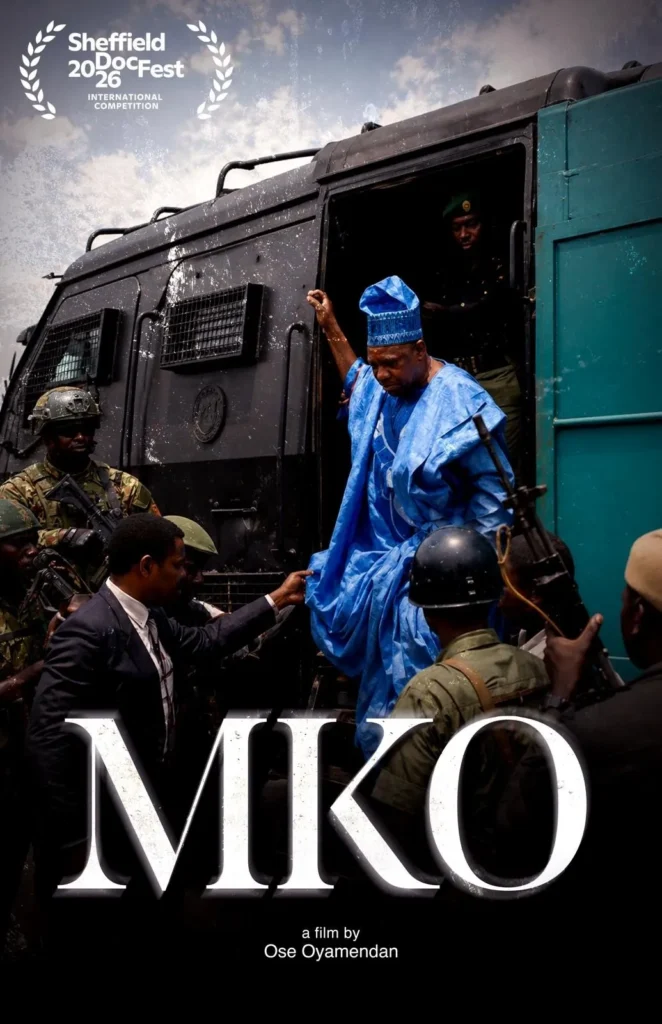
The film opens with a declaration about Black struggle and historical sabotage on a black screen. This is a bold thesis—perhaps broader than the documentary can fully prove—that requires patience to click, particularly with the story of the documentary. As the story unfolds, one begins to understand why Oyamendan (Aswat Acherim) starts there. Perhaps it is his own way of defining MKO as not just a politician, but also as a symbol of a possibility across geography and time.
The documentary’s first stroke of brilliance is its decision to begin with Abiola’s own voice. We hear him speaking to the BBC on a phone call as military operatives arrive at his house to arrest him. This urgency prepares viewers, albeit inadequately, into the story of a man fully aware that his freedom is slipping away.
From there, the documentary moves backwards.
We learn about the boy from Abeokuta who was born into poverty and improbability. The twenty-third child in a family that had lost twenty-two children before him. Through the recollections of his daughter, Hafsat Abiola, we hear of a child who often attended school without books because his father, a poor farmer, could not afford them. Yet he excelled anyway, relying on a memory so sharp that it compensated for what circumstance denied him.
The film traces his journey from that childhood to Glasgow, to business success, philanthropy, and eventually politics. One of the documentary’s most revealing moments comes when his family explains why philanthropy was no longer enough for him. Abiola had spent years giving away wealth, building schools, funding causes, and supporting communities in Nigeria and other parts of the continent. Yet he came to believe that charity alone could not fix a broken system. As Hafsat recalls, he gave an analogy of a broken pail. “He felt about all his philanthropy,” she says, “as if he was a man pouring water into a pail, and the pail had holes in it.” You could keep pouring water into it, but unless the holes were repaired, nothing would change. No matter how much he gave away, the bucket remained broken.
Politics then became his attempt to repair the bucket.
MKO seems to not care much about asking whether Abiola was a good man. Most participants already seem to agree that he was generous, charismatic, and ambitious. The more interesting question is why a man who had already acquired wealth and influence felt compelled to pursue power directly. His wife Doyin Abiola recalls asking him precisely this. Why not remain a kingmaker? Why not continue supporting politicians from the background? His answer was simply, “if you are not at the table, you cannot make that much of a difference.”
The real tragedy, of course, is that he would never be allowed to take that seat.
One of the documentary’s major achievements is its extraordinary access and by extension its representation of several sides of the MKO story. Oyamendan gathers military figures, politicians, diplomats, local and international journalists, activists, members of the Abiola family, international actors, and ordinary people into a single conversation. Ibrahim Babangida appears. Abdulsalami Abubakar appears. Bola Ahmed Tinubu appears. Olusegun Obasanjo appears. Wole Soyinka appears. Dele Momodu appears. American diplomats and congressmen appear. Even David Adedeji, MKO’s driver, appears. Rasheed Lambo, who was master of ceremony at MKO’s Declaration event, appears. Theodore Zadok, MKO’s guard in jail, appears.
An easy guess as to why the documentary is able to secure such remarkable access may be Oyamendan’s own history. Having worked with the Weekend Concord, part of a media network founded by Abiola, where he was hunted by the military government under General Sani Abacha, and subsequently exiling to the United States where he joined Amnesty International and became part of “a high-stakes global battle to save Nigeria’s soul,” the filmmaker is now approaching the story he shared a part in from a position of one who lived through and was affected by it, although in a detached sense.
The documentary, however, is less successful in its choice to use narrations. Early on, the narrator appears positioned as a guide through the complexities of Nigeria’s political history, offering broad reflections on democracy and national identity. “I’m going to tell you the wildest story you’ve ever heard,” they promise from the start. Yet not much is said in these interventions, except for mostly cliche and predictable remarks, “Nigerian politics is often like magic; the more you look, the less you see,” that don’t necessarily advance the documentary’s argument. As the documentary progresses, the narration becomes increasingly sparse, almost disappearing during the final stretch. The narrative voice is introduced with confidence but never fully integrated into the film’s larger storytelling strategy.
This is particularly noticeable because the interviews themselves are so detailed. Many of the film’s most illuminating insights come directly from participants, leaving the narration feeling less essential than the documentary initially suggests.
There is a point where one begins to realise that the film is not driving to prove a single theory, particularly evident in the documentary’s treatment of the annulment. Babangida has his version of events. Obasanjo has his. Soyinka has his. The military officers have theirs. The family has theirs. The film simply places these competing narratives beside one another and allows the contradictions to speak.
So, why was June 12 cancelled?
Even after three decades, nobody seems able to answer that question without immediately colliding with another version of the truth. Babangida, who was a very good friend of Abiola before June 12, insists he “was working against political forces, military forces at that time, and I had to maneuver my way.”
Some participants describe Obasanjo’s role in the aftermath of the annulment as an active participant in the emergence of the Interim National Government (ING). The accusations are serious. The denials are equally forceful. Oyamendan interestingly refuses to settle the argument for the audience.
Perhaps the film’s most painful sections are those devoted to the years after the annulment. Kudirat Abiola’s assassination. The international campaigns. The imprisonment. The role of foreign governments. The uneasy dance between democracy, oil, diplomacy, and political interest. By the time the documentary reaches Abiola’s final meeting (where he collapsed) with the American delegation led by Undersecretary of State Thomas Pickering and diplomat Susan Rice (who some Nigerians till today still believe poisoned Abiola and declined to participate in the documentary), viewers are left with more questions than answers.
Visually, the documentary adopts a restrained approach. The cinematography is elegant without becoming self-conscious; simple and neat. Archival footage is well integrated. Most striking are the dramatic recreations scattered throughout the documentary. The scenes are sometimes intentionally blurred, with figures whose faces are not visible or partially obscured to the audience. At other times, these recreated scenes are framed to evoke the perspective of an observer standing outside a room. Perhaps, this, too, is Oyamendan’s resistance to finite resolutions. The closest viewers come to being participants in this national trouble is in the scene where Abiola drops dead after drinking from a teacup served by Susan Rice, and even here, conclusions remain deliberately unresolved.
The storytelling itself is equally disciplined. The documentary proceeds largely in chronological order. Despite the sheer number of participants and the complexity of the history being discussed, the film manages to not confuse its audience, and this is no small achievement. Credit is due not only to Oyamendan’s direction but also to Lucas Villegas (Minutes Past Midnight) for the film’s editing, which somehow manages to keep decades of political intrigue from collapsing under their own weight.
Whether Abiola would have fulfilled those hopes is ultimately unknowable. The documentary cannot answer that question. No documentary can. More than thirty years later, Nigeria still seems to be living in the shadow of that loss or maybe of something else. It’s 2026, and with the general elections looming closely, Nigeria is again discussing democracy, representation, elections, economic hardship, elite bargains, state legitimacy.
A Nigeria-UK-Canada-US co-production, MKO is produced by O2A Media in association with Iliad Entertainment, Filmoption Production, Oseville Productions and Dare Pictures. The documentary world premiered in International Competition at Sheffield DocFest and received development support from Hot Docs, DocsBarcelona and DOC NYC. In Nigerian cinemas from October 2, 2026, distributed by Nile.
Become a patron: To support our in-depth and critical coverage—become a Patron today!
Join the conversation: Share your thoughts in the comments section or on our social media accounts.
Side Musings
- Politics may be the only profession where evidence and denial can occupy the same room for thirty years and still leave without settling an argument.
- Watching MKO as a double bill alongside My Father’s Shadow would be something.

Our dear leaders help us make to make this country a better place to enjoy, and peaceful 🙏🙏