In a rare Nigerian series continuation on Netflix, Blood Sisters returns four years after its first season in 2022, picking up directly from the Ademola family shooting. While Uncle B (Ramsey Nouah) dies from the attack, Femi (Gabriel Afolayan) and Olayinka (Kehinde Bankole) survive, with Femi now paralyzed. Leaving Kemi (Nancy Isime) and Sarah (Ini Dima-Okojie) once again trapped in the orbit of a family determined to destroy them.
While the first season delivered crime and drama right from the outset, the new season builds on its predecessor’s excess across four episodes titled “The Trial”, “Jailbirds”, “On the Run”, and “Wherever You Go, I Go”, maintaining the (not-so-limited) series’ four-episode compact structure.
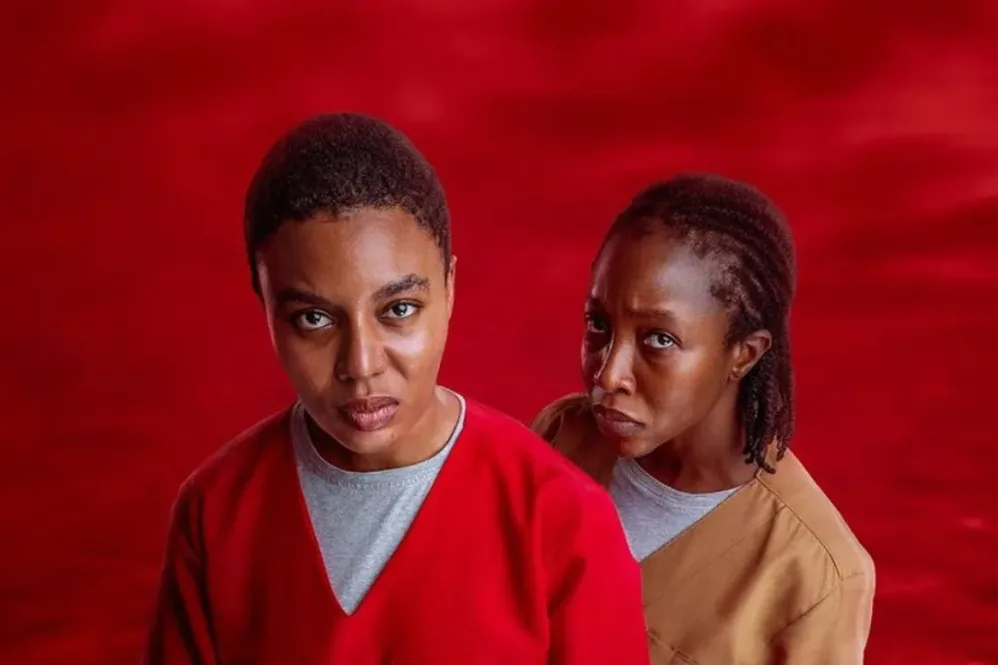
Ahead of its release, a teaser was met with a near-universal derision, particularly for its derivative prison costumes and performances that appeared to verge on the ridiculous. Upon watching, however, the prison costumes prove less distracting than expected, rarely feeling out of place within the series’ heightened world. The criticisms of the performances, on the other hand, are not entirely misplaced.
(Click to Follow the What Kept Me Up channel on WhatsApp)

In season 2, The Blood Sisters world is extended with a larger cast and new directors (Daniel Oriahi and Kayode Kasum). New key characters include B Junior (Ben Touitou), who, seeking revenge for his father’s murder, replaces his father as the Ademolas’s enforcer. There is Mimi (Blessing Obasi-Nze), a powerful prison gang leader. And Folake (Michelle Dede), an overzealous lawyer who would go the extra mile to help her clients.
This expansion contributes to weak performances across the series, save for a few notables, including Gabriel Afolayan (Ijogbon) whose performance as Femi remains controlled even as the material leans into excess. Uche Jumbo (Onyegwu), by contrast, delivers a more overtly emotive performance as an unrelenting mother— an inherently hyperbolic role that aligns with the work’s broader excess.
Other consistent performances include Kate Henshaw’s unflinching presence as the Ademola matriarch, and Blessing Obasi-Nze (Momiwa) whose performance carries the weight of her character’s dominance, asserting a powerful presence in a prison world otherwise marked by weak performances.
“The Trial” deals with Kemi and Sarah’s persecution for Kola’s murder, alongside additional charges for a muder and attempted murders they did not commit—all of which are TImeyin’s crimes. Here, judgement is split between the judiciary and the Ademolas. Structural injustice is foregrounded in the affluent’s effortless weaponization of the law; legal order functions as an instrument of domination rather than justice.
“Jailbirds” covers the duo’s jail experience, their solidarity vs the environment. The prison environment is constructed through numerous Nigerian prison anecdotes that frame it as a hell-hole. Where new inmates are oppressed by prison cults, prisoners are smuggled out (freed and replaced), executed and falsely witnessed. Here, maladministration is on display, the prison is not a correctional centre, but a ground for more crimes; solidarity is tested and pushed beyond convenience.
“On the Run” follows Kemi and Sarah’s escape, the prenominal manhunt, a breach of loyalty and trust. Lastly, “Wherever You Go, I Go” depicts a renewal of solidarity, a refusal to remain in flight and choosing confrontation instead. The episodes collectively produce a clear escalation, from law, through confinement and escape, to relational entanglement.
Blood Sisters 2 is constructed through a familiar EbonyLife excess—of dialogue, performance, and control— that is not always contained, leaning into melodrama both structurally and aesthetically. Yet, it remains a compactly staged fiction that diverges from reality while retaining and condensing social truths. This culminates in a portrait of moral decay—corruption, violence, murders, betrayals.
One of the series’ poorly contained excesses is the earliest court protest scene, which situates the narrative within a broader social field but ultimately collapses into histrionic noise, misaligned with the Nigerian setting. The scene assembles chants of justice, placards bearing portraits of Kola and Kemi, and competing slogans of solidarity and demand for accountability, while protesters throw paper wads at Kemi and Sarah. There are also clumsy pressmen and unconvincing crowd control by the police who attempt to contain a crowd that barely appear as genuine rioters. The sequence is halted by Uduak’s clenched-fist gesture, which suggests it may have been staged by her. The result is a piece of Hollywood-derived chaotic hokum. One is left questioning the direction on set, and how such material reached the final cut. While the series has established that representation of reality is not its focus, this scene fails even as spectacle.
One of the season’s more effective choices is the sustained juxtaposition between Kemi and Sarah’s crisis and the apparent polished life of the Ademolas. This extends beyond the central characters into the world around them, allowing tension to emerge through contrast rather than direct explanation. The device proves more compelling than many of the series’ louder dramatic spectacles, demonstrating that Blood Sisters is often at its strongest when it allows situations to speak for themselves.
A dominant theme across the season is control. Uduak (Kate Henshaw) exerts familial and systemic control across relationships through both violent and emotional manipulation. Femi’s sexual limitations are counterbalanced by control over Yinka’s sexual gratification, mediated through Moses; unable to participate directly, he still dictates the order of things. Similarly, Blessing Obasi-Nze’s Mimi controls prison dynamics, at one point coercing Kemi into oral sex. Throughout the series, control is sustained through violence, coercion and intimacy.
Excess is both Blood Sisters 2’s greatest strength and its most persistent weakness. The series remains an entertaining, hyper-staged moral thriller series in which law, intimacy and violence are theatricalized. Worth watching for its juxtaposition and sustained inquiry into control, it is less convincing whenever its excess overwhelms the material. Even so, that excess feels intrinsic to the series rather than accidental, a world where everyone speaks loudly because silence has no jurisdiction.
Blood Sisters season 2, with four episodes, is an EbonyLife production streaming on Netflix in select regions.
Become a patron: To support our in-depth and critical coverage—become a Patron today!
Join the conversation: Share your thoughts in the comments section or on our social media accounts.
Side Musings
- Observing the poster for Blood Sisters season 1 and 2, it says a lot about the Netflix slowdown in Nigeria.
- “National Maximum Security Prison” is a particularly clumsy naming; it lacks any real imaginative or contextual depth, and amounts to a reductive claim of maximum security status.
- BREAKING! Uduak Ademola is never caught unfresh; come rain or shine, she remains impeccably dressed.
- Viewers are now threatened with a third season, consent not required.